Evaluating individual boats
Issue 56 : Sept/Oct 2007
This excerpt from Beth Leonard’s new book, The Voyager’s Handbook, second edition, is the second of a three-part series with a focus on selecting the right sailboat for extensive passagemaking. The first part focused on the available designs and choosing the right boat for your purposes.
Boats of almost every conceivable type, keel configuration, rig, hull material, and length make successful voyages. While these characteristics can help define the boat that best suits you, they don’t matter much in determining the general success or failure of a specific boat brand for offshore sailing and liveaboard cruising. The things that really do matter are less straightforward and harder to quantify than the depth of the keel or the number of masts. They include the boat’s stability, durability, design and layout, and sailing ability.
Screening criteria
In an ideal world, you would do nothing over the course of the next year but look at boats in order to figure out what you really want. You would spend several days going over every detail of each candidate’s construction and then take each one on a passage and evaluate its sailing performance and layout in everything from calms to gales. But in the real world, you’ll be lucky if you thoroughly inspect a dozen boats sitting on the hard and get out sailing for a couple of hours on the boat you end up buying.
That means making sure the few boats you do examine and the one or two boats you sail are the right boats. A set of screening criteria can help identify boats of interest and eliminate others.
Your budget and the age range of the boats you have decided to consider will also be used to screen out boats, as will any special requirements related to where you intend to cruise or how you intend to use the boat.
Something far less tangible but at least as important is seaworthiness. This concept includes stability (the ability to stay upright when the sea would have it otherwise) and durability (the ability to take the constant punishment the sea delivers). Though both are difficult to evaluate, there are some objective measurements for each.
Taken together, the screening criteria should help you narrow your search to a couple dozen specific boat brands that meet all your requirements. If you have access to the Internet, you can reach this list without leaving your desk. Many brokerage sites provide most of the information you need to work through your screening criteria, including walk-through photo tours that let you evaluate a boat’s layout against your needs.
But most people prefer to get a feel for boats in person. They start their search by opening the net wide and learning everything they can about as many different boats as possible. They go to boat shows. They order brochures for dozens of new boats and spend hours comparing ratios and specifications. They read all the boat reviews in sailing magazines and surf the Internet looking for owner’s groups, sailing bulletin boards, and searchable databases of brokerage listings. They compile exhaustive lists of everything the boat must have, then scratch out the entries and start again after talking to another expert or reading another book. If all this sounds familiar, then you’re already well launched into your search.
Make as much use as possible of the wealth of information within the cruising community. Most sailors love to talk about their boats and are flattered to be asked. If you see a boat with scuffed topsides and a battered dinghy, ask the people aboard where they’ve been, and the conversation will almost certainly take off from there. You won’t fully appreciate the willingness of cruisers to help those who’d like to join their ranks until you experience it for yourself. And you’ll remember it when you get out on your own boat and someone stops by and shyly asks how it has performed for you.
Even if you’ve already decided you want a name-brand fiberglass performance cruiser built for offshore sailing between 40 and 43 feet long and less than 15 years old with shoal draft and a two-cabin layout, you still have a vast array of cruising boats to choose from. At first, it can seem impossible to sort out opinion from fact, entrenched dogma from valuable experience. But the more boats you see — and the more you actually manage to sail — the clearer the picture of your ideal boat will become. Eventually you’ll be ready to look seriously at a short list of boats.
Stability
Stability — a boat’s ability to stay upright despite a sudden squall or large seas combined with its willingness to come back upright if knocked down — is the ultimate measure of sea-worthiness. Almost as much has been written about stability as about boats in general, and even less of it is helpful in picking one boat over another.
An incredible variety of boats have successfully completed long voyages; many of these craft would barely be considered seaworthy by most cruisers today. In our travels, we have met sailors who have crossed oceans in open boats, some little more than dugout canoes; in 20-foot catamarans affording only a bit more shelter than a beachcat or Hobie Cat; in converted lifeboats less than 20 feet long; and in a huge variety of small, homemade boats under 25 feet long, some of which weighed little more than a couple of tons. A few minutes spent considering any of these boats keeps me from getting dogmatic about that elusive quality called “sea-worthiness.” They remind me that just about any boat can successfully sail offshore, as long as its crew respects its limits and sails it wisely.
That’s not to negate the seriousness of the question of picking a boat to which you will entrust your life. As poorly understood as it is, stability represents one of the only measures of how well a boat will stand up to extreme conditions. Coastal sailors encounter stability issues when they don’t put enough weight on the rail during a heavy-weather race or when they broach while carrying a chute. Inshore, such events are exciting; offshore, they are terrifying and potentially life-threatening.
An offshore boat needs to stay upright. If it is rolled by an exceptionally large wave, a monohull needs to come back upright within less than 2 minutes, the length of time most of us can hold our breath. In theory, a boat’s stability is determined by her size, hull shape, center of gravity, buoyancy, and a host of other factors. In practice, many dynamic factors affect stability, including the shape and speed of the waves and the inertia created by the mast and keel in a roll.
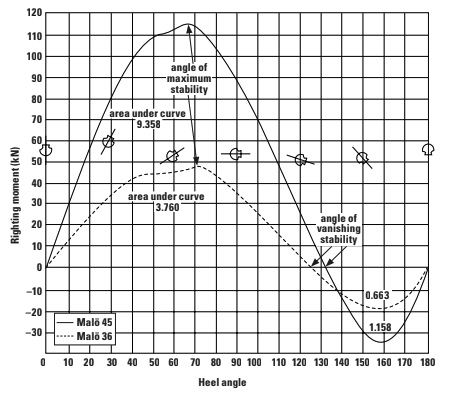
Designers use various measures to describe a boat’s stability. The righting moment or stability curve shows how much additional force is necessary to heel the boat through each degree of a 180-degree roll (see graphs on this page and top of the facing page). The amount of force required to make it heel the first degree is called its initial stability. Each additional degree of heel requires more force, so the curve slopes steeply upward for the first 50 or 60 degrees of heel.
The curve levels off where the greatest force is required to roll the boat one more degree. This is called the boat’s angle of maximum stability — just under 70 degrees for the Malö 45 below. After that, it takes less and less force to make the boat heel another degree. As the boat continues rolling, it reaches a point where it will continue over rather than come back upright, even if no more force is applied. This occurs where the curve crosses the X-axis and is called the limit of positive stability (LPS) or the angle of vanishing stability (AVS), about 132 degrees for the Malö 45.
Note how much difference size makes in the graph at left and the table at the bottom of the facing page. On average, the absolute force required to heel a boat 1 degree and keep heeling it through each additional degree doubles with each 5-foot increase in length for boats with similar displacement/length ratios (DLRs). The same is true for catamarans, which explains why cruising boats of any type over 50 feet so rarely get capsized or knocked down beyond the horizontal.
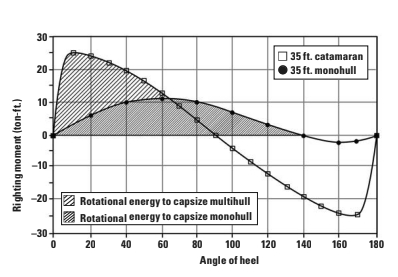
Also note how much more force it takes to capsize a modern catamaran versus a modern monohull of the same overall length in the graph at right. Catamarans are inherently much more stable than monohulls — whether right side up or upside down.
The governing bodies of offshore racing agree that a 40-foot monohull should have an LPS of at least 120 degrees, meaning that it can withstand a knockdown 30 degrees beyond the horizontal without capsizing. This number is considered the minimum because, if inverted, such a boat will right itself in less than 2 minutes, before any crew trapped under the boat can drown. For offshore sailing, smaller boats require a higher limit because their lighter displacement means the absolute magnitude of the forces necessary to capsize them are lower. The minimum recommended LPS for traditional designs under 40 feet can be approximated by 160 degrees minus the waterline length of the boat in feet.
Once a boat is completely upside down, at 180 degrees, it is again stable. What matters at that point is how much force is required to bring it back upright. A catamaran is at least as stable upside down as right side up; while it takes more to capsize it initially, once capsized it’s going to stay that way. A cruising monohull is designed to be unstable upside down; a small amount of force will get it to return to its proper orientation. In righting itself from 180 degrees, it needs only to reach its LPS before the forces will carry it back around. In a good design, the weight of the keel acts like a pendulum when the boat’s inverted. If a wave rolls the boat just a little bit, the keel helps carry the boat through the LPS and back upright.
The stability ratio measures how easily the boat will come back upright once it has reached an inverted position. It is calculated by dividing the area of positive stability (the area under the curve and above the X-axis) by the area of negative stability (the area over the curve and below the X-axis). The higher the number, the faster the boat will return upright once rolled to 180 degrees. On well-designed monohulls, the area under the curve is much larger than the area over the curve. Monohull stability ratios range from just over 1 to as high as 10 and vary a great deal even among boats of similar DLRs. In the graph on the opposite page, the ratio for the Malö 36 comes out to 5.7 (3.76 ÷ 0.663); for the Malö 45, it’s over 8 (9.358 ÷ 1.158). An offshore boat should have a ratio over 2.
Stability curves contain a wealth of information and would be exceptionally useful in evaluating offshore boats if they were readily available and if the way the measurements and calculations were performed could be standardized. Since no one actually rolls their boats through 180 degrees to measure the forces required (except participants in some single-handed offshore races), the curve comes from a few objective measurements and a lot of theoretical calculations. Very few manufacturers put together stability curves for their boats, and when they do the calculation methodologies vary widely, making them almost impossible to compare. There have been moves to create a uniform standard for generating stability curves, and in Europe the International Standards Organization (ISO) has been working on a sophisticated stability index they’ve dubbed STIX. The process is highly political. It will be many years before the industry comes to agreement and comparable curves become available for all new production boats. Even then, reliable, standardized data will continue to be difficult to obtain for used boats.
Given this lack of data, how do you go about determining whether a boat you’re interested in has sufficient stability to be trusted offshore?
The easiest way is to find out how sister ships have actually performed. The manufacturer, owners’ groups, Internet cruising websites, and boat show seminars all offer opportunities to meet and “chat” with people who have cruised aboard the make and model of boat you are considering. A dozen or so sister ships that have successfully circumnavigated or completed long voyages does not certify that model as Southern Ocean-capable, but it almost certainly indicates the vessel has sufficient stability for offshore sailing. If you’re considering a multihull, this will be about the best information you can get in conjunction with any stability curves the manufacturer has created, but if you’re considering a monohull there are other ways to assess stability.
The second easiest way to determine monohull stability is to calculate the boat’s capsize screening value (CSV). This ratio was created following the disastrous 1979 Fastnet Race, when a Force 10 gale went through a fleet of 303 boats, sinking 5, rolling 18, and killing 15 sailors. In the race’s aftermath, the United States Yacht Racing Union (now the U.S. Sailing Association — USSA) and the Society of Naval Architects and Marine Engineers developed the capsize screening value to quantify the “risk of being unduly easily capsized and the risk of sticking in the inverted position for an extended period of time.” The CSV is calculated by dividing the cube root of the boat’s displacement volume (in cubic feet) into its maximum beam: CSV = MB ÷ (D ÷ 64)0.33. The lower the value, the less likely it is that the boat will be prone to capsize, with 2 considered a maximum value for an offshore boat.
This formula offers a quick and easy way to get some feel for a boat’s stability; however, the ratio does not take into account the distribution of weight in a boat, and it penalizes beam quite heavily. It will give two boats of the same beam and displacement the same rating even if, on one boat, the weight is all in the hull and, in another boat, half the weight is in a bulb at the bottom of a 10-foot keel. As a result, the CSV should not be considered a definitive measure, especially with respect to more modern, beamier hull types like racer/cruisers and cruising sleds.
Beyond this, the only source of consistent, useful stability data for used boats is fleet data from rating agencies such as the U.S. Sailing Association and the Royal Ocean Racing Club (RORC). If the boat you are considering or a sister ship has ever been measured for racing by one of these organizations, you can purchase a rating certificate that will include basic stability information.
To examine the stability characteristics of a wide variety of boats in order to narrow your choices, purchase USSA’s Sailmakers’ Listing of IMS Yachts. While the calculation methodologies can always be debated, fleet statistics offer comparable data for evaluating many boats on consistent though static measurements. As USSA itself cautions, “No account is made for any of the dynamic factors which accompany capsizes.”
Based on all these data, we should be able to identify specific design features that increase stability. But characteristics that increase stability are complex and not always consistent. A deep hull increases the angle of maximum stability but decreases the amount of force the boat can withstand at that angle. A wide beam increases initial stability but makes the boat less likely to right itself after a capsize. Lowering the center of gravity by putting much of the ballast at the bottom of the keel would seem an obvious way to increase stability, yet some researchers claim that this can create a flywheel effect that carries the boat past its limit of positive stability and contributes to capsize.
Potential long-distance cruisers end up with few clear rules to follow when selecting a boat. Only size seems to correlate consistently with stability, as the earlier righting moment curves demonstrated. This is not surprising given that the kinetic energy to capsize a boat will vary as the fourth power of boat length. That means that a 60-foot sailboat can absorb 16 times as much kinetic energy from a wave crest without capsizing as a 30-foot boat. The exact relationship between size and stability has been demonstrated for monohulls using tank testing.
But small boats can meet minimum stability requirements given adequate displacement. The table below shows the stability characteristics of two groups of boats, the first around 35 feet long and the second around 50 feet long. Boats within the shaded areas do not meet some or all the recommended stability criteria for offshore sailing. As this table illustrates, traditional boats (with DLRs over 300) under 35 feet are more likely to meet the criteria than those with lower DLRs. Fifty-foot boats can rely on length to give them adequate stability even with DLRs less than 100. Very few cruising boats with waterlines of 50 feet or more fail to meet the minimal requirements shown in the table. Stability is probably the single biggest reason why the ULDBs now starting to infiltrate the cruising ranks tend to be at least 50 feet long.
Thus, length and displacement seem to be the only two design factors that correlate unequivocally with stability, and it is possible to make up for a lack of one with the other. Heavy, small boats and light, large boats can both be stable enough to weather extreme conditions offshore. Many boats that do not meet the stability criteria shown in the table have successfully completed long voyages. On an average trade wind circumnavigation timed to avoid both tropical cyclones and winter gales, only a handful of people will be unlucky enough to test their boat’s limits. This is not true in the high latitudes. Of the 18 boats we know that completed Southern Ocean passages, more than half were knocked down past the horizontal at least once during their voyage. Given the consequences of not staying upright, most cruisers will want to add these basic stability guidelines to their search criteria. For a high-latitude voyage, stability should be close to the top of the list.
Durability
An offshore boat needs to be rugged enough to stand up to the constant punishment of sailing 5,000 to 12,000 miles per year, year after year. Even boats with good track records designed and built for offshore sailing require constant maintenance and attention to keep them up to the task. Taking a production offshore boat, no matter how well built, voyaging is like taking a stock Jeep in the Paris-to-Dakar rally. Taking a coastal boat is like trying to do the rally in an economy car.
A well-built offshore boat should get you through a circumnavigation without needing serious structural work halfway around the globe. What you want to avoid are major failures that require you to remove half the interior or to sit on the hard for six months or more — bulkheads pulling away from the hull, compression around the mast step, a failed hull-to-deck joint, extensive delamination, large-scale osmotic blistering, and so on. These are the kinds of things that can easily ruin a voyage or end it altogether when the money runs out.
The best way to avoid these problems is to invest in a good marine surveyor who can evaluate the boat’s suitability for the voyage you plan to take. Even if you are buying a new boat, hire a surveyor to inspect it before it leaves the factory. We have seen brand-new boats in which a mast was off-center by almost 4 inches, an improperly wired electrical system caused a fire within a few months of purchase, and missing structural stringers around a keel caused leaking through the keel bolts on the first offshore passage.
If you’re buying a wooden or metal boat, hire a surveyor who specializes in these materials. For any boat, check references and ask around to be sure you’re getting someone competent. Your friendly neighborhood boatyard manager will probably have opinions on local surveyors. Ask surveyors about their past experience, areas of expertise, and what boat brands they are most familiar with. Also ask them for a sample of a past survey (with the owner’s information blacked out) so you can evaluate their professionalism and thoroughness. A good survey costs from $12 to $15 per foot in the United States. Most of us can only afford to survey the boat we really believe we’re going to buy, which means we hope to have eliminated any boats with major problems before a surveyor ever sees them. Information from others having experience with the model of boat under consideration is the best way to do this.
As with stability, a half-dozen boats of a specific model that have completed long offshore voyages can be taken as necessary — but not sufficient — proof of the boat’s durability. Here’s where it really pays to get on the Internet and track down other owners. Just “eavesdropping” on an owner’s group will offer a wealth of information on how many boats have actually done extensive offshore voyaging and the problems they encountered. It will also put you way ahead on figuring out what you’ll need to do after you buy the boat by giving you firsthand knowledge of how other people have refitted the same model for offshore, what kind of work other owners have needed to do after two or three years of voyaging, and typical structural problems among older boats and how to fix them.
Yachting magazines, including Cruising World and Yachting Monthly, offer services to put you in touch with owners willing to talk about their experiences. (Note: See the Good Old Boat association pages online also. –Eds.) Contact the manufacturer as well — if a sister ship has completed a circumnavigation, the manufacturer will probably be using that fact in its advertising. See if the company will give you contact information for people who have done major voyages on the boat model you’re considering. When you find anyone who has cruised the boat for several years, ask the owners the following questions:
- How old was the boat when they bought it? What did they do to refit it before they left?
- Did they do a refit while cruising? What did they do?
- If they were to refit the boat for another long voyage now, what would they do?
- Did they have any problems with osmotic blistering? Delamination? Galvanic corrosion? Rust? Electrolysis? Leaking through the toerail or hull-to-deck joint? Compression under the mast? Keel attachment? Rig failure?
Finally, before you start looking at individual boats, consider the most common upgrades that need to be made to older boats. Bear in mind that no boat is ever trouble-free; every boat has minor issues you will need to address during the refit. The goal is to find any major structural problems that would undermine durability. But also, you want to know about any specific weaknesses you’ll have to deal with on that boat, to weigh those against the weaknesses of other boats you’re considering, and, if you buy that boat, to learn ways to reinforce and upgrade these areas before you head offshore.
Next issue, in the third part of this series, Beth will discuss design considerations including deck layout, accommodations, and equipment.
Beth Leonard and Evans Starzinger circumnavigated from 1992 to 1995. They spent three years ashore rebuilding their cruising kitty and building a boat capable of sailing in higher latitudes. In May 1998 they left aboard Hawk. Their itinerary consists of a list of places they’d like to visit.
Thank you to Sailrite Enterprises, Inc., for providing free access to back issues of Good Old Boat through intellectual property rights. Sailrite.com