A tool roll stocked with these top indispensable tools will be your go-to kit.
Issue 129: Nov/Dec 2019
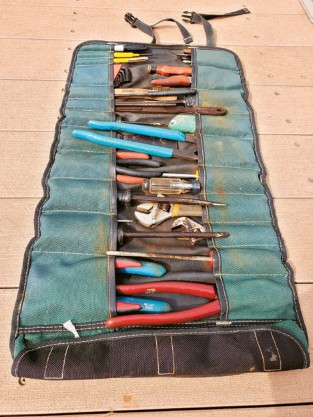
After nearly a decade of living aboard full-time and earning my keep fixing other people’s boats (so that I can fix my own), I’ve discovered a simple truth: Of all the tools I own, I use only about two dozen of them to fix 90 percent of the problems I encounter. Accordingly, I keep these tools together, well maintained, and accessible. No longer am I searching in separate places for any of these tools, wasting time rummaging in multiple lockers. Nope, I have a tried-and-true solution that has made my life much easier. I call it the Indispensable Boat Owners Toolkit, or, in keeping with today’s vernacular, the iBOT. Here’s what I keep in it:
Screwdrivers
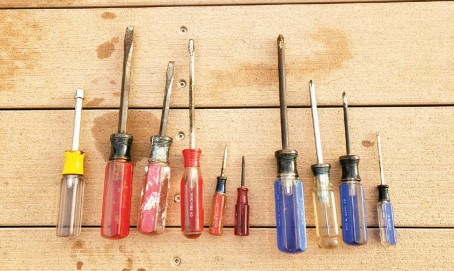
These spend more time in my hand than any other tool in my kit. Rather than succumb to clever marketing, I eschew the 15-in-1 screwdriver gizmos sold in hardware store check-out aisles. Instead, I own a set of quality stand-alone drivers of different types and sizes. My set includes #1, #2, and #3 Phillips-head screwdrivers; a big, long, and strong flathead screwdriver that doubles as a pry bar; a medium flathead screwdriver for the majority of slotted screws; and a narrower fine-edged flathead screwdriver (preferably with a long shank) for small items.
Wrenches
Adjustable wrenches are a singular exception to my prohibition on all-in-one tools on boats, but there are simply too many sizes of hex heads out there to carry complete sets in metric and imperial. I keep two adjustable wrenches in my iBOT because too often I need to hold both a head and nut at the same time. Although it’s best to have a set of metric and imperial Allen wrenches, it’s possible to fudge the correct imperial size with a metric equivalent (but you didn’t hear it from me!), so I carry just one set in my kit and keep my fingers crossed.
Pliers
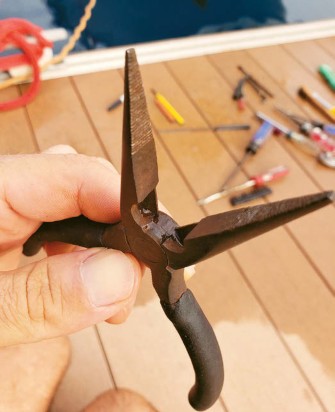
I didn’t skimp when I bought my Channellocks. The jaws are able to get around 2-inch (50-mm) hardware, and the handles are long enough to give necessary leverage. The added weight and size of this tool has paid off when I’ve used it as a makeshift hammer. I also keep a comfortable pair of needle-nose pliers in this kit, along with a medium-sized pair of Vice-Grips. The latter gives me a “third hand” that won’t burn, yell, or bleed when I miss. Diagonal wire cutters work like a dream to snip away zip ties and separate rigging, but I could get by without these if I wanted to lighten the load.
Files
These are a must for taking the sting out of tool-mauled metal or for enlarging a fiberglass hole just a tad bigger to fit that new radar cable through a deck. One decent-sized flat file (with a fine and coarse side) and one round file usually get me through.
Razor Blades
I sometimes keep a sharp knife in my pocket, but a fully functioning utility knife with a ready arsenal of fresh blades saves me time, frustration, and emergency stitches. I prefer the old-school aluminum-constructed “clamshell” jobs (the fewer moving parts the better), and because I always have a screwdriver at hand, changing out the internally stored blades isn’t a hassle.
Marking Tools
I find myself using a pencil more than I expect, and because my kit is so well stocked and handy, I’ll often grab it just because I know there’s a working Sharpie inside, something I might otherwise struggle to find elsewhere on the boat.
Miscellaneous
I keep several indispensable tools in the iBOT that aren’t easily categorized. I’m not sure what it’s properly called, but the pokey tool (with a long, thin, strong, bent pointer at the end) that I keep in there has gotten me out of countless jams, from de-clogging bilge pumps, to cleaning out tiny drain holes, to retrieving dropped nuts in narrow lockers. I keep a small wire brush for cleaning the corrosion off battery terminals and bimini connections. I also include a small unwound strand of rigging wire. It’s similar to the pokey tool above, but because it’s thinner and bends easily, I use it to get in places that nothing else can. It’s the same wire I use to pop out the SIM card from my phone. Consider your own favorites to include, such as a telescoping inspection mirror, which lets you peer into nooks and crannies and around corners where no part of your body could possibly fit, and a similar telescoping magnet that lets you grab dropped or wedged metal objects like nuts and bolts.
These are the tools I carry and store at the ready, but how do I carry and store them? Long ago, after rooting around in a former boss’ work truck for over an hour, I thoroughly learned the lesson that “If you can’t find it, then you don’t have it.” That’s why it’s important to keep this discreet group of tools together and separate from larger tool collections.
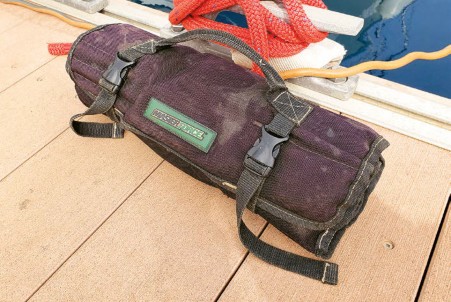
After using a variety of tool boxes — even plastic ones have cheap steel hinges and latches — and tool bags, most of which only close with problematic zippers, I stumbled upon the tool roll and I haven’t looked back. Constructed entirely of noncorrodible thick fabric and plastic, tool rolls are lightweight, adjustable, portable, and take up far less space than boxes when not in use. With a bit of doubling-up, I’m amazed at how many tools I’m able to fit into a roll and then readily tuck it into a backpack or dry bag (think dinghy transport). I unroll as much or as little as necessary to reach the required tool. It’s as if tool rolls were specifically designed for boat owners.
Keeping these tools stored in a hefty fabric roll provides corrosion protection, but I still need to maintain them so they are always ready to function. I once went over to a friend’s boat to give him a hand with a new water pump install. When I asked for a pair of pliers, he handed me a hunk of crunchy red metal.
“What’s this? Are you growing experimental coral?”
“No,” he replied straight-faced, “they’re pliers.”
We both laughed, but my first thought was, “If it doesn’t work, then you don’t have it.”
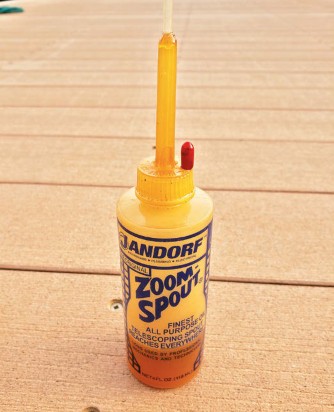
Outside of the iBOT (but always nearby), I keep a plastic oiling container with a long, narrow spout. This allows me to put just the amount of oil I want, where I want it. I can hear you thinking: “Oh, I’ve already got a can of WD-40.” No. Extremely lightweight and solvent-containing penetrating oils do not hold up well for prolonged use and protection. I’ve found that a higher-viscosity oil more effectively keeps all tools and moving metal parts aboard (including zippers, padlocks, hinges, and shackles) functioning smoothly. And when I run out of oil, I simply refill the narrow-spout bottle with whatever’s left over from a quart of engine oil used for the boat or car.
Here’s my essential tool-love procedure: Working on one tool at a time, I place a couple drops of oil at the seams of every moving part and then I operate the tool in quick, even successions to help the oil fully penetrate and coat all moving surfaces. If I drop some oil into the jaws of pliers, for example, and then quickly work them open and closed a dozen times, I’ll find oil oozing out from the center of the hinge, a good indication that things are well coated. I use a rag to mop excess oil and then give all the metal surfaces a once-over with the lightly saturated rag. I typically do this just once a year, finding that’s enough to keep my tools healthy and limber. That said, if I ever drop a tool in salt water, then I simply flush it well with fresh water before re-oiling and it’s ready to store back in my tool roll.
It may not fit in my pocket, but my iBOT saves me more time and money than any other “i” device I own.
After two years of extensive refit, Zach and his Aussie wife, Clare, cast off from the Florida Keys in their 1972 Dufour 35 headed for the Land Down Under. Somewhere along the way they took a “wrong” turn and found themselves crossing the Atlantic where they’ve been exploring the Med ever since. As soon as they can pull away from these history-drenched shorelines, they’ll return to their rhumb line and begin following the trade winds west.
Thank you to Sailrite Enterprises, Inc., for providing free access to back issues of Good Old Boat through intellectual property rights. Sailrite.com