New crew in the fam? Here’s how to take them sailing.
Issue 129: Nov/Dec 2019
When my husband, Michael, and I found out we were going to be parents in eight short months, the first thing our family and friends said was, “Congratulations!” Then, “You’re going to sell your boat now, right?”
We were asked this question so many times that I couldn’t help doubting our plans to continue living aboard and sailing our boat with our newborn daughter as crew. This doubt only added to our existing new-parent trepidation. Were we crazy to think we could take care of an actual human and sail too? How does one sail with a baby? Should we sell the boat and live on dry land for a while? Resume sailing when our daughter is older? How old? Uncertainty loomed.
In the end we swallowed hard and carried forward with our plans. It’s been 13 years since we brought our daughter aboard, and her sister after that. We’ve since sailed with kids of all ages, from newborns to teens, on a variety of boats. I’ll confidently tell any expecting sailor not to sell the boat. In fact, I tell them that sailing with children is easiest from infants up to age 3: they’re easy to tie down, easy to distract, and happy simply being with their parents (you definitely can’t say any of that about teens).
In the course of my research while co-writing Voyaging With Kids, I talked with many parents whose experiences — along with my own — helped me understand that successful sailing with babies simply requires a little preparation and planning and a lot of adjusted expectations. Or, as Leah Kruger, who sails aboard a Nor’West 33 with her husband and infant son, said, “Lose your expectations — then the whole thing is fun!”
Sailing With a Baby: Stage 1
The tactics and approaches to sailing with a little one aboard vary according to age, roughly broken into stages. Stage 1 is the beginning, when you’re maybe just past those first few sleepless weeks, have feeding and diaper changing down, and begin thinking, “Maybe it’s time to take the baby sailing.” While it might sound impossible in the haze of sleeplessness, this really is the easiest stage to bring a baby aboard.
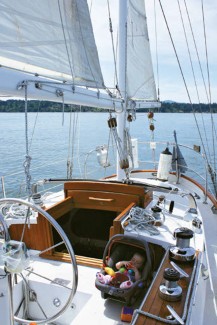
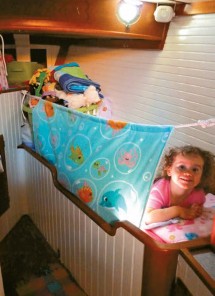
At this age, your baby will typically stay wherever you put her, so the key is to find that magic place to set her down. Aboard a boat, the place must be secure: a travel bed, a car seat strapped into the cockpit, a baby-wearing device, a bunk with leecloths or netting that is free from any falling hazards. In these places, a baby can be safe and protected while underway. We used all of these methods when sailing with our newborn daughters, depending on the distance, weather conditions, and how many other crewmembers were aboard to lend a hand.
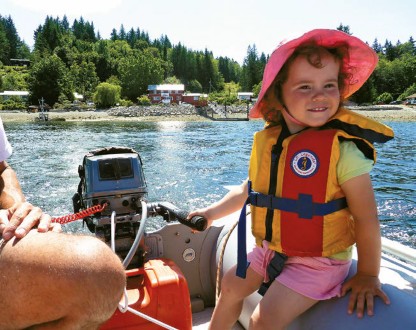
Long before we left the dock, we procured a properly fitted, comfortable life jacket for our baby. This is a critical item, as even going from car to boat can expose the infant to the danger of falling in the water. For similar reasons, we tried to avoid using a stroller on the docks. The danger of a stroller winding up in the water with a baby strapped inside is too great. And while it’s tempting to use a baby carrier in a dinghy (I’ve done it!), the safest place for a life-jacketed child aboard a dinghy is in a parent’s arms.
Realistically, most parents of tiny sailors find that one parent tends to the boat while the other tends to the baby. The same was often true for us, but this is not ideal for anyone. Erin Courtenay, who sails a 20-foot Beneteau with her two young children said: “I read all these lovely stories of people raising littles on a boat but for me, daysailing is a drag. Not fun being … basically sentenced to the salon for 75% of the outing.”
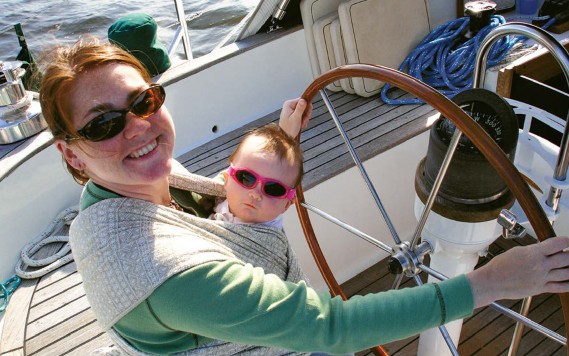
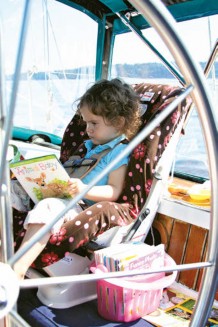
It doesn’t have to be this way. Parents can switch it up, taking turns meeting a baby’s needs so that neither one is sentenced to the salon. Add other crew to the mix, so the burden can be shared more widely. Aboard a larger boat, securing a child in a car seat strapped in a safe, shaded spot in the cockpit allows everyone equal topsides time (this was our favored approach aboard our Benford 38).
Start slowly when first sailing with a baby. Keep trips short. Once the baby has settled into a steady nap schedule (hallelujah!), plan sails for nap times. You’ll likely be pleased to learn that the motion and sounds of a sailboat underway lull a baby right to dreamland and that afternoon sail is yours to enjoy alone, perhaps uninterrupted. Of course, fair weather is important; plan on sailing in light airs while getting used to new family sailing routines. And once that happens, pretty soon you’ll find yourself in Stage 2, when baby is on the move.
Sailing With a Baby: Stage 2
When our daughter reached the 6-month mark and suddenly got the urge to move around, growing more active with each passing day, we found sailing with her a lot more difficult. Unlike other crewmembers, a 6-month-old baby can’t be expected to obey commands or listen to reason. Rules? An empty word.
At this stage, one of us kept an eye on the baby at all times. Once she was crawling, our daughter could move from safety to harm’s way in the blink of an eye, despite our best planning and precautions. We found relief in that babies at this age still nap daily. This is the stage where we got good at planning sailing around nap times. We gave both our girls a secure place to sleep (still a car seat, travel bed, or bunk with netting or canvas to keep them contained).
But you will sail when baby is awake, and that’s when it gets more challenging. Babywearing is useful; I had no problem helming with a baby strapped to my front or back. At 6 to 9 months old, it’s time to invest in a well-fitting harness (Edilrid makes a child’s climbing harness that is perfect for use on a boat, and West Marine sells a child sailing harness). Your new sailor will appreciate the freedom of being able to roam the cockpit, but on a tether that doesn’t let her get past the coamings.
Also at this age, the infant life jacket will be long due for replacement. There are plenty of jackets available, but resist purchasing one they can “grow into.” Only buy the correct-fit life jacket. One that’s too big can be especially dangerous due to the possibility of it slipping off.
Should you add lifeline netting at this stage? Arguments have been made for and against; if done right, it can add an increased level of safety, but lifeline netting is never a substitute for keeping a steady eye on your child at all times. For what it’s worth, we’ve never installed lifeline netting on any of our boats, preferring to use diligent attention instead.
Sailing With a Baby: Stage 3
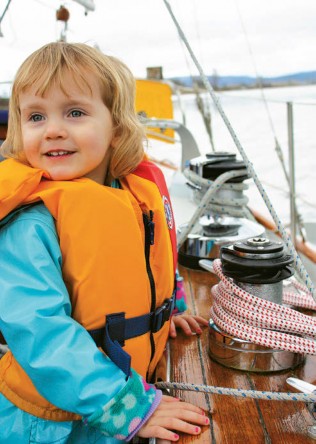
As our daughter neared her second birthday, she began to understand rules and guidelines and even exhibited an eagerness to follow them (if we’d presented them in a fun way). Don’t hesitate to introduce your rules now. At 24 months, our daughter understood she wasn’t to exit the boat cabin without first putting her life jacket on. We enforced this consistently and both our daughters quickly learned this point was non-negotiable and capably self-enforced.
Of course, that doesn’t mean you won’t encounter any resistance — we did with our strong-willed firstborn. If a child balks at wearing a life jacket, make sure the one you’re trying to get her to wear is comfortable and appeals to her. If possible, take her to a chandler and try on a few, letting her choose the one she likes best.
Between ages 2 and 3, nap schedules will become less predictable and little crew members are even more active, but all hope is not lost. The motion of the boat still retains its narcoleptic effects. My daughters, now ages 10 and 13, still dependably fall asleep while under sail. Keeping sails short and the destinations fun (the beach!) can keep young (and old) crew morale up.
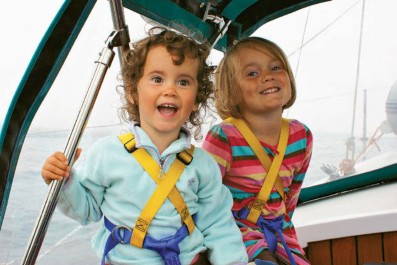
While babywearing is probably on its way out at this stage, a car seat secured in the cockpit can still be useful, especially when a child needs to be well-secured immediately and for a short time, such as when the weather gets rowdy and all adult hands are needed on deck. Parents and children will equally appreciate the harness-and-tether combo at this age.
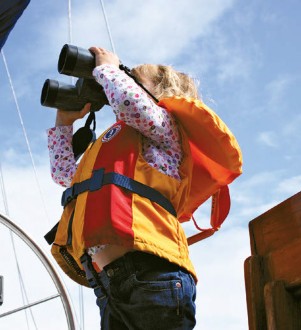
We also found that keeping the little crew busy while the big crew handles the boat is key. A supply of snacks, books, toys, and simple art supplies was always at hand in our cockpit. Charlotte Merritt said that when sailing their Erikson 29, her young son would play with his toys in a bucket of water for hours while underway. The key is to discover your child’s bucket of water and toys.
This is also the stage when sea sickness might become a factor (if it hasn’t already). While there are many remedies on the market, I’ve found that fresh air, a view of the horizon, plain crackers, and sips of water or juice have best helped my kids defeat mal de mer. If your child is struggling with seasickness and the first lines of defense don’t seem to be doing the job, a medication such as Dramamine or Benadryl can be helpful if your child is over 2 years old.
Sailing With a Baby: Stage 4
I suppose there’s also a fourth stage: When baby #2 arrives. That’s when things really get interesting. But rest assured. I’ve done it and so have countless sailing parents, many living aboard and cruising. Everything applies as before, but the good news is that you can likely start to involve your older child in sailing the boat. Ours was eager to steer and help raise a sail at 4 years old. It’s never too early to give kids responsibilities on a boat. Even small and inconsequential things start to give children a sense of pride, of being a valued crew member.
And when baby #3 arrives? I’m sorry to be the bearer of bad news, but you might have to sell your boat after all…so that you can buy a bigger one.
Sara Dawn Johnson has been sailing since 1999, exploring waters from Alaska to New Zealand. In 2011, Sara, her husband, and two young daughters departed Olympia, Washington aboard their 38-foot Jay Benford ketch, Wondertime. They spent the next 18 months cruising British Columbia, Mexico, French Polynesia, Niue, and Tonga before finally arriving in New Zealand, where they are still exploring under sail. Sara is co-author of Voyaging With Kids: A Guide to Family Life Afloat (L&L Pardey Books, 2015).
Thank you to Sailrite Enterprises, Inc., for providing free access to back issues of Good Old Boat through intellectual property rights. Sailrite.com