When winter impounds the keelboat, the trailer-boat heads south toward spring
The voice of Elvis Presley is running through my brain once more as I write. It’s the same refrain that played often during the month we spent sailing in the Land Between the Lakes (LBL) of Kentucky and Tennessee: “Kentucky rain keeps pouring down.”
One of the virtues of a trailerable sailboat is that we can take it almost anywhere quickly and without great expense. Obviously it involves some cost, such as acquiring a vehicle capable of towing it, but moving a full-keel boat like our Mystic around the country so as to enjoy a change of scenery would be much more problematic. Therefore, we’ve become two-boat owners . . . for better and worse.
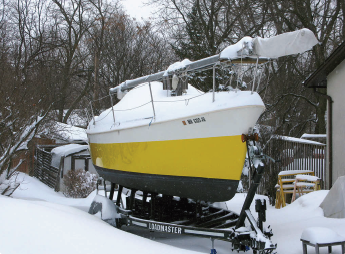
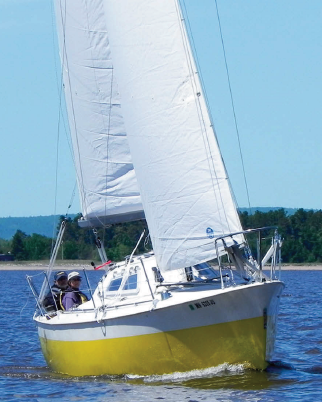
Towing Sunflower, our C&C Mega 30, we arrived in Grand Rivers, Kentucky, at the top of the LBL, after dark and in a Kentucky deluge that would have ended Elvis’ “searching for you.” We wanted nothing more than to decouple our truck and be finally free of the 30-foot encumbrance that had cramped our style for the two-day drive. We went to work in the downpour, sidestepping instantly forming puddles and drenching all our tools the moment we opened the truck’s tailgate. Once free, we were off to town for dinner and hot showers.
Traveling from our Lake Superior home to Kentucky for the month of May allowed us to explore a new cruising ground while extending our spring and summer sailing by two to three weeks more than Lake Superior’s notably short sailing season permits. We’d left Minnesota following a freak mid-April storm that delivered record-setting snowfall of 22 inches, so a little “cold Kentucky rain” seemed bearable.
A bounty for boaters
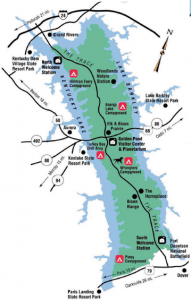
The Land Between the Lakes National Recreation Area was created in 1963 as part of the work by the Tennessee Valley Authority to dam the Cumberland and Tennessee rivers and, as a side effect, to preserve the area between them as a wilderness. The resulting lakes are Lake Barkley (on the Cumberland) and Kentucky Lake (on the Tennessee). The rivers were dammed to ensure continued commercial traffic, prevent disastrous floods, bring electrification to many rural communities, and conserve water for the dry seasons. Whatever the thinking at the time, today’s recreational boaters have benefited immensely from the initial massive effort to control the rivers and from the Army Corps of Engineers’ ongoing work to maintain the waterways.
Recreational boating in the Land Between the Lakes looks nothing like what we’re used to on Lake Superior. As well as sailboats (especially on Kentucky Lake, which is deeper than Lake Barkley), we shared the waterways with bass boats, houseboats, pontoon boats, cigarette boats, trawlers, fishing skiffs, personal water craft, and runabouts galore. A few kayaks and canoes found room too.
We saw lots of dry-stack storage and what seemed like millions of covered boat slips. Both are practically unknown on Lake Superior, where sailboats abound. All of the small boats and some not-so-small craft (the houseboats are monsters) respect the Big-Boat Rule: The large barges under tow have the right of way in all situations. They are amazing to watch. We don’t see much commercial traffic on Lake Superior and we certainly don’t get as up close and personal with the big lake freighters as we did with the multi-barge monsters. We enjoyed every opportunity we had to observe them and to learn more about them at a couple of local maritime museums.
New neighborhood, colorful neighbors
We rented a slip for the month at Green Turtle Bay Marina near the little town of Grand Rivers. The facility was well named, since everywhere in the nearshore waters there were hundreds of turtles of several species.
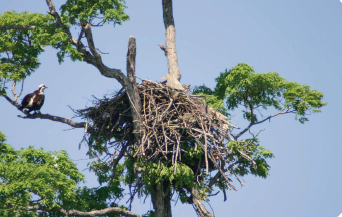
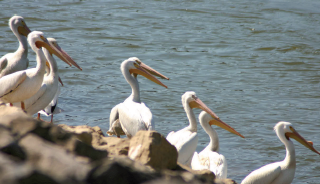
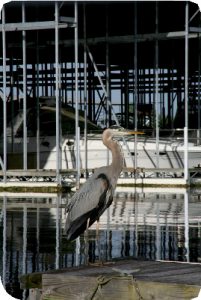
Life at the western edges of Kentucky and Tennessee offered us new birds and wildlife to appreciate. Osprey were everywhere, and in May their nestlings were in full cry. The white pelicans floating downstream of the dams were a beautiful sight, as were the cliff swallows with their acrobatic flight and architecturally distinctive nests. There were plenty of purple martins and other swallows to keep the insect population down. Great blue herons stalked the shoreline for fish, and Jerry named the one that spent time on the end of our finger pier Spike, for obvious reasons.
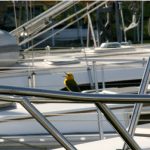
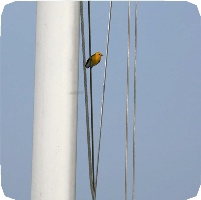
A mighty little speck of yellow fluff about the size of a wren arrived one day and proceeded to bellow out his signature song “sweet, sweet, sweet, sweet, sweet” from the mastheads, shrouds, and backstays of all the boats on our pier. Jerry named him the Kentucky backstay warbler — much easier to spell and pronounce than prothonotary warbler.
The term “Minnesota nice” is in wide use, but our fellow Minnesotans have nothing on the warmth of the people we met at Green Turtle Bay Marina (both the staff and our fellow boaters) and elsewhere in Kentucky and Tennessee during our stay. People want to help. They recognize a Yankee accent and want to know where we’re from. They have words of advice and make friends easily. We were touched by small kindnesses time and time again.
 We shared our sailboat pier with three kinds of sailors: locals, liveaboards, and transients. The locals arrived from their homes as far away as Ohio, Indiana, and Illinois, but primarily from Nashville, Tennessee, and nearby towns in Kentucky. These folks live and sail here year after year. Each May weekend, more arrived and began preparing their boats for another summer sailing season in their favorite cruising ground. Their boats winter over in the water — very few are hauled out — a concept foreign indeed to northerners like us.
A few hardy souls live on board year-round at this and other nearby marinas. Accustomed to mild winter weather, they had tales to tell of the previous winter from hell. This sort of suffering clearly builds character and creates strong bonds among the hardy few. Or so it seemed.
The final group of boaters is the transients. The first of the southbound transients begin showing up at Green Turtle Bay Marina in May. The Tennessee River is part of the Tennessee-Tombigbee Waterway, one stage of the Great Loop route for those circumnavigating the eastern half of the US. Rivers between Chicago, Illinois, and Mobile, Alabama, give Great Lakes boaters an inland route by water to the Gulf of Mexico. The Tenn-Tom, which opened in late 1984, is a major part of that path to the sea.
River idiosyncracies
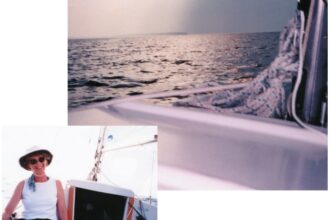
We enjoyed our time sailing on Kentucky Lake and even did some exploring (while staying within the buoyed channel) on shallow Lake Barkley. The winds in May were light, and just right for our lightweight Sunflower, so we were able to get comfortable with her. She is nothing at all like Mystic and has required some getting used to since we launched her.
River sailing introduced a few subtleties for a pair of Great Lakes sailors. The water was fresh, but the lake level can rise and fall, especially seasonally, as dams are used to control flow and water levels. Rather than observing tide tables as saltwater sailors do, riverboaters pay attention to water-level gauges at the dams, bridges, and other locations on the rivers. This “pool level” is based on elevation, the height in feet above sea level.
“Say what?” you ask. Think about it. As a river flows downhill to the sea, its elevation changes. The levels of lakes created by dams along the Tennessee River vary from 741 to 359 feet above sea level, which is why the locks associated with each dam are so important to river commerce. A few miles beyond the final dam (the one that created Kentucky Lake), the Tennessee River joins the Ohio, which then flows into the Mississippi and onward toward the Gulf of Mexico. Both the Tennessee and Cumberland rivers meander in a general westerly direction from their sources but then flow north toward the Ohio, a geological quirk that can trouble those who use the terminology “upriver” and “downriver” when navigating these waterways.
Shoreside excursions
That cold Kentucky rain soon gave way to a hot Kentucky sun, and we escaped some of the hottest weather by traveling in our air-conditioned truck to tourist attractions in the area. The Land Between the Lakes was the top draw, but we were also fascinated by the two nearby dams and locks and visited them on multiple occasions. We spent a great day in two museums in nearby Paducah: the River Discovery Center, about towboats and barges on the rivers, and the National Quilt Museum, where quilting is elevated to an art form.
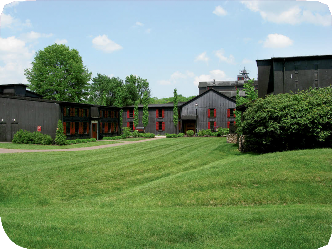
We made a couple of trips farther afield with overnight stays so we could visit friends in Nashville, see Mammoth Cave, and tour a bourbon distillery, one of many in the area. Maker’s Mark, a very impressive facility well worth the visit, is the one we chose. I’m not a fan of bourbon, but the buildings and grounds are picture-postcard beautiful. It’s not necessary to drink the stuff, but the tour ends with a tasting experience that is clearly very enjoyable to those who do.
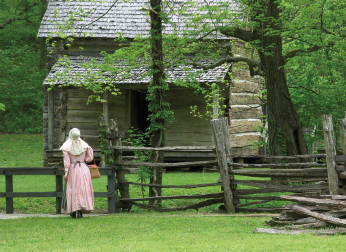
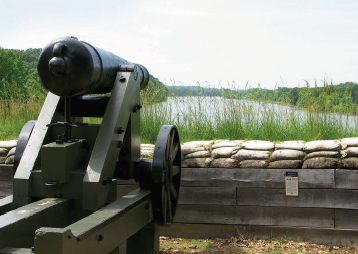
At Grand Rivers’ famous Badgett Playhouse, we attended an excellent show honoring Elvis Presley, which planted that song loop that still plays in my brain. We also visited a couple of Civil War memorial parks. Fort Donelson, in particular, stretches over several park locations. Battles in this area were pivotal to the outcome of the Civil War.
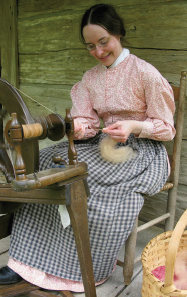 But the nearby LBL was a constant draw. The Homeplace, an 1850s working farm there, was of great interest to us both. Staff members dress as people did in the day, and work the farm using the means available at the time, with oxen for pulling and horses for transportation. I could have returned there several times, as I’m sure something different goes on every day. While we were there, a couple of women were quilting and spinning, and men were planting and taking care of the farm stock. We just missed seeing the blacksmith work his magic.
The LBL is also host to a planetarium and observatory, an elk and bison prairie, and a nature station where animals that cannot return to the wild are kept for their safety and for our appreciation. At the time, these included bald eagles, several varieties of owl, vultures, turkeys, a bobcat, a coyote, deer, a red wolf, and more.
We’ll no doubt return to the Land Between the Lakes and other parts of the Tennessee River area to expand on what we’ve already seen and done . . . and to get a jump start on our limited northern sailing season.
Resources
Fred Myers’ The Tennessee River Cruise Guide offers a historical perspective on the area, advice about anchorages, and useful information about river sailing.
The Powerboats of Kentucky Lake —Jerry Powlas
The last powerboat I owned I sold in 1964. It was 12 feet long and had a wonderful 5-horsepower Elto engine. Later, I restored a freight canoe and converted it to a lateen-rigged schooner. The 7.5-horsepower Mercury outboard that came with it was an engine without charm.
In the 55 years since then, the only powerboating I’ve done was in a pontoon boat I used for doing minor tasks at my local yacht club. When I needed to use the pontoon, I attached the 2-horsepower outboard from my Flying Scot. It seemed like enough power.
Things have changed since 1964. On Kentucky Lake, much of the fishing is done from bass boats. These carry single engines of 150 to maybe 250 horsepower. The slow ones might reach speeds of 40 knots and the faster ones might reach 65 knots or more. We never saw large waves on the lake except once in a thunder- storm. These specialized rockets have hulls that get up on plane and make the most of the flat water.
The bass boats are numerous, but the real lake boat is the pontoon . . . which has come a long way, baby. Some have two hulls, some have three. Some mount a single engine, some mount twin engines. Some of the tri-hulls mount twin 350-horsepower outboards. I don’t know how fast these boats can go, but they aren’t slow. Their crews fish from them and party on them.
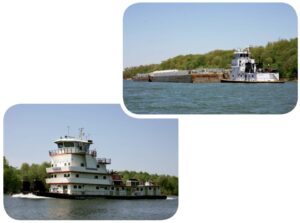
New to us were the towboats. Single- and twin-engine boats pushed tows that might be as long as an oceangoing ship. Their combined 5,000 horsepower did not seem excessive when I looked at what they were pushing. “Tow” seems a strange choice of words to us, since all the towboats were pushing rafts of barges, usually three barges wide and often as many as five barges long. I was
concerned about sharing the water with these craft, but the professionalism of the pilots and crews made it look like easy work, and many times we marveled at the skilled maneuvers they put their vessels through.
Powerboats outnumber sailboats on Kentucky Lake by a wide margin. This is the opposite of our experience in our home waters of Lake Superior, but most boats of all types were handled well and we were comfortable being on the water with them.
Karen Larson and her husband, Jerry Powlas, the founders of Good Old Boat, have been sailing their C&C 30, Mystic, on Lake Superior for more than 20 years. Since retiring in 2017, they have been learning the very different sailing characteristics of their trailerable C&C Mega 30, Sunflower.
Thank you to Sailrite Enterprises, Inc., for providing free access to back issues of Good Old Boat through intellectual property rights. Sailrite.com