A dehumidifier keeps a cabin dry and free from mold
Issue 124: Jan/Feb 2019
My friend Don Smith and I live and keep our boats in Alaska. To control moisture aboard, and its negative side effects, mildew and corrosion, each of us operates a small electric dehumidifier in our boat’s cabin. In the Seward climate where Don keeps Gimme Shelter, winter temperatures can drop below 0°F. About 300 miles south, in the warmer but rainier Ketchikan climate where I keep Golden Eagle, my Passport 40, winter temperatures can drop to about 15°F, but are normally in the 30-degree range. Both harbors are ice-free, so we both keep our boats afloat in their slips year-round.
Don asked me whether his cabin dehumidifier was doing any good when operating in winter. He noted that, with his cabin at 40°F, it produced very little water, yet at 65°F it was dehumidifying nicely. The short answer to Don’s question is that humidity is dynamic and, yes, there are benefits to operating a dehumidifier continuously. But to understand the answer fully, some knowledge of dehumidifiers and psychrometrics — the study of the heat and water content of air — is necessary. Dehumidifier performance is intertwined with this science.
Psychrometrics
Water vapor is held in air; we call this humidity, and express it in absolute and relative terms. The absolute humidity of a sample of air is the actual amount of water it holds, measured in grams of water per cubic meter of air. That same sample of air at any temperature has the same absolute humidity. Relative humidity (RH) is the amount of water vapor in the air compared to the maximum it could hold at that temperature according to the laws of nature.
Air’s ability to hold vaporous water is governed by the ratio of water-vapor pressure to atmospheric pressure: the lower the temperature of water, the lower its vapor pressure, so the cooler the air, the less its ability to hold moisture. As air cools, the water it contains might approach the maximum — 100 percent — it can hold. This is 100 percent RH. That same air at a warmer temperature could be 50 percent RH or even less. An interesting fact is that the vapor pressure of frozen water is almost zero, so the absolute humidity of air below 32°F is almost zero, yet the tiniest amount of vapor will raise the RH to 100 percent.
When an air/water-vapor mixture cools below the 100 percent RH point, it is no longer in balance, so some water must condense, becoming liquid. This happens to moist, warm breath exhaled on a cold day, to air when it touches an iced-tea glass, and to air in a dehumidifier. The temperature at which condensation starts, the 100 percent RH point, is called the dew point, or saturation point.
Without a dehumidifier
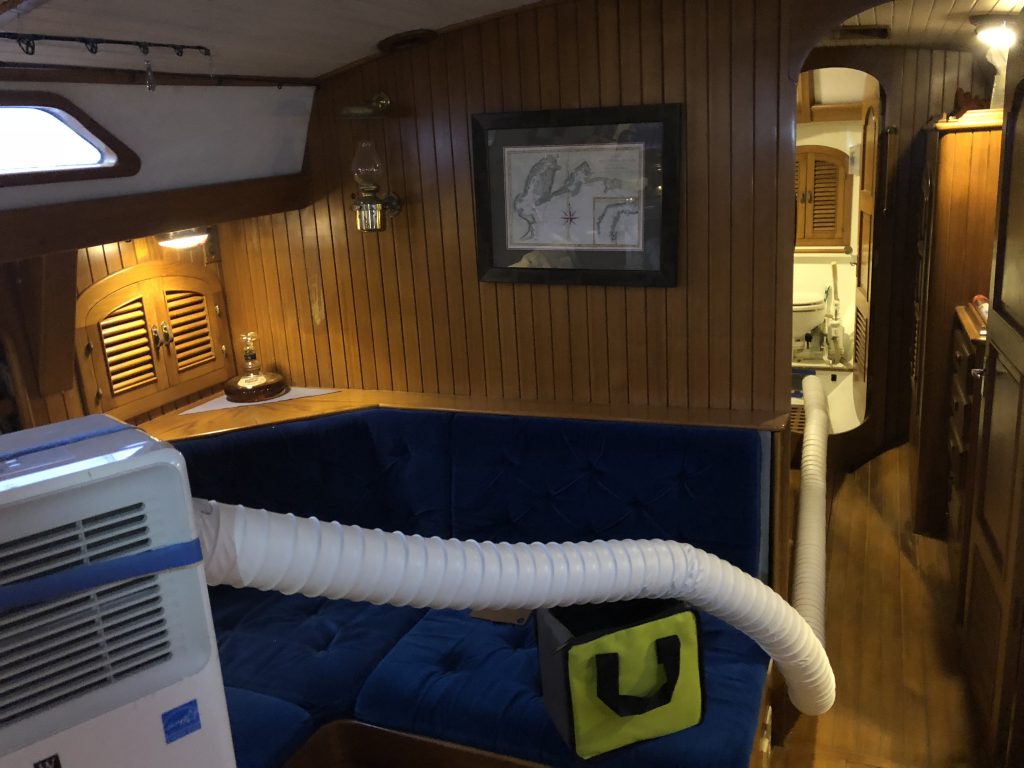
As the air in a boat’s cabin warms on a sunny day, available water begins to evaporate, raising the absolute humidity while the RH goes down. As evaporation slows in the cool night air, absolute humidity remains stable, but the cooling air’s ability to hold vapor falls, so the RH rises. If the RH reaches the 100 percent point, any further cooling of the air results in condensation. As normal circulation brings air in contact with the cooler surfaces of portlights, deck hatches, and the inside of the hull, the moisture condenses onto them. This condensation promotes mildew, rot, and corrosion — it’s what we seek to avoid.
The role of the dehumidifier
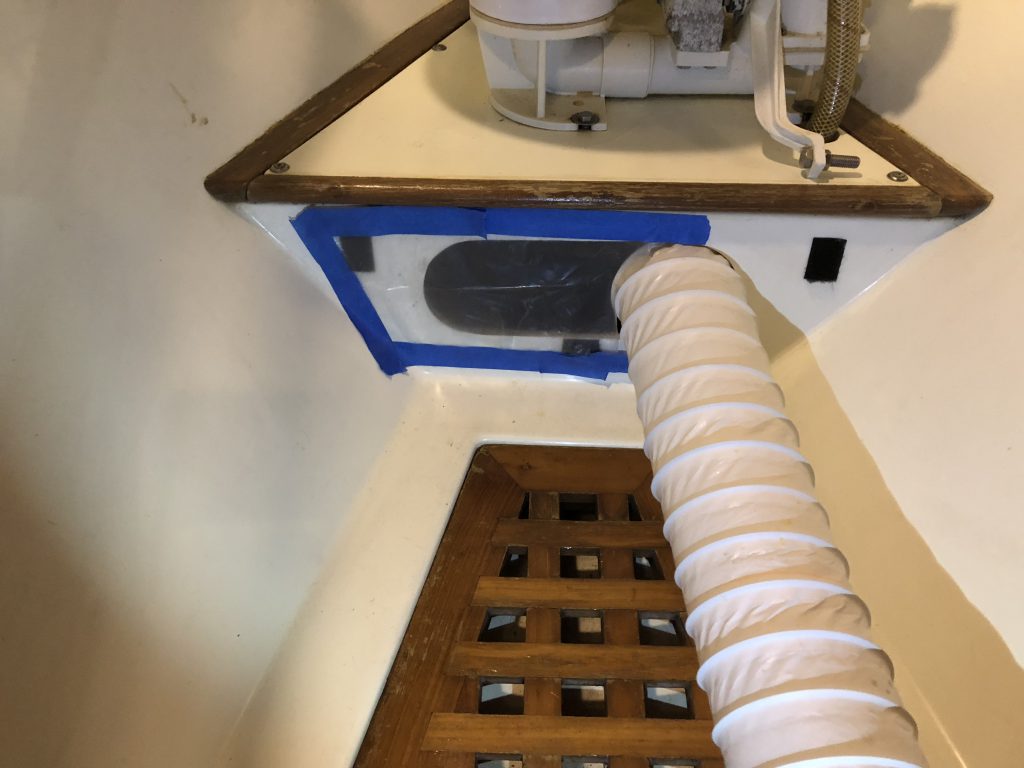
On the warm, sunny day, newly evaporated water raises the absolute humidity in the cabin. Air drawn over the dehumidifier’s cold coil cools until its water vapor drops below the dew point. This vapor must condense. The crucial factor here is for the coil temperature to be cool enough for condensation yet not so cold that it frosts up. When the coil temperature at, say, 37°F equals the entering air temperature, no condensation occurs. The dehumidifier and the air can be said to be in equilibrium.
The dehumidified cabin
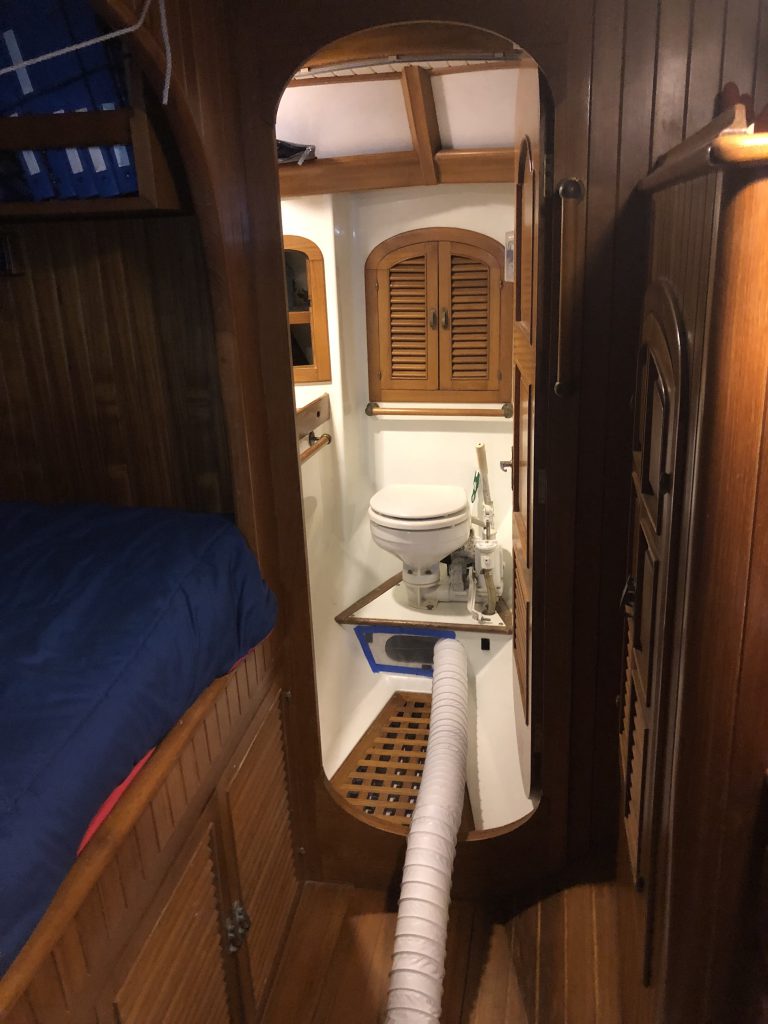
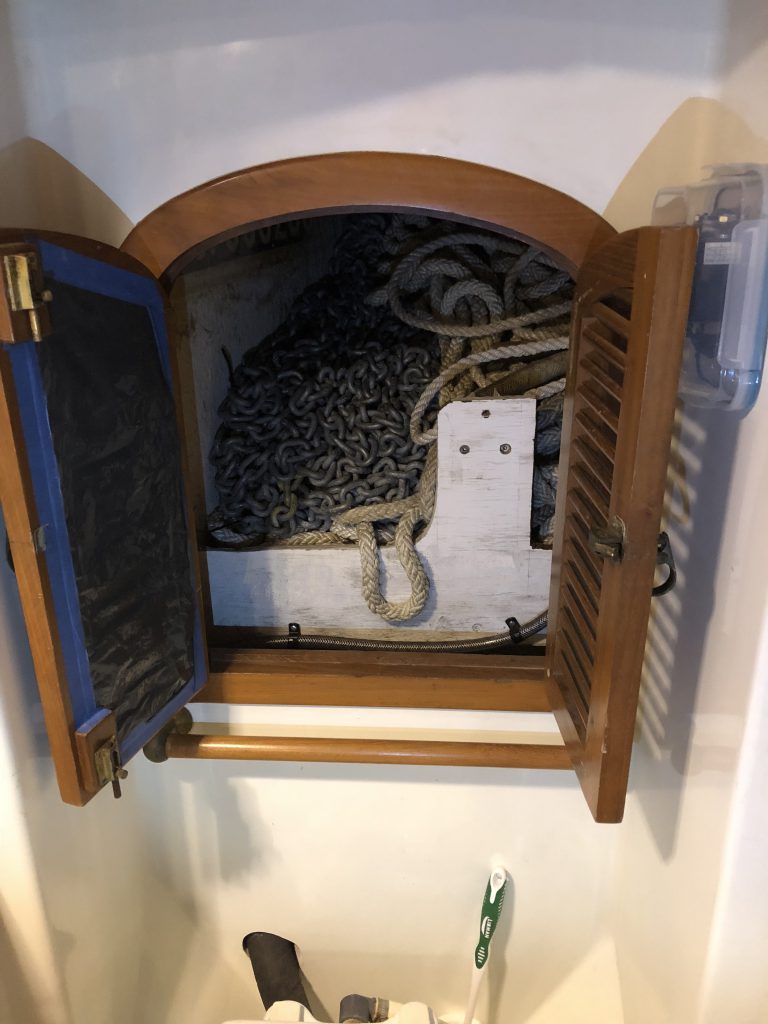
In my boat, small amounts of moisture are forever invading the cabin: there is atmospheric moisture on a rainy day and liquid water in the bilge and from leaks via the deck, portlights, or hatches. On a warmer day, absolute humidity in the cabin rises due to evaporation of the invasive water, but, because the air is warmer, it is no longer in equilibrium with the dehumidifier and new moisture is removed as fast as it is added. As the air cools at night, circulated vapor in the air does not condense on the portlights or on the hull in the chain locker. It is therefore unimportant that dehumidification ceases on a cool night; the air is kept dry in absolute terms, so vapor seldom condenses on the cold surfaces of the boat.
Demystifying the dehumidifier
The dehumidifier’s refrigeration cycle creates a cold coil and a warm coil. It draws the same air over both coils, first dehumidifying, then reheating it. Since efficiency is not perfect, the air actually leaves slightly warmed.
The dehumidifier’s internal controls read two factors: relative humidity in the air and head pressure in the refrigeration tubing. If the RH is higher than the RH setpoint, the refrigeration compressor starts. But if it is too cold, the head pressure will be too low and the compressor will shut off to protect itself from damage (refrigeration slugging). That temperature is probably about 35° to 40°F. A sophisticated dehumidifier would have a very cold coil and a defrost cycle. Then the air could be dried to a sub-cooled dew point, say, 0°F, without frosting the coil.
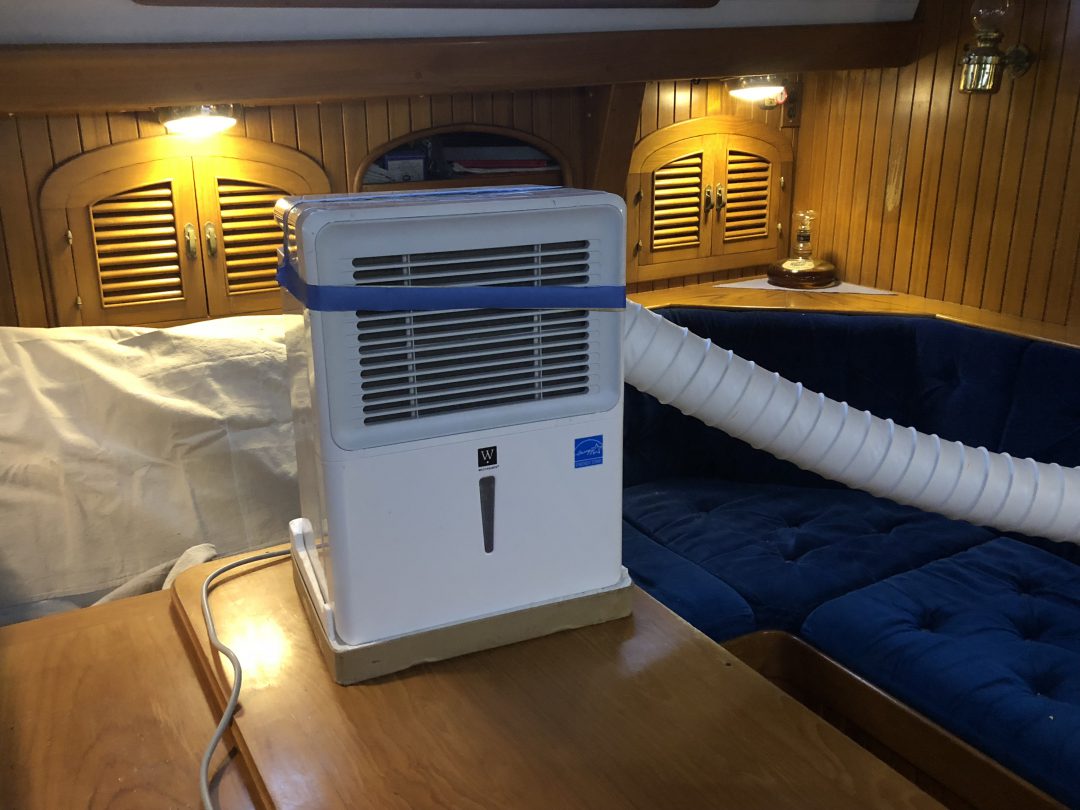
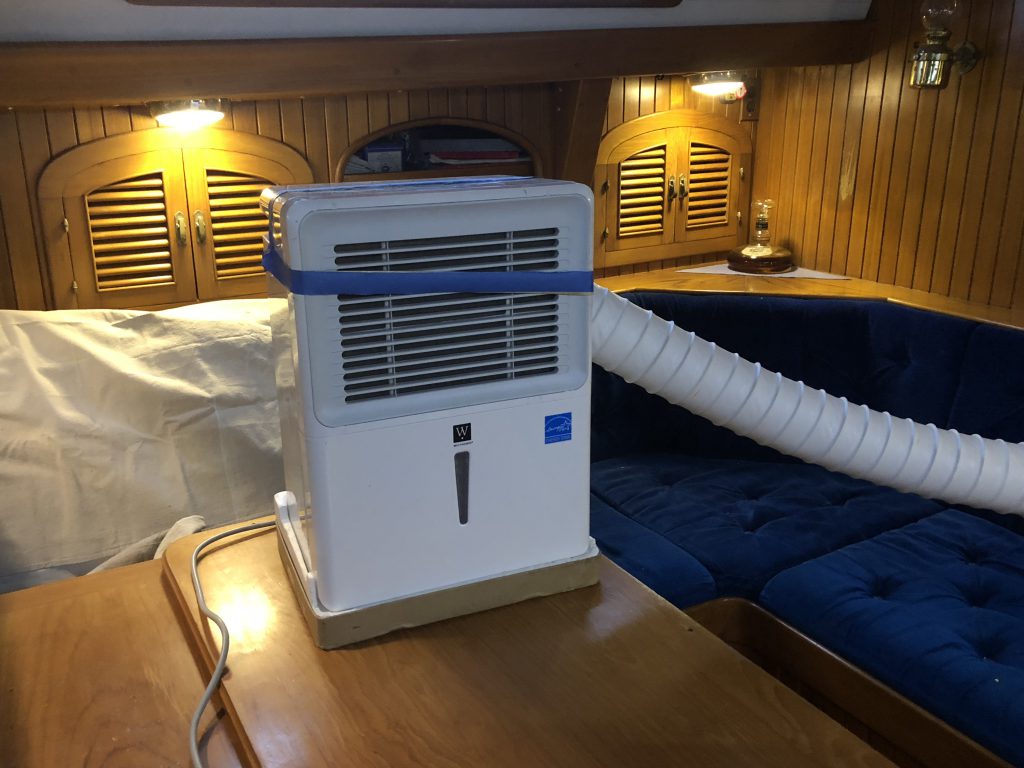
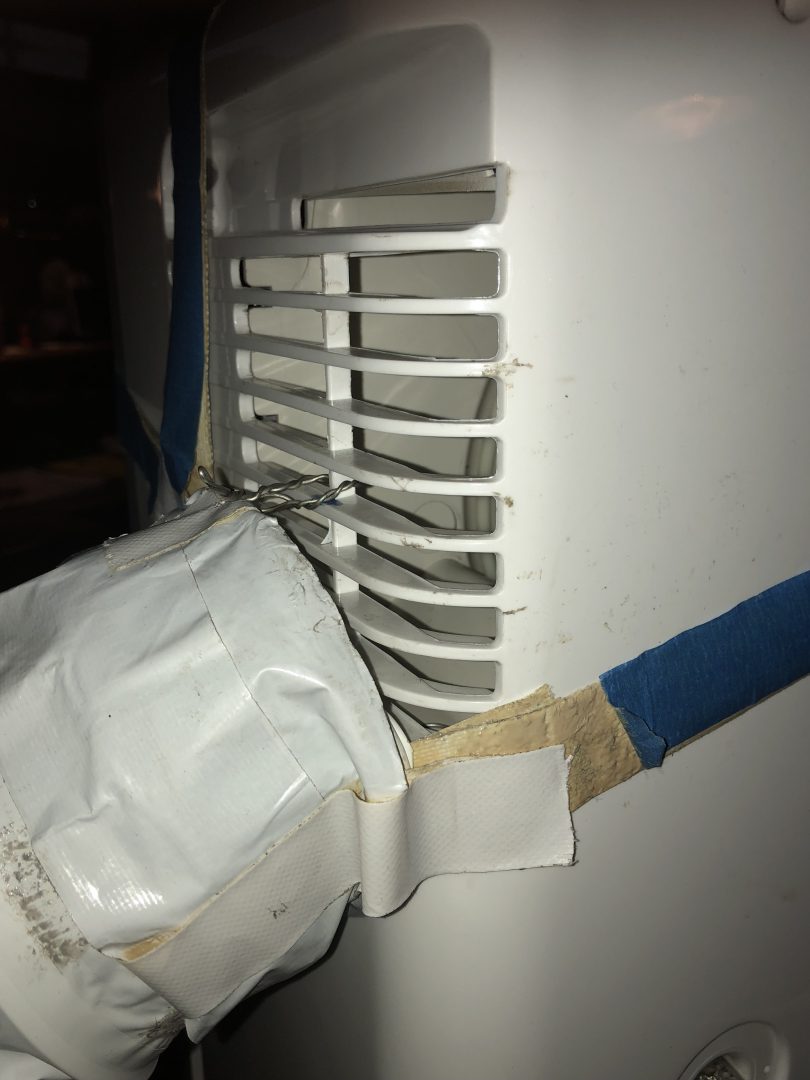
Different brands of dehumidifiers differ on the head-pressure shutoff point, but given that the cool air has only a small amount of moisture to begin with, the temperature range probably makes little difference. Warming its entering air will enhance the dehumidifier’s performance slightly. That could be done by heating the cabin where it’s located and ducting the dried air throughout the boat. I do this with an air duct to my chain locker.
When the dehumidifier fan is set to “continuous,” air is circulating 24/7, while the refrigeration compressor starts and stops on its internal controls. Setting the humidistat is a matter of personal preference. In my colder climate, condensation on the hull sides and portlights can be troublesome, so I set it to “maximum.” Thus, whenever the temperature warms enough to let the dehumidifier compressor run, I remove as much moisture as possible. In cases where interior condensation is not an issue, 50 percent RH might be adequate. At a utility rate of about $0.10/kWh, my dehumidifier costs about $20 per month to run in winter, and slightly higher in spring and fall when it is warmer.
Small refrigerated dehumidifiers are available from most hardware and appliance stores for less than $200. They are rated in pints of water removed per day or as suitable for a room of so many square feet. Neither rating is particularly enlightening, as they are developed under laboratory conditions, and the square-foot rating would be for a house. The smallest dehumidifier available is sufficient for my Passport 40.
Dynamic humidity
I have watched the RH in my cabin double just by my taking a shower or boiling a pot on the stove. This illustrates that moisture content is very dynamic, and I believe it is worth it to run the dehumidifier continuously to clip the humidity spikes that occur on warm afternoons. There is a heating benefit too. All the energy that goes into the machine eventually becomes heat. Therefore, when the compressor is running it releases about 350 watts of heat into the air. When only the fan is running, it releases about 50 watts, so it’s essentially a small heater. In Ketchikan, I seldom need additional heat to keep the cabin above 40°F, although I do have a space heater set at 40°F just for security.

Coping with condensate
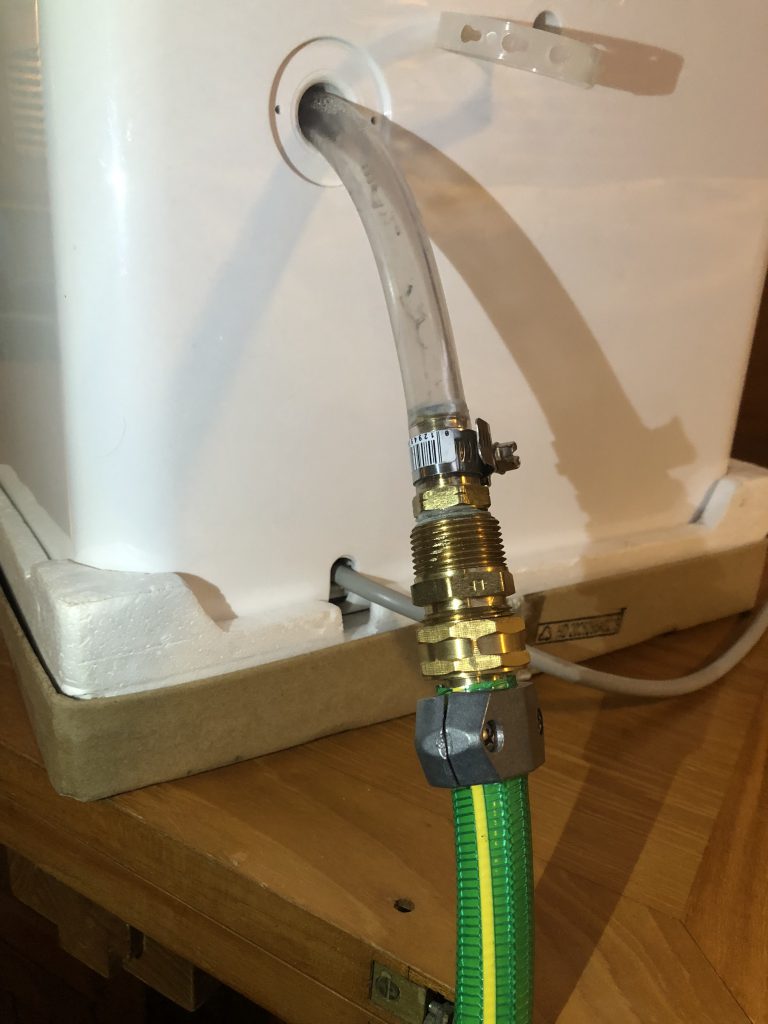
The byproduct of a dehumidifier is water condensate (this is clean distilled water). The dripping water may be collected in the integral bucket and emptied manually or allowed to funnel into a hose to drain continuously to a convenient location. Condensate disposal solutions include draining to the bilge for pump-out and draining to a sink with a discharge above the waterline. I would not recommend keeping a seacock below the waterline open just for draining a dehumidifier.
During our non-boating season, approximately from October to April, I run my dehumidifier continuously. In other seasons, I run the dehumidifier, as convenience allows, whenever I’m not on board. Using the dehumidifier actively dries my anchor rode between uses. I enjoy the fresh air that greets me on my return to the boat, instead of that “funky boat smell” it used to have.
Operating a dehumidifier in a boat’s cabin will reduce corrosion, rot, and odors associated with moisture. It can be effective in most climates, provided the cabin temperature is above 40°F at least part of the day.
Humidity Control in the Tropics
In the tropics, and in other hot and humid regions, it seems that keeping a boat well ventilated is the best way to minimize the problems of mold and corrosion. In such a climate, a boat wouldn’t have cold interior surfaces for water to condense on, so the dynamic humidity cycle (condense/evaporate/condense . . .) wouldn’t occur.
A dehumidifier would work throughout the day and night to keep the cabin at, say, 50 percent RH, a level that does not generally support mold and mildew growth. However, the constant onslaught of ambient air infiltrating through any opening, such as ports, vents, and door gaps, could raise the operating cost. The dehumidifier’s fan would aid in the circulation via ducting, as I demonstrated on my boat in its northern climate.
I am not a microbiologist so I can’t say what air circulation does to spoor planting and growth. However, I imagine that if circulation were closed off, errant moisture would accumulate in the cabin, humidity would rise to nearly 100 percent, and spoors could find adequate growing conditions. Then, once one spoor matured, an explosion of spoors would overwhelm the small, closed cabin.
Walter Heins was a mechanical engineer in the heating, ventilation, and cooling (HVAC) industry for more than 30 years. His infatuation with sailing began at Boy Scout camp on Lake Pepin, Minnesota, and was furthered when he crewed a 41-foot Coronado from Hawaii to San Diego about five years later. After a 30-year break for kids and career, he bought his first boat, a Lapworth 36. In 2009, he upgraded to Golden Eagle, the Passport 40 he now keeps and sails in Southeast Alaska.
Thank you to Sailrite Enterprises, Inc., for providing free access to back issues of Good Old Boat through intellectual property rights. Sailrite.com