Tom Thomas finds art in sailboats. Good Old Boat subscribers can win a handbuilt model of their boat.
Issue 5 : Mar/Apr 1999
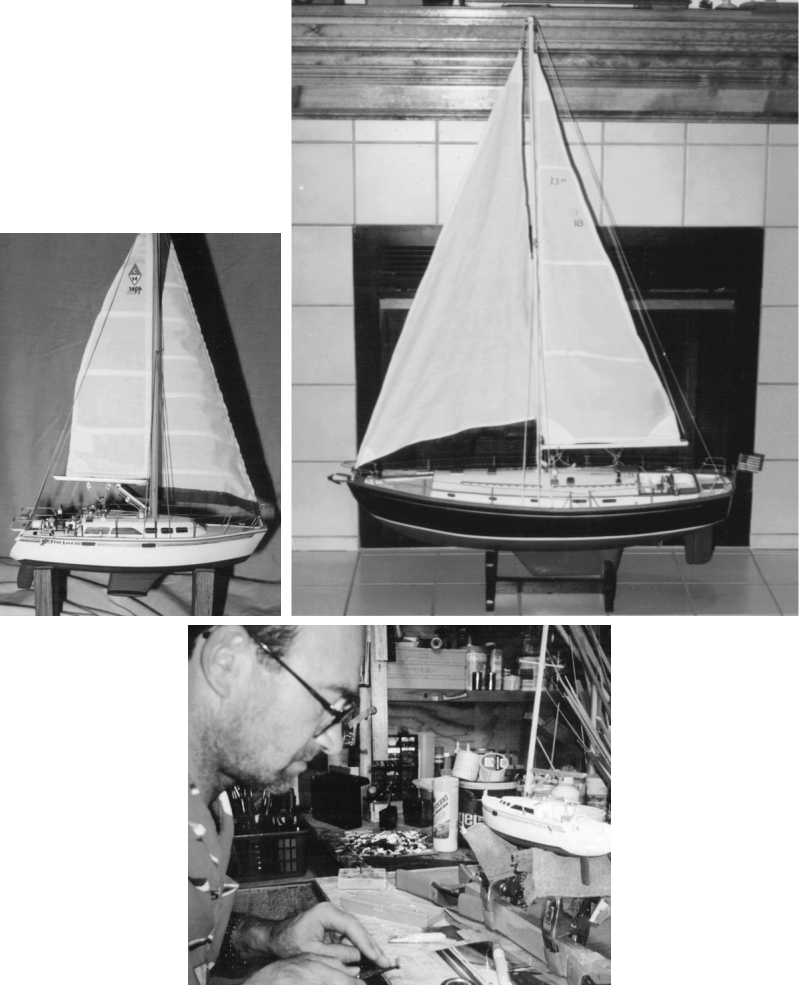
Tom Thomas is not a sailor — not yet — a fact that can be easily forgiven once you’ve met him. As an artist, he recognizes the beauty in sailboats, and his enthusiasm is so contagious you want to take him sailing. He’s been promised rides by sailors all over the country. Once he’s cashed in all those IOUs, it’s a sure bet Tom will be scheming to buy his own sailboat. For now, he builds models of sailboats. One of these hand-crafted works of art will go to the winner of Good Old Boat’s subscriber drawing to be held in mid-June.
While his artistic training is quite extensive, Tom’s talents have turned toward model building in recent years. Of these, “I especially like the sailboats,” he says, “They’re designed and built more in cooperation with the water and the forces of nature than a powerboat. The earlier sailing yachts were works of art in themselves. Men sailed for thousands of years before motors were even invented. So sailboats are a link to a very interesting part of history. Sailing is a cooperation of man, wind, water, and sail in combinations that are sometimes tipped in favor of the man and sometimes in favor of the water and the wind. The thing that brings them together, though, is the boat itself.”
To understand what moves a man who understands sailing so well without having been on the water is to paint “a portrait of the artist as a young man.” Tom was the kid next door who gathered up empty fruit crates from the corner market, dragged them home, and used the lumber and nails to create pirate ships, airplanes, and go-karts. He made balsa wood models of planes depicted in flying magazines. He took oil painting and watercolor lessons and went on to earn a degree in art.
“At the time, I hadn’t really focused on art as a way of making a living but used it primarily for my own personal enjoyment. That’s how I expressed myself when I was troubled or feeling good, or when I just needed to do something for myself,” he says.
Tom worked for the Missouri Pacific Railroad during the summers between college terms, and the railroad was quick to hire him full time after he finished college. Art became a hobby . . . one that didn’t surface often until he hit a stressful period in his life when a job transfer caused a family relocation. As Tom recalls, “I hadn’t been doing any artwork for some time, and then all of a sudden, I couldn’t do enough of it. When my wife, Lori, asked me to make her a birdhouse, that was the stimulus that inspired the model making. Of course, if you are going to do anything, you might as well go overboard, so I built a two-story colonial birdhouse. It was pretty rough, but I saw a lot of possibility. Next I built a two-story Victorian with a wrap-around porch, lap siding, the works. I made the windows from miniature lumber and hand-chipped the cedar shakes. Needless to say, it turned out a little better than the first one.”
Tom’s neighbor liked the concept and hired him to build a model of his home for his wife for Christmas. Tom realized that he might unintentionally be creating a small business. “A person’s home, grandmother’s house, barn, or church is a very personal place which invokes personal memories,” Tom says. “I enjoy being able to capture those memories in a three-dimensional art form. Rather than creating a work and hoping that someone could relate to it, I was utilizing the input of the client and creating very personalized works which could be passed down through the family as treasures. The fact that they are marketable as a very unique art form is important, but secondary to the building process. I would build them whether I was selling them or not.”
Creating models of buildings led to an interest in developing models of boats. “I’ve always been interested in boats of all kinds. My first model was rough, but I thought I had the right idea. I just needed more information. I started going to the library and reading everything I could find on boat design, boat history, early designs, and so on. I then started selecting pictures of boats out of the books and replicating them as models. It was basically the same process as building the architectural models — as far as reproducing curves in a three-dimensional model goes — only with more curves.”
Meanwhile, Tom’s hobby was becoming a nifty little part-time business. One thing seemed to lead to another. A model of a Victorian home for one client drew the attention of Victoria Magazine in New York City. The feature editor asked Tom if they could photograph the model for their Christmas issue. Not too long after that the Kansas City Star magazine featured Tom, and the article which resulted drew the attention of Martha Trammell.
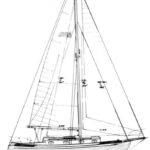
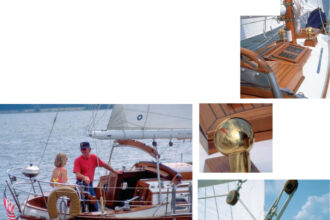
Martha and Lee Trammell had been sailing through life together for 25 years when she chose to celebrate their anniversary by surprising her husband with a model of their Dickerson 37, Calypso. More than 20 years ago friends of theirs moved to the Chesapeake and invited them to go sailing. Martha says, “It was love at first sail for both of us.” They raised two sons while moving through a fleet of sailboats beginning with a Renken 18, and moving to a Cal 24 and Beneteau 285 before arriving at the Dickerson 37.
The article in the Kansas City Star appeared about the time she decided she was interested in having a model built for the upcoming anniversary. “As soon as I read the article, I contacted Tom,” Martha says. “The Dickerson 37 is a lovely boat and is featured in the World’s Greatest Sailboats book. We spend many enjoyable hours sailing ours and when we are not on the boat, we have the model to remind us of when we are!” The 1-inch per foot scale model is on display in the family room, where Martha says, “we seem to spend a great deal of time.”
A hand-crafted sailboat requires hours of detail work, so the price of one of these models gives one pause. Martha said, however, that she didn’t experience an instant of hesitation about the project once she’d met Tom and seen his work. Since this was his first sailboat commission, Tom says, “I was a little intimidated by the project at first, but once I got started I enjoyed it immensely.”
Martha adds, “Tom is quite humble about his work. I have an art background, and I can say with confidence that he is very talented.”
Like Martha, Jeanine Jackson surprised her husband, Roland, with a model of True Love, their Catalina 34. Because the boat was commissioned just after their honeymoon, they thought the name was appropriate. The 1/3-inch per foot scale model of True Love is proudly displayed in Roland’s office. When asked whether she thinks of the model as a family heirloom, Jeanine says without hesitation, “Absolutely. That is, if my husband will ever part with it!”
One more happy boater with a model in his office is Jack Okerstrom, an orthodontist who was surprised by his staff last year with a 1/2-inch per foot scale model of his Gulf Star 36 Trawler, Das Boot, as a combination Christmas and 50th birthday present. His office manager, Patty Alley, says the staff members gathered their dollars together and ordered the model after visiting Tom’s website but without seeing his work. They had a few doubts during the ensuing weeks while waiting for delivery. But the boat’s arrival was very exciting for the staff and recipient. “It turned out to be wonderful,” Patty says. “It’s on Dr. Okerstrom’s desk and serves as a great conversation piece. Patients get to know a bit more about him this way.”
Those who have had models built are excited by the Good Old Boat subscriber contest which will place a model on a shelf, desk, or table of one lucky good old boater. As Jeanine says, “I couldn’t imagine a greater award!”
Tom’s philosophy is, as he says, “to create something that is very special for the owner. I build my models entirely by hand. In today’s modern world, there are too many mass-produced items available. I want to build something that will last. As our lives become more and more technical, and machinery and electronics become more prevalent in our society, I think it is important to stay in touch with our past and our history. When you look at what a person like Nathaniel Herreshoff had to work with when he was designing and building boats, you have to realize that there is a certain amount of beauty and consistency in the simpler way of doing things. My goal is to capture that in my models.”
The recipients of these special works of art often invite Tom to come along on a boat ride. Before long we sailors will have made him one of us. It’s just a matter of time. Perhaps the real winner will be the lucky sailor who is able to introduce Tom to the passion we call sailing.
In Tom’s own words . . .
Having read all of the Horatio Hornblower books as a kid, while I’m working on a model I can imagine the hull slicing through the water, the spray kicking up in my face, and the creak and groan of taut lines as nature struggles to equalize the forces driving the boat. I was building a model of a three-masted schooner late one night. It was in the spring, and the fog outside was very thick. My son and I went out on the patio and were talking about the fog. We played a game in which we tried to imagine that we were on the wharf at Portsmouth in the year 1810. We tried to imagine all the sounds we could hear through the fog . . . the rattle of carriage wheels on cobblestones and the clatter of horses’ hooves . . . the massive hulks of the anchored men-of-war sloshing in the tide . . . the creaks and clanks of ropes and tackle as they rocked gently back and forth in the current . . . the muted voices of the sailors in the guard boats and the creak of oars as they pulled around the giant ships . . . the sounds of the lighters and their crews as they loaded the supplies for extended voyages into the dark holds of the anchored ships . . .
Those are the types of things I think about when I’m working on a boat model. By looking at a picture and then having it come out the ends of my fingers as a fully detailed boat model, I think I impart some of my personality and feeling into it and, by the same token, absorb some of the boat’s spirit in return. I consider each boat model as much a work of art as a painting or sculpture because of the feeling I personally put into it and get out of it.
Thank you to Sailrite Enterprises, Inc., for providing free access to back issues of Good Old Boat through intellectual property rights. Sailrite.com