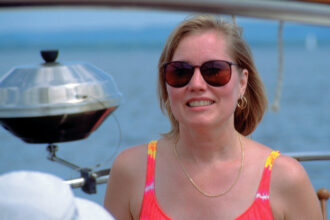
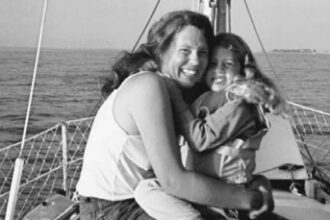
Ken and Cathy McIntire had more conservative plans for the future until their Baba 30, Kahlua, came into their lives. Now liveaboard cruising has risen to the top of the list
Issue 5 : Mar/Apr 1999
Ken and Cathy McIntire didn’t make a plan and follow it. On the contrary, they seem to be following a plan that has been pre-scripted. Once they were on their way, they recognized the plan and adopted it as their own.
Now that it has been revealed to them, the McIntires’ grand scheme is to retire early, sell the house, move aboard a seakindly vessel, and follow the seasons along the Atlantic Seaboard. Even though they took all the right steps to make this possible, they didn’t start out with these intentions. Early retirement seemed like an impossible dream for Ken, a college professor who has been teaching psychology as long as he can remember to wave upon wave of students as they descend upon the University of Wisconsin – Eau Claire.
Like retirement, the boat of their dreams seemed desirable, but out of reach. Ken and Cathy believed they were bound for many more years of weekend and vacation sailing. The purchase of their Baba 30, which they have named Kahlua, was the beginning of a new way of thinking. In an article he wrote for Baba Salt, the newsletter for the owners of Babas and their close relatives, Ken says:
It really began about the middle of November, after our previous boat had been lovingly covered, hugged, and put to sleep for the winter. It is the time of year when I’m getting over the depression of the end of the previous sailing season, but not yet heartened by thoughts of the beginning of the next one. One evening, as casually as one might expect with a discussion of the day’s events, Cathy said something to the effect of “. . . Honey, why don’t we get a new boat?”
We have done most of our sailing on a body of water called Lake Pepin, which is really just a long wide spot in the Mississippi River. Our ambitions, however, are greater, and we had talked seriously about “doing the Great Lakes” when the last of the kids is off to college in about four years. As we are both planning on having time available during summer months for cruising for the foreseeable future, this seemed reasonable. We hadn’t given a whole lot of thought or discussion to either the details of the plan or what boat we might use to carry out the plan. Our existing boat was inadequate if for no other reason than the fact that I developed severe back and neck aches after a weekend aboard. With several children to educate, my thinking about a new boat had been, admittedly, conservative. My guess is that it would take another married man to understand the power, the bliss, the ecstasy of those few words “. . . Honey, why don’t we . . .” Clearly, I am blessed with a wife who likes sailing as much as I do.
Even as he wrote those words in 1995 with a Baba of his own sitting at a dock on nearby Lake Pepin, Ken had no idea yet what plan was in store for him. In fact, he was still recovering from the shock of buying a boat he considered to be beyond their means. But there it was, and in his musings, Ken is eloquent:
This is a tale of destiny and dreams set against a background of snow and improbability. Why would anyone want to purchase a lovely sailing vessel intended for offshore cruising and have it trucked halfway across the continent to the lands of snow and ice where the sailing season is shorter than the snowmobiling season?
My earliest recollection of anything related to the state of Wisconsin (other than the fact that my fourth-grade teacher, Mrs. Crumb, was from Wisconsin and knew a lot about dairy cows and cheese) was watching a football game on television between the Packers and Vikings, a very, very long time ago, in the comfort of my sunny, coddled Southern California teenage existence. The image on the screen showed snow falling heavily on the football stadium of a distant and mysterious land; I can remember feeling pity for the players because it was obviously a very unpleasant place.
I clearly recall the television camera slowly panning across the stadium crowd. The natives of this unfamiliar place were a race totally alien to me. In a bizarre scene, the fans were huddled in the stands wearing what I later came to recognize as snowmobile suits, heavy winter hats, and full-face snowmobiling masks. Some of them had what appeared to be large wedges of cheese on their heads. Yet, despite these handicaps, they appeared to be laughing, cheering, and generally having a jovial time drinking beer and other “anti-freeze-treated” beverages. I deduced, cleverly, the necessity of antifreeze in the drinks since the temperature in the stadium was well below the freezing point of plain water. They seemed to be an amazing race of hearty and fun-loving, if not-too-bright, people. I could not understand how anyone could or would live in such an uncomfortable place.
Fast forward about half a lifetime. I’m driving across frozen rural highways in west-central Wisconsin in mid-winter, coming from my home of over 20 years in Eau Claire, (yes) Wisconsin. I’m going to Wabasha, Minn., a small town on the Mississippi River, about an hour away. For those who have seen the movie Grumpy Old Men, yes, Dorothy, there is a Wabasha (and a Slippery’s Bar). As a point of reference before anyone gets a map, Eau Claire is about 1.5 hours east of Minneapolis, Minn., and Wabasha is about 1.5 hours southeast of Minneapolis. Minneapolis is west of the Hudson and east of the Colorado rivers.
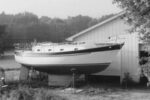
I’m driving on a cold, clear morning through the great white north to meet the planned arrival of our recently purchased, but as yet unseen, Baba 30. Hajji Baba (as it was called at the time of purchase) is being trucked from its previous home on the Chesapeake Bay to a new home on the northern tundra.
So if you are sitting in North Carolina or southern California trying to imagine this scene, don’t bother. It’s beyond your experiences, and it must forever remain in the little compartment in your mind next to “Salvador Dali paintings.” Unseen Baba, cold and snow, grumpy old men, Mississippi River, ice fishing — they just don’t connect in any rational way.
But Ken was just learning the power of a dynamic woman, and Cathy is such a woman. The couple met and married later in life. Ken had been the sailor, starting in his 20s on an 11-foot lateen-rigged Styrofoam boat purchased from J.C. Penney. Just as he was ready for the next step, it presented itself. A friend invited him to crew in a Hobie 16 race. This gave him the thrill of hanging out on a trapeze and the adrenaline rush of racing. Hooked, he bought his own Hobie and started a 10-year racing adventure until his first marriage disintegrated. During his single years, a regular racing crewmember for a two-person boat was hard to find. He sold the boat.
The next year he and Cathy were reacquainted. She is a school psychologist and had been a student in one of his classes many years before. Like Ken, she was newly single. Cathy regrets not having a chance to crew on that Hobie, but if she had done so, the fates might not have been able to move ahead with their liveaboard plan for the McIntires. Cathy might still be happily hanging on the Hobie’s trapeze and winning races with Ken. She has an adventuresome spirit, and Hobie racing might have been perfect for her.
Cathy’s first sailing experience says much about the kind of sailor she would become. They went out with a friend in a Columbia 7.6. Cathy took the helm, not timidly but with a will, and spent the day with an iron hold on the tiller and her eye on the knotmeter seeing how fast she could make the boat go. Heeling did not frighten this first-time sailor, it thrilled her. One of the first things the newly forming couple did together, therefore, was to buy that Columbia 7.6. At 25 feet, it was meant to accommodate kids from both families on a score of grand sailing adventures. This it did. Unfortunately, it didn’t accommodate Ken’s 6-foot 2-inch frame very well and several of the kids grew to that size and beyond as well. The constant stooping was hard on Ken’s back, and as the kids grew into their own weekend activities, Ken and Cathy considered the 33-foot Columbia 9.6 as a spacious alternative. They had sailed on a friend’s Baba and loved it, but that boat was not in their price range. Ken writes:
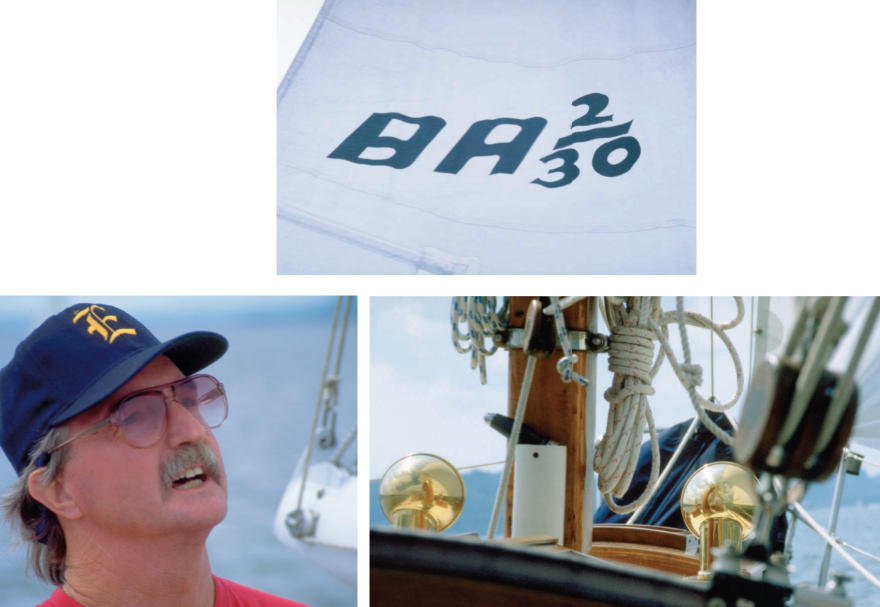
At the time the decision was made to begin looking for a new boat, we both knew we wanted a Baba even though we hadn’t discussed it and hadn’t even begun looking. That unspoken decision had been made about six years earlier, when we first stepped aboard China Girl, a lovely Baba 30 relocated from Seattle to Lake Pepin by our friend, Paul Molinari (he recently sold her and moved up to a pristine Baba 35, Élan Sea).
Our decision to look for a Baba wasn’t consciously made (we like to kid ourselves and think we are in control) until after we had done a lot of comparison shopping. Somehow “comparison shopping,” in the true K-Mart sense, seems appropriate to describe some of what we did at the time. As we sometimes together, sometimes alone, continued our search, we had come to the still unspoken — but mutual — conclusion that we wouldn’t be happy with anything but a Baba. Well . . . maybe a Cabo Rico in another life, but this time around our karma is a Baba.
Once our emotions convinced our intellects of the proper course of action and the intellects grudgingly admitted it to consciousness, Cathy and I began talking realistically and started looking seriously. After a few fits and false starts, working with brokers, some lackluster negotiations with not very encouraging results, we were beginning to get a little worried about the possibility that we might not find the “right for us” boat this year. One morning about 2 a.m., my wife (who was now a relentless, unstoppable boat-buying machine) was having difficulty sleeping so she left our bed, went to the guest room, and started reading the ads in the backs of sailing magazines, looking for a sign, any sign, that there was still hope and reason to be optimistic. What was initially a half-hearted attempt to get back to sleep turned into a relentless, driven quest — a quest for a sign that life is meaningful. And meaning, after all, is The Right Boat. And behold, the sign appeared as in a vision — in tiny print, very tiny print — and the sign was located on the Chesapeake. Cathy had found what appeared to be an available Baba we had missed and which was not yet in the multiple listings. Could fate be playing with us or was this truly our destiny?
The next morning at 7 a.m. (our time), after a night of half sleep, Cathy called John Nelson, the listing broker, to get the particulars. She then came in and woke me to tell me about the quest of the previous night and her vision. I had read about visions and even seen people purportedly having visions on television. But I never realized how wonderful it could be to be married to someone whose early morning, sleep-deprived vision would prove to be prophetic.
As part of an estate settlement, the 1982 Hajji Baba, former love of Sam Ornstein, was reluctantly being sold by the family. Pictures were sent (love at first sight; we love spruce and teak) and an equipment list and recent survey soon followed. A contingent offer was made and accepted and, two weeks after the pictures were received, the deal was closed thanks to the fax machine at Kinko’s, overnight mail services, some very efficient people, and destiny. Before Christmas, 1994 we took possession, albeit long distance possession, of the new partner in our relationship.
During that hectic two-week period, assets were liquidated, a bank loan approved, re-documentation initiated, a new survey completed, and trucking arrangements negotiated. There were no major delays, problems, or annoyances in the process. We both experienced a little anxiety because we hadn’t gone through this process before (and we weren’t quite sure what we were going to do with two boats), but we never had a major concern that things wouldn’t work out. After all, this love was in our stars, and there was no way to deny it.
Thus, in early January 1995, I found myself driving through the loneliness of rural Wisconsin up and over the frozen Mississippi River into Minnesota, down from the bridge overlooking Slippery’s Bar and the fishing shanties and into the marina at Wabasha where Hajji Baba was waiting. So ends this story and begins another one.
The McIntires were so committed to finding a Baba, they bought Kahlua without seeing and sailing her in person. Ken writes about a few lessons learned in this process:
During this adventure we learned several things that we wish we had known before we started and made several mistakes we won’t make again. First, since we knew what we wanted and were generally familiar with Babas and since it was difficult for us to get away at that time of year, we had the surveyor make a thorough video of the boat, in and out of the water. It was an extra expense, but one we feel was worthwhile.
Originally the video was not going to replace a personal visit and sea trial. After considering everything, we decided, on the basis of the video, that a visit would be redundant. We found, when Hajji Baba arrived, that we had a pretty accurate picture of our new boat and that there were no major surprises. Clearly we were going to rely heavily on the surveyor, so it was important for us to do some homework before selecting one. Even though a surveyor is working for you, he or she may have an established working relationship with dealers in the area, which may not always work in your best interests.
Second, since our boat was in one part of the country and we were in another part, we needed someone to prepare the boat for shipment. The person preparing the boat is responsible for supervising the boatyard activities and doing the detail packing of equipment related to the purchase. This person may or may not be a boatyard employee, and the services can be very expensive. In our case I calculated that Cathy and I could have gone to North Carolina, stayed in a nice motel, supervised unstepping the mast and the boat transfer in the yard, packed the boat, etc., and still had a nice two-week vacation for what it cost us to have these simple jobs done for us. We were led to believe the process was complicated and for trained professionals only — “don’t try this at home, kids.” Nonsense. In Wisconsin and many northern areas we put our boats in and out of the water every year, working with the marina operators to do it. It isn’t any different on the Chesapeake.
Third, we learned about trucking companies. There are a lot of them and they vary in quality, efficiency, and price. We did a lot of calling before deciding on Boat Transport located in South Carolina. We found them to be pleasant, efficient, and competitively priced. At one extreme there are big, pricey companies with secretaries and official cost estimators with computer programs to do estimates that can be mailed to you. At the other end of the spectrum are mom-and-pop operations where some kid answers the phone. Estimates varied by about 30 percent, and some companies wouldn’t commit to their estimates. Some companies specialize in powerboats and when you ask about their equipment, they tell you about some Rube Goldberg contraption they can rig to haul your sailboat — thanks, I’ll get back to you. As with most things, you have to shop around to find the company that best suits your purposes.
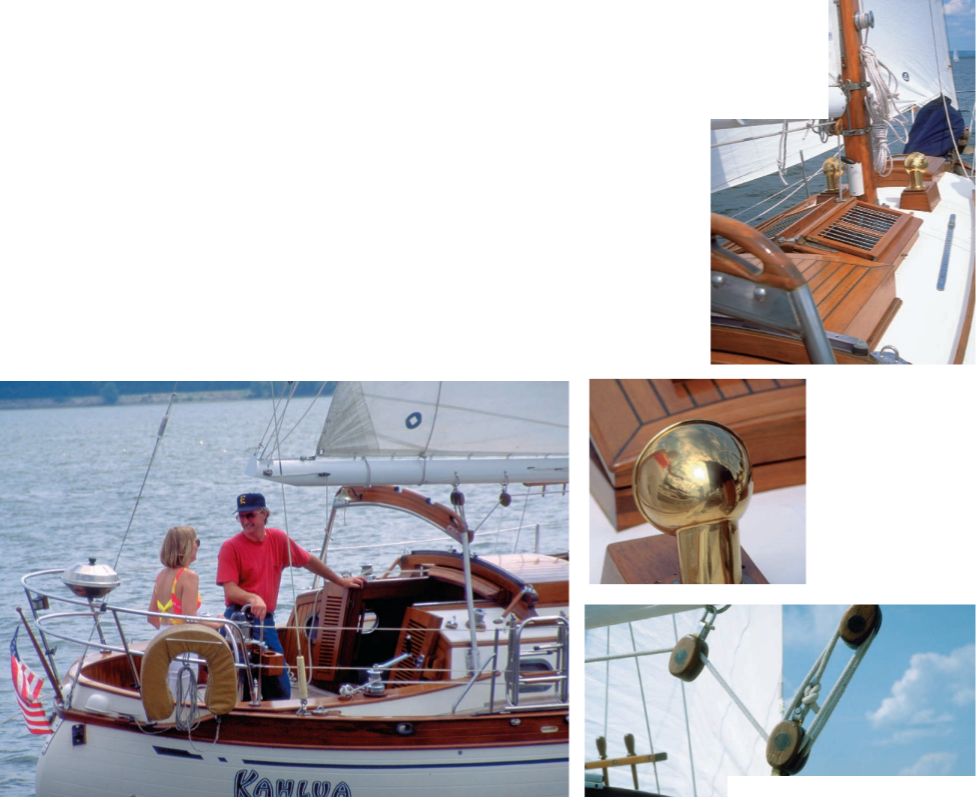
There were few surprises in spite of buying a boat in an unusual way. Kahlua (the boat’s new name) was in need of more cosmetic work than either Ken or Cathy had expected: her floor was hidden behind a grimy accumulation resulting from years of neglect by a bachelor sailor, and all her bronze had turned green with time. Inside and out the teak, too, was in need of attention.
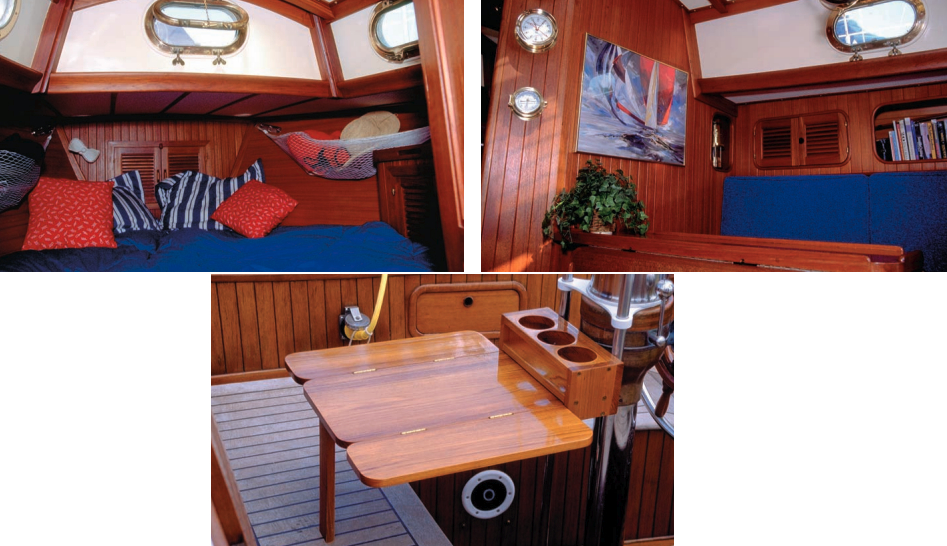
But Ken and Cathy had acquired the boat of their dreams, and they had immeasurable amounts of enthusiasm and elbow grease fueled by a growing love for their new boat. For a while the cabin floorboards adorned their dining room table at home, and the wood blocks hung drying from knobs on kitchen cabinets. Ken’s home workshop produced a cockpit table which fits its surroundings so well it can be mistaken for original equipment. Cathy sought a meticulous upholsterer to recover the cushions. They also applied a barrier coat and bottom paint. Acres of teak were lovingly sanded, rubbed, and coated with Cetol. Inside and outside the bronze was brought back to better-than-new status. And interior wood received oil sanding with Daly’s Seafin Teakoil, faithfully applied according to instructions in Rebecca Whittman’s book, Brightwork. Cathy may have gone a bit overboard here using sandpaper which progressed from 320 to 600, according to the book’s instructions, and then beyond to 1000 grit. “It rewards you,” Cathy says feeling the velvet smoothness of the bulkhead. She glows like the brass and woodwork she has restored.
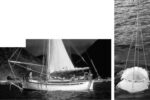
Kahlua herself has rewarded the McIntires for their trouble. Ken calls her “confidence-inspiring, predictable, and seakindly.” Beautiful and polished from bow to stern, Kahlua has emerged from the grime. She is a princess who has been touched by a magic wand.
Once the McIntires realized what a treasure they had in an offshore boat, Lake Pepin began to look mighty confining. They first discussed sailing the Great Lakes, but Cathy took the dreams to the next step when she made another one of those innocent “Honey . . . ” suggestions. This one had to do with early retirement. Ken hadn’t considered that option, believing their monthly retirement income to be too small, but Cathy suggested selling the house and living aboard, and suddenly the concept became a possibility.
In the spring of 1998, the house was sold, quickly and at the height of the seller’s market. Ken and Cathy moved to a rented townhouse and began discarding the “stuff” accumulated in two lifetimes. This summer they will conclude their preparations, summer 2000 they will move Kahlua to Kentucky, and the following winter Ken and Cathy will mark the millennium with retirement and a one-way trip on the Mississippi River and out via the Tennessee-Tombigbee Waterway.
Of her suggestion to retire early, Cathy says, “I met Ken later in life. I’d already missed so much time with him. I’d trade stuff and a house for more time with this wonderful man anytime.”
They both agree that the work required to bring Kahlua back and to keep her teak and brass maintained is worth it. Ken says, “We love the ambiance, the warmth, the woodwork joinery. The longer we live with Kahlua, the more we’ve grown to love her.”
Thank you to Sailrite Enterprises, Inc., for providing free access to back issues of Good Old Boat through intellectual property rights. Sailrite.com