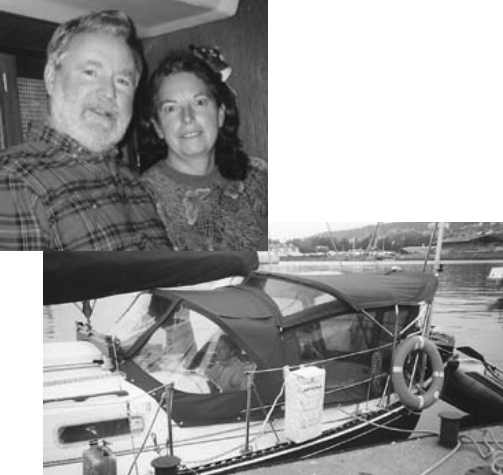
“You can do it, go for it!” is this couple’s advice to others
Issue 16 : Jan/Feb 2001
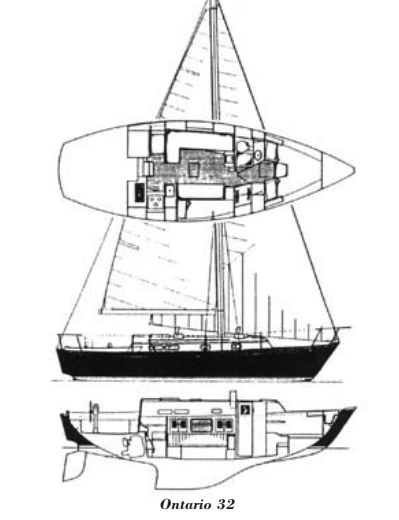
Aubrey and Judy Millard took a good old boat, a 1978 Ontario 32, and left their Toronto home in July 1998. They traveled the Great Lakes and passed through the North American continent using the Tennessee-Tombigbee Waterway. They cruised Florida, Cuba, and the Bahamas and then headed across the Atlantic in spring of 1999, a 44-day passage with stops in Bermuda and the Azores, for Great Britain, wintering in London. They spent the summer of 2000 in Northern Europe, sight-seeing and enjoying the cruising community in France, the Netherlands, Germany, Sweden, Denmark, Norway, Scotland, and Wales.
Aubrey’s logs speak of many grand and glorious moments and a handful of unforgettable “character-building events,” primarily of the heavy-weather variety in the North Sea and the Irish Sea (worse than anything the Atlantic crossing handed out). In doing so, they earned the chance to explore some of the most beautiful, isolated, and tricky anchorages in Northern Europe, particularly the coasts of Scotland and Wales.
As they’ve moved from country to country, they have had ongoing frustrations about the compatibility of email systems and about propane canister connections. And they’ve experienced the usual cross-cultural issues and bureaucracies in which rules and regulations are proudly promulgated and expressly enforced in languages that were not their own.
Having spent a cold and wet North Sea summer in 2000, they are now soaking up the sun and slowing their pace in the Mediterranean. They arrived there mast down through the French canal system. All told, Aubrey and Judy have logged more than 15,000 miles since leaving Toronto.
Aubrey summarizes, “It must sound exotic . . . It is! We frequently have to pinch ourselves to establish that this is our good fortune to have this lifestyle and our fantastic opportunity to see the world. However, one of the reasons I am writing these logs . . . is to encourage people to dream and to work toward making their dreams come true. We are not rich in terms of financial wealth, but we have accepted what life has given us, both the good and the not so good, and have made the necessary adjustments and decisions to realize a dream we have both had for some time. My theme is, ‘You can do it! You are only in this life once. Go for it!’
In this account, I have given close estimations of costs incurred, not to show how shrewd or economical we are (which we are not), but to give others a frame of reference for expenses and to illustrate that a couple does not have to be rich to set off on a world voyage in a seaworthy, comfortable sailboat. But they do have to be prepared to pay the price, financially and emotionally.
We bought Veleda for $28,000 ($42,000 Canadian) in May of 1996 from her third owner. We had heard the Ontario 32 praised as a solid sailboat, and we loved Veleda from the first time we saw her in midwinter in Brockville, Ontario. During the summer of 1996 we sailed from Toronto to Thunder Bay on Lake Superior. The second summer (1997) we sailed Lake Erie. We departed on our world cruise the third summer (1998).
We did not do any upgrades until the winter before our departure, with the exception of installing a Dinghy Tow system. Those first two summers gave us the experience with the boat and her systems to show us what changes we would like to have for liveaboard comfort and safety.
We had Veleda surveyed before we bought her and again in the fall, at a cost of $290 ($435 Cdn.), before our departure to outfit her for ocean cruising. We were cautioned by the second marine surveyor that we could expect to put 50 percent of her value into the necessary upgrades for bluewater sailing in safety. This we did.
These are the major upgrades we undertook. (Prices in parentheses are Canadian dollars.)
A new engine – The original 20-year-old, 15-hp 2QM Yanmar seemed powerful enough but had impeller problems, was raw-water cooled, and had already been in salt water for one or two seasons. The engine was our major concern. Did we have the right boat for what we wanted to do? Was it worth a new engine and all the expenses to upgrade her? We did a considerable amount of soul searching about our plans and the boat. However, she had a solid hull and rigging, we liked her sailing characteristics, and we were impressed with her below-decks space and layout. To buy a larger, more expensive boat would still mean expending money to upgrade, and we could not afford boats in the $50,000 to $65,000 ($80,000 to $100,000) range.
Our dream was in danger of fading or being postponed for a couple of years. So we decided to go for it with Veleda. We had E&C Marine, in Toronto, install a new 3GM 30-hp Yanmar with a heat-exchanger cooling system for $10,000 ($15,000), less the $1,000 ($1,500) they got for selling the old motor. They gave Veleda a backhanded compliment when they complained that her hull was too thick when they were drilling a through-hull for the water system. We also had a Vetus anti-siphon system installed and a larger exhaust opening made. We are quite happy with their service and with the engine.
A new dodger/Bimini – At the Toronto Boat Show we were impressed with the dodger/Bimini system we saw at the Genco stand. As I’d had a cancerous growth removed from my arm that fall, we knew we would need good sun protection. We initially were going to have just the dodger/Bimini made, but then went for full vinyl-and-screen side curtains (see photo on Page 23), and even new cockpit cushions. The Bimini had a new design whereby it was secured to the toerails rather than to the outside of the cockpit coaming.
This design gave a more spacious cockpit enclosure, and has proven to be quite stable. We have standing headroom beneath the dodger and 6-foot headroom under the Bimini. We also had a clear vinyl window with a Velcro flap made in the aft third of the Bimini to permit a view of the set of the mainsail. Pockets sewn into the dodger give a handy place to store a sound horn, sailing gloves, navigation instruments, and light lines. Straps sewn on the port and starboard top of the dodger give useful handholds when getting into or out of the cockpit. We spent another $2,000 ($3,000) but feel it was well worth it for an “Add-a-room.” We have had the system up all the way across the Atlantic with no problems, even through 55-knot winds. We rarely use our foul weather gear now as, with the full enclosure even in rainstorms, we are dry and warm. The structure makes our boat look bigger, but does not detract from her lines.
As much as we like this system, had our budget permitted, we would probably have gone with a rigid dodger and Bimini with appropriate canvas/ vinyl side curtains.
Electrical systems – We wanted alternate rapid and reliable sources of charging our batteries, so went with an Air Marine wind generator for $1,000 ($1,500), a 30-amp marine battery charger for $350 ($525), and a 100-amp heavy-duty alternator for $330 ($500). We replaced the standard, heavy-duty automotive-type 12-volt batteries with four 6-volt, golf-cart batteries for $300 ($440). The advantages are that they are lighter-to-handle, sturdy, deep-cycle batteries that we were able to fit beneath the cabin sole, lashed down on a platform built on top of the keel bolts. Two are hooked up in series (for the equivalent of one 12-volt battery), and then two pairs are hooked up in parallel, making a single house bank of two 12-volt batteries. We kept one 12-volt, automotive-type battery separate, lashed in a battery box in a cockpit locker, for engine starting only.
We also installed an Alpha regulator for $150 ($225) for controlling the charge rates from the alternator, allowing a higher charge rate for a longer period before dropping to an intermediate rate, then to a trickle charge. An Echo charger ensures separation of the starting and golf-cart batteries, so that the house bank cannot drain the starting battery but allows both starting and house banks to be charged.
My favorite toy is the E-Meter installed above our electrical panels. I was always frustrated by the question of how much charge we had left in the batteries? As far as I’m concerned, simple ammeters and volt meters are not as dependable. My E-Meter monitors the house bank and tells me the voltage, the current draw in amps, the number of amp-hours used, and the number of amp-hours remaining at the present rate of consumption to lower the bank to its 50-percent level.
The household wiring was replaced with marine-grade wiring throughout the boat. We replaced the domestic AC switch box with a marine-grade AC panel for $115 ($170) with a master breaker and reverse-polarity warning light as well as four breaker switches separating the battery charger, water heater, and port and starboard AC outlets. The old six-switch DC fuse panel was replaced by four panels, giving us 22 fused switches.
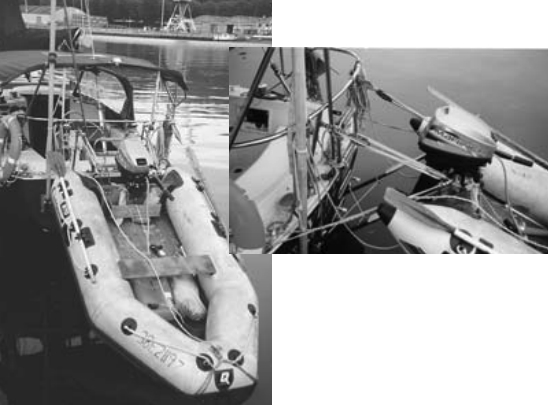
Dinghy Tow – One of the first upgrades we got for Veleda was the Dinghy Tow system. We actually got it the first year we had our boat. At the Toronto Boat Show in 1996 we saw the system on their video and it appealed to us as the ideal solution for towing an inflatable dinghy. We had the usual problems of towing a dinghy behind the boat. We wanted a more powerful motor, one we did not have to “manhandle” off the dinghy each time we left an anchorage. In addition, we always had to watch that the dinghy line did not get fouled in our prop when coming alongside or anchoring. As we enjoy anchoring, a reliable, powerful dinghy was a high priority.
We purchased this system (see photo on Page 22) for about $650 ($1,000). It is one of the best purchases we have made. It came as a do-it-yourself kit, which took about two hours to install on our transom. It consists of two rigid arms attached to plates secured to the transom. The arms are controlled by pulleys attached to the stern rails, allowing them to be raised from the water level up to about 120 degrees. At the end of each arm is a quick-release hook; these clips fit onto brackets attached to the transom of the dinghy. Thus the dinghy is towed with the transom raised out of the water, with only the bow dragging in the water behind Veleda. This allows us to leave a 9.9-hp engine on the dinghy, with the gas tank, life jackets, bailer, anchor, and line secured in the dinghy while towing it. When we come to anchor, we lower the dinghy into the water, slip the quick-release mechanism, releasing the arms from the transom of the dinghy, and pull it alongside for immediate use. Very handy.
On a few occasions when we have grounded, we have lowered the dinghy into the water, but not detached it. I would then enter the dinghy, start the engine, and with Judy at the wheel of Veleda in full astern, and me in the rigidly attached dinghy, full ahead on the 9.9-hp outboard, Veleda has always come back off any grounding so far. The only time we removed this system was when we crossed the Atlantic. Otherwise, we have had it on all through the Great Lakes, down the Mississippi, around the Florida Keys and the Bahamas, and ever since our landfall at Falmouth in July of 1999, including through a Force 9 gale the following summer in the North Sea.
Sails – Veleda came with an inventory of an 18-year-old full-battened main, jib, and 150-percent furling genoa with luff pads, and a spinnaker. We got a storm jib (never used), and purchased a used, but good, mainsail for $800 ($1,200) and a 120-percent genoa with luff pads for about $900 ($1,400). We never used the spinnaker before we left. We actually crossed the Atlantic with the original sails on the assumption that if they blew out, we had replacements. However, they are still flying, albeit with some new UV cloth, and some stitching and patch repairs.
Other upgrades:
New navigation light – The original port and starboard lights were mounted on the hull. We installed bow-pulpit-mounted lights and repaired our trilight for $200 ($300). And we installed our sternlight on the wind generator tower.
GPS – We waited until just before departure to purchase a GPS to replace the Loran C that we had been using until then. We got an economical Garmin 128 for about $330 ($500) with a swivel mount for $33 ($50) so we can use it in our nav station, and swing it out into the cockpit for heads-up navigation. The antenna was mounted on the stern Bimini frame. It has proved quite satis- factory.
Jordan series drogue – Judy made this drogue system for “Perfect Storm” conditions. It consists of 100 droguettes on 150 feet of line, to be streamed aft as a last-resort maneuver in horrendous storm conditions. We purchased the kit from Genco for about $130 ($200). We have not yet deployed this system, although we hove to several times in heavy conditions.
Jack lines – We replaced the rope jack lines with flat nylon braid lines, so they would not roll underfoot.
Antifouling paint – We soda-blasted the hull for $560 ($850) to clean it off, then applied epoxy putty to seal the few blisters we noted. We then put on two coats of epoxy paint, plus one coat of red, and two coats of blue Woolsey bottom paint to seal the hull — Holland Marine products, $230 ($350).
Radio/tape/CD player – We purchased a good used car radio/tape/CD system with a cartridge for 10 CDs for about $210 ($320) that was connected to our two main cabin speakers.
Mast steps – Triangular fixed mast steps from Holland Marine for $240 ($360) were installed to facilitate climbing the mast under all conditions. We have used them alongside a dock as well as in mid-ocean.
Refrigerator insulation – As we were heading toward warm climates, we increased the insulation around the Adler Barbour Cold Machine refrigerator with sheet (where possible) and spray can expanding foam. We unwound a wire coat hanger and used it as the support to direct the expanding foam insulation through tubing, behind and around the fridge.
Sewing – Judy did a good job of sewing fitted sheets, blankets, and quilts for our V-berth cushions. In addition she made a bag with zipper top to hold our towels and washcloths, and another bag for spare sheets. She also made curtains and a mast cover for the main cabin, as well as throw-pillow covers.
Spice rack – A spice rack was constructed above the stove area for a dozen spice jars.
Flag halyards – Port and starboard flag halyards were installed on the spreaders, and a main flag halyard was fixed two-thirds the way up the aft stay.
Stanchion bases – The bow and stern pulpit bases were replaced as cracks were noted in them — Holland Marine $53 ($80).
Barbecue – A Force Ten barbecue, a gift from my son, was mounted and connected up with propane on the stern rail.
Laptop computer – A friend gave us an old Macintosh Powerbook 170 laptop computer that we connected up to an AOL 2.7 email system that we’ve been using for communications via email from Toronto to England. I initially wanted a more up-to-date computer for chart plotting and electronic navigation but soon realized it was too expensive and impractical for our budget. We have been generally happy with the AOL local access numbers we have been able to use throughout the States, Bahamas, Bermuda, Azores, and England. It has limited capacity and cannot download sophisticated attachments and graphics but can email logs of our voyage to more than 75 addresses: clubs, magazines, and friends.
After writing this article and summarizing our expenses, I can readily see why people refer to a boat as a hole in the water into which you keep throwing money. We will never recover the money we have put into Veleda, but she is our home and our way of life. Without a doubt, it was worth it!
Veleda was named when the Millards bought her. The name is that of a Germanic priestess in the 1st century AD. Aubrey started sailing dinghies in the late 1950s as an officer cadet in the Canadian Navy. He has continued sailing recreationally and has earned a number of sailboat handling and navigation qualifications.
Thank you to Sailrite Enterprises, Inc., for providing free access to back issues of Good Old Boat through intellectual property rights. Sailrite.com