Issue 19 : Jul/Aug 2001
Ron Bohannon is a fussy guy. The world needs fussy people, those more inclined to say “that’s not good enough.” Ron looked at the lifeline stanchions on the market and said he wanted something better on his boat.
“Good enough” is not a concept at Matella Manufacturing. Until recently, his customers were primarily aerospace manufacturers, customers who knew precisely what they wanted. When machining parts for these customers, the easy parts are made to a tolerance of ±0.0005 inches (half a thousandth of an inch), while the difficult parts can have a tolerance of ±0.0002 inches. The thickness of the page you are now reading is 0.0025 inches, 12 times thicker than the closer tolerance. Holding a micrometer in your hand for a few minutes will warm it from room temperature and introduce errors greater than 0.0001 inches, so very special measuring equipment is needed for this kind of work. There is no policy for the disposition of out-of-spec parts at Matella. Parts per print are shipped to customers; out-of-spec parts are shipped to the scrap buyer along with the chips and shavings. You have to be fussy to do this kind of work.
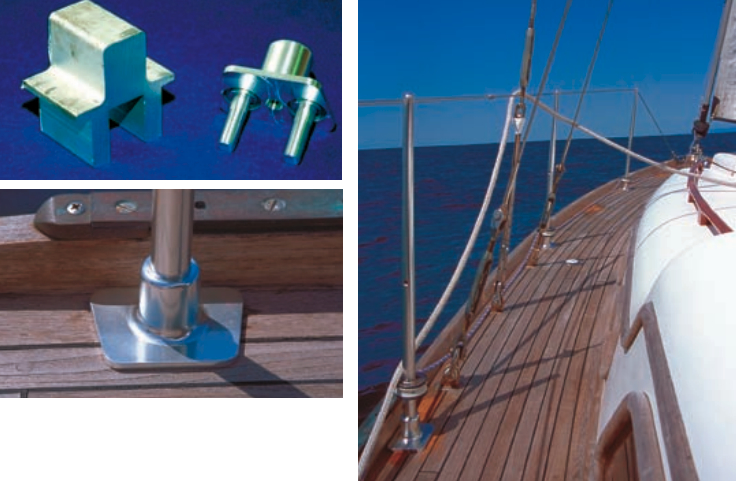
The Matella operation is on two floors of a 5,000-square-foot building. The ground floor houses five computer-controlled milling centers, a computer-controlled lathe, and several manually operated machines. The stanchion bases are machined in the milling centers, and the stanchions are turned in the lathe and drilled and tapped in the mills. The bases are milled from saw-cut sections of a custom extrusion that is oversized enough to allow the mill to cut all surfaces of the finished part.
The machine operator clamps the extrusion in a vise, shifts the previously milled part to another vise next to it (so the bottom can be milled), closes the door and starts the milling from the adjacent control panel. The machine selects a tool from a rotary magazine of tools, chucks it in the three-axis milling head, and goes to work on the extrusion according to programmed instructions. As the mill executes the program, it selects tools from the tool holder as needed, while a nozzle sprays a coolant/lubricant on the tool and surface being cut.
Ron designs the parts on a desktop CAD computer and writes the machining programs based on the 3D designs in another software. He says “People think CAD/CAM means you feed a print of a part into the machine and it makes the part. Actually, if you don’t know how to machine the part, the computer won’t help you,” Ron notes. “Even with CAD/CAM you have to be a good machinist, or you make bad parts.”
All the stanchion parts are made from 6061 T6 aluminum, which is a corrosion-resistant marine-grade alloy. Finished parts are polished and mil-spec anodized to produce a tough, corrosion-resistant surface. The customer has a choice of type 2 anodizing or type 3 hard anodizing. The type 2 clear anodizing looks like stainless steel, or it can also be applied in several colors. Type 3 hard anodizing yields a medium-gray color and the most corrosion-resistant surface.
The Matella stanchions were tested against other stanchions on the market. The objective was to make stiffer, stronger parts that were no heavier. Milling the bases from extruded aluminum, instead of using castings or weldments, and milling the oversize threaded fasteners right onto the bottom of the base, instead of making them as separate parts, is what gives the bases superior strength. Making the stanchions from solid, extruded, round-bar stock instead of tubing gives them superior stiffness and strength and prevents them from kinking under extreme bending deflection. Ron notes, “If you can’t do chin-ups on them, what good are they?”
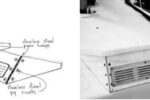
The stanchion is permanently attached to the base with a screw made by Matella from a matching alloy. The stanchion and base are a precise fit and are sealed to prevent moisture entry. Two massive 5⁄8-inch studs are machined from the saw-cut extrusion onto the bottom of the finished base. These are designed to pass through a thick backing plate and to be fastened by large aluminum nuts also machined by Matella for this specific assembly. All parts are made from the same alloy and anodized to prevent galvanic corrosion.
The resulting assembly is the stiffest and strongest available but is comparable in weight to other stanchions. Destructive bending tests run by Matella, and later by Practical Sailor, confirmed that no other product reaches the same level of stiffness and strength. A 28-inch Matella stanchion bent at 440 pounds, while a comparable stanchion kinked and failed at 181 pounds. In the failure mode (anything can be loaded to failure), the solid aluminum stanchions retain a very high loading as they deflect, while tubular stainless stanchions kink at a lower deflection, and their stiffness falls off rapidly. On a dark and rainy night in a pounding sea, all this helps a tired sailor stay on the boat.
Maybe you have to be fussy to make a quantum leap like this.
Thank you to Sailrite Enterprises, Inc., for providing free access to back issues of Good Old Boat through intellectual property rights. Sailrite.com