Three female authors promote sailing through publishing
Issue 19 : Jul/Aug 2001
Morgan Van der Ree
Two years ago, at the age of 10, Morgan Van der Ree was inspired to write her first article for GirlsCan magazine, a Canadian publication for and about young girls. After it was published, this industrious young lady of Royston, British Columbia, wrote two more. One was published, and then the magazine folded after the initial year’s run.
The focus of one of Morgan’s articles was the construction and sailing of a Sabot, an 8-foot sailing dinghy of the same design her father had built before her, when he was 10.
“As a young boy, I was extremely excited about having my own boat,” Morgan’s father, Farrell, relates. “My parents were totally engrossed in boats, and this rubbed off on me.” He says that his family needed a dinghy for their cruising boat, a 26-foot Thunderbird, so his dad took on the project of building a Sabot. “This turned into my 10th birthday present. I was able to help him during the construction process, and by the time it was launched I was shaking with excitement.” Farrell then reportedly attempted to christen the Sabot with a champagne bottle. “We put a dent in it — not the bottle, but the boat!”
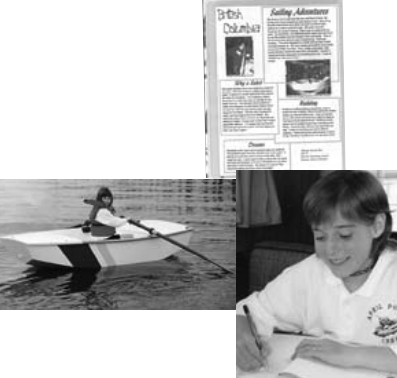
Over the years the little boat enjoyed much sailing and rowing, until eventually the plywood hull became too soft for use. “I always thought that one day I might build another one, so we kept the plans, rigging, and sail.” This history was repeated 25 years later, almost to the day.
“I had hoped my own kids would have as much fun and learn as much with the boat. So far, it’s turning out to be the case. Morgan is now an expert rower and last summer learned to handle sailing on her own. Kayleen (Morgan’s younger sister) often acts as first mate as they head off on their excursions.”
Learned a lot
Morgan played an instrumental role in the construction of Splash, the second dinghy. “I learned a lot of things when building the Sabot,” she says. “I got to know the boat and its parts. It was built on a jig, so it was sort of inside out.” What was her favorite part of the construction? “The tiller,” she says, “because I did it all by myself, spoke planing and all!”
This was also a significant learning experience. “I learned how to cut wood and sand really well, I got pretty good at using a hammer and nails. When rowing the boat, I learned how to tell which way I should go in the wind, what direction to go against the waves, how to push the oars hard so it will go fast, and that you sit backward to row.” As an afterthought, Morgan adds, “I learned how to steer myself.
“My friends love my dinghy. They like how small it is and that we are allowed to handle it ourselves. A few of my friends can’t do anything with my dinghy because they have trouble getting coordinated.” This obviously doesn’t deter their adventurous spirits, however.
Morgan wrote for GirlsCan, “Learning how to sail my little boat was a lot harder than I thought it would be. Once, when we were on vacation, my sister and I were sailing on Champion Lake. We were having trouble controlling the boat . . . Suddenly the wind gusted, and we tipped so far over that water was coming in over the side . . . Fortunately, we managed to figure things out and make our way back to shore . . . One day we’ll even practice this on our own and hopefully get so good at it we won’t even get wet.”
A small world
Morgan’s grandmother, Frieda Van der Ree, has written for Pacific Yachting magazine and has also authored a book, Exploring the Coast by Boat, which Morgan finds quite amusing when it turns up on bookshelves and in boats she sees.
Could Morgan, now 12, be following in her grandmother’s footsteps? “I plan to write in the future. I hope to be an author writing children’s novels.” Already working toward these ends, she says, “Right now I write stories for school, and I have started a journal for April Point, our new ‘old’ boat. I like writing because it gives me some time to myself and it uses my imagination.
“When my article was published in GirlsCan magazine, everybody was happy for me. We got the magazine into the school library, and my classmates were surprised that I had done something like that. When I saw my article in print I was very happy and proud.”
April Point, a 28-foot Tollycraft displacement cruiser, is the Van der Rees’ form of weekend recreation during the summer, cruising the Georgia Strait and Baynes Sound on the east side of Vancouver Island. April Point is large enough to sleep four and their traveling companions, two “big, mucky dogs.” One of Morgan’s favorite activities was setting crab traps. “I was excited at the thought of crabs for dinner,” she says. “I was disappointed the next day. There was not even a single piece of seaweed inside!”
Morgan says, “I’ve read lots of good books, and I dream about writing like those authors some day.” Watch for articles and books by Morgan Van der Ree in the years ahead.
Theresa Fort
Presently living in Titusville, Florida, and the mother of two, Theresa Fort spends her time juggling homeschooling, working on the boat, keeping up with daily household responsibilities, and writing.
“My difficulties are mainly time constraints. The kids and Chuck have always helped with the running of the house and boat, but there doesn’t ever seem like there’s time to fit in everything we want to do.”
Theresa, Chuck, and Amie and Alex (9 and 6 at the time), left Everett, Wash., May 1, 1995. Since then the family has seen Alaska, California, Mexico, Guatemala, Honduras, Costa Rica, Panama, much of the Caribbean, Belize, and Florida.
The children had always been homeschooled, but Theresa felt she needed supplemental material to fortify their educational diet while underway. “When you are out there cruising,” says Theresa, “you and your kids are together 24 hours seven days a week. School is not the only part of the day.
“Aside from help with boat maintenance, other positive activities are needed to keep your boat and relationships running smoothly,” Theresa continues. “If it involves an activity that ties into your learning at the time, or helps the kids become better sailors, so much the better.”
Alex, she says, is a very active kid who loves to be working on projects from sunup to sundown. “Imagining a bored Alex is a scary thought. I’ve seen it on our longer passages.” It involves pacing. Amie, on the other hand, can handle a greater degree of boredom without requiring such pacing. “On one of our longer passages, she once covered her whole face with stickers to see what she would look like. Kids and adults really need ideas to keep them going in a positive direction. Once kids become readers, their downtime can be spent reading, and reading, and reading.” This isn’t the total answer, however, Theresa says, and other activities are required to round out a day and keep everyone upbeat.
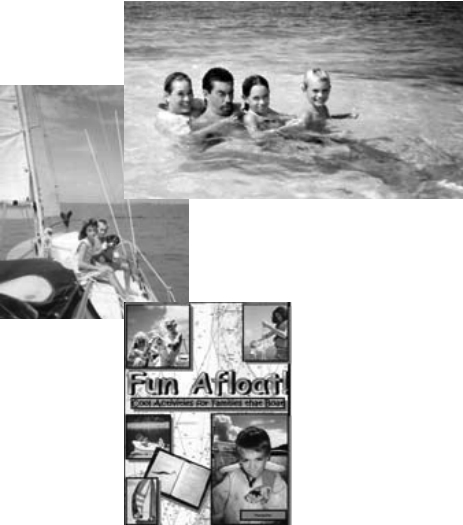
Fun Afloat!
Despite the Forts’ best efforts, they couldn’t find any specific books with boating activities for their children’s homeschooling and entertainment, so Theresa began to modify closely related activities and to create others as they occurred to her. When the Fort family reached Florida and decided to refit the boat and save up money for their next venture, she began writing her own activity book.
The idea for an activity book— not just for cruising sailors but for all boaters with kids aboard — slowly took shape. “We met many families who seemed unhappy with their cruising experience at times; it seemed like they needed to have their children more involved with the day-to-day work onboard and to have more of their children’s activities in school related to their cruising lifestyle.”
The result is a book with more than 60 activities for children and parents. Each activity helps open their minds to the world around them while helping them to learn about boating and navigation. Activities include making a plankton net, designing your own postcards, fish dissection, figuring your boat’s speed, making a print of a fish, and so forth.
“It’s difficult watching the kids grow up,” Theresa says. “It is a heartwrenching experience that I both enjoy and bemoan. We had so much fun when they were younger and have a great deal of fun now, but it’s different because they are becoming their own people, stretching out and away slowly.”
Theresa and her family are eagerly planning their next adventure. “It’s a fine line we walk as we look ahead to our future sailing life traveling aboard a boat again. Our children are 15 and 12 years old now, so we will have two mostly teenagers when we set out again. We are looking forward to it because we will have so much help with watches!” Theresa says.
Unsettled future
“Chuck and I have learned that we are travelers at heart. Whether or not we will settle down will be decided later,” she continues. The two have dreams to go on several very different adventures, including a drive from the Arctic Circle to the equator, a trip aboard the Alaska ferry, and a cross-country biking excursion. “It could be that we do these things in between cruising or that we never do them. Who is to know? But, we do know that if we set our minds to it, we could do it all.”
She says cruising has helped develop her self-confidence. “We were already quite self-sufficient, but we grew even more so. It helped Chuck realize that there is no thing called ‘security’ on land or out cruising . . . that security comes from within ourselves . . . In terms of the children, it is an awesome thing to be part of a goal like this. It can’t help but teach them that they can do anything they set their minds on. That is a very powerful realization. They also learned that the U.S. is not the end-all and that life is very different in other countries.
“We also understand our responsibility to our children. As they become older, it may be that they will want to stop traveling, that they will want a more settled existence.” Amie hosts a marine conservation website and has plans to become a marine biologist, while Alex is taking an interest in robotics and airplanes. “If they ever do ask to have a home on land again, we will honor that need and make the best of it, enjoying that part of life as well,” Theresa says.
Fun Afloat!, a family project really, is available on the Good Old Bookshelf (see Page 65).
Jahnn Gibson
Jahnn Gibson might just be proof that sailing is, truly, in the blood. Her family has a long history of maritime tradition, dating back to her great-grandfather, a Norwegian sea captain who used to pilot a 22-foot 1910 Long Island Sandbagger. Keeping up the tradition, her daughter, Becky, took fourth place in her first attempt at racing several years ago.
Jahnn and her husband, Dave, sail their Hallberg-Rassy 33 Mistral, Hotspur, on the Sacandaga Lake in the southern foothills of the Adirondak Mountains in upstate New York. It’s a 30-mile long reservoir,” she says matter-of-factly, “They just call it the Great Sacandaga Lake for the tourists. Actually, it’s quite a pretty lake with mountains in the background and a pretty dairy farm on a nearby hill.”
A while back, Jahnn helped deliver a boat from Rhode Island to Delaware and lost her job due to the time she had to take off. After the trip and during the two-month interim while she was looking for work, she got the idea for a book. “I just felt so much more creative, not having to report in for nursing duty from 11 to 7 every night.”
The manuscript she has written, Susan’s Sailing Adventures, covers the adventures of a fictitious 13-year-old girl, Susan, and her sailing experiences from the Chesapeake to Rhode Island with many stops in between. In the course of her journey, she learns many things, including what a Fresnel lens is (while sailing in the Chesapeake), about Benedict Arnold and the Battle of Valcour (while on Lake Chaplain), and about Hell Gate as she sails through.
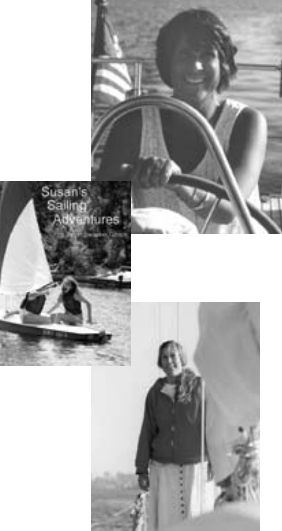
Informative and entertaining
Jahnn, a self-proclaimed history enthusiast, wanted to ensure that her young readers would enjoy their reading and learn a little as they went along. “I think that a book should inform, as well as entertain, especially for young folk. Learning need not be a chore. If it’s done correctly, the reader does not even realize that he or she is learning.” An excerpt about a race Susan attends:
“The start of a sailboat race is not like the start of any other race. In other races, the contestants start from a dead standstill. Sailboats can’t just stop at the starting line and then start up when the gun goes off, because the wind is always moving them. This is how they do it: There is a 10-minute sequence, during which time the boats sail around behind the starting line, jockeying for position and deciding how far away and on what course they want to be when they finally turn and run for the line. Their goal is to be right at the line when the gun sounds. If a boat is over early, it has to turn around and go back to restart. However, the skipper of each boat also has to decide where on the line he wants to be — upwind is generally favored — and on what tack he wants to be . . . starboard tack boats have right-of-way over port tack boats . . . this leads to some very interesting situations and frequently a lot of yelling.”
Jahnn didn’t set out to write a book that teaches youth. “It just happened,” she says. “The books I read are books from which I can learn something, including history, biography and, for frivolous fun, historical fiction.” She goes on to say that she enjoys reading books written in different eras, such as her mother’s Outdoor Girls books. “Frivolous as they were when they were written, they are really loaded with information about the early 1900s and imbued with the attitudes of the people at that time.” This, she says, is an education in itself.
Susan’s Sailing Adventures concerns a girl “basically because I let the child in me relate the story, and that child happens to be a girl. However, it would not be difficult for me to change Susan into Eric if I had to. I would let the publisher decide.” The target audience for the manuscript is around 10 to 14 years old, as the protagonist is 13.
Of this book, Jahnn says, “To tell the truth, I have no idea if it will ever be published. I’m sending it off to three big publishing houses and will work toward the boating-oriented publishers, should I not succeed with these three.”
Going cruising
“What we really want to do,” she says, “is take off and cruise. We each realize that we’re not getting any younger, and we want to cruise while we still can.”
A Hallberg-Rassy Web site is hosted by her husband, Dave. “I’m just enjoying three of my favorite things,” he proclaims, “namely boats, people, and computers. In that order.”
Herbert Davies II is 19 years old and hails from Manchester, England. He has been traveling all his life, having crossed the Atlantic Ocean five times by the age of 13. His ultimate dream is to be a sailing writer. He lives in Maryland aboard his family’s ketch Ojala, a 40-foot 1967 Mason.
Thank you to Sailrite Enterprises, Inc., for providing free access to back issues of Good Old Boat through intellectual property rights. Sailrite.com