Issue 20 : Sept/Oct 2001
We all have to start somewhere. Jerry and I started from the back of the fleet when it came to anchoring. A dinghy sailor most of his life, Jerry didn’t get much opportunity to practice dropping and retrieving hooks. As a racer, in fact, he tried to have the smallest, lightest anchor aboard (and only if one was required, of course). Anchors of any kind were a scourge to a guy who didn’t allow an extra can of pop on board for members of his racing crew.
However, we were of the belief that anyone who sails a small boat can certainly sail a large one. And so it was that — with more moxie than experience — we came to be sailing a friend’s O’Day 27 all by ourselves for several days on Florida’s Gulf Coast many years ago.
This is how all of us start, isn’t it? One day you just sort of . . . start. We were about to begin our anchoring career simply because we needed to drop the hook for the night. Unbeknownst to us, the friend with the O’Day didn’t anchor often either.
In our twosome, Jerry was by far the more experienced sailor. Besides, he had read some articles describing the process. So he gave me the order to go to the bow and drop the anchor on his command. He would back down, and we’d be set. That’s all there is to it, really. But it was dark and choppy, I was green as a sailor and green about the gills as well, and it had been a long day.
I dropped the anchor when told. But then I had the curious sensation I used to have when waterskiing . . . just after yelling “Hit it!” We flew in reverse — at what speed I can only guess. The rode burned through my hands, and I realized I’d have lasting scars if I didn’t drop the line. About then reality struck: the end of the rode wasn’t connected to anything. Shouldn’t it be? Was I responsible for hanging on to the bitter end against all odds? Ignoring all pain? Had I just failed at my part of the job? Oh horrors!
A few days later our friend got a brand-new anchor and rode from a couple of sadder-but-wiser cruising sailors.
We’ve anchored hundreds of times since then, preferring life on the hook to all other forms of overnighting aboard. In fact, we typically drop not one anchor but two, something that allows us to sleep through the night without anchor watches or alarms. On our first attempt we learned that yes, Virginia, there is a bitter end, and it’s on the other end of the anchor rode.
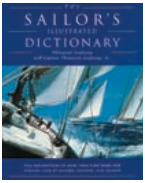
Just to prove that there’s always more to learn about this sailing activity of ours, I recently looked up the term “bitter end” in a newly released sailing dictionary. It says, “n. (1) The end of a rope, cable, or anchor chain. (2) The end that might be bent on a bitt, thus the term.” Then I had to know what a bitt was, of course, and there on the facing page was an illustration of various cleats used for tying ships and boats to docks and piers. The bitt is more likely to show up on a ship than on the docks where we sail. It is a coffee-can-shaped affair with two pegs sticking out from opposite ends near the top. You’ve seen them from time to time. Perhaps you even knew what to call them. Now I know also.
The dictionary, by the way, is a real gem. While it’s difficult to “review” a dictionary, I will say that it has made it to an honored position on my bookshelf. It’s The Sailor’s Illustrated Dictionary, by Thompson Lenfestey. A beefy 541 pages with several pages of naval and nautical abbreviations worth looking up, this one’s a real treasure. It’s from Globe Pequot Press, released in June 2001.
Thank you to Sailrite Enterprises, Inc., for providing free access to back issues of Good Old Boat through intellectual property rights. Sailrite.com