A tale of Restoration relived
Issue 21 : Nov/Dec 2001
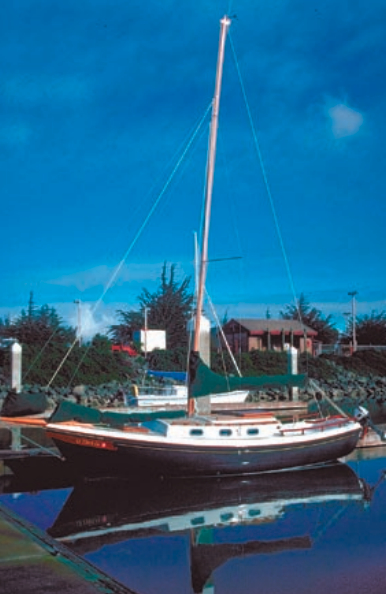
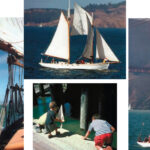
We were stormbound Eureka, Calif., on our voyage south from Vancouver, British Columbia. One thing leading to another, we had wintered over in this delightful, friendly town. I was walking the dock one cloudy winter day when I noticed a boat tugging at her mooring lines. Even from the embarcadero, I could see she was something special. Her clean graceful line was uncluttered. No clunky pulpit or lifelines to distract the eye from the exuberant swoop of her sheer. Her dark green hull and immaculate brightwork were eye-catching, and her proportions were simply wonderful. There was a feeling of rightness about this boat. It said this was what sailing was supposed to be about: grace and beauty under sail, unassailed by modern pressures about speed or conformity to the latest Euro-styling fad.
This was Scallywag, a 1973 MacGregor Venture Newport, arguably the most handsome boat built by the firm renowned for its water-ballasted trailersailers. The Venture Newport predates the firm’s water ballast development and is equipped with a swing keel, displacing 2,300 pounds. Other vital statistics are length: 26 feet overall, 23 feet on deck, with a beam of just under 8 feet. She draws 18 inches with the board up, 5 feet with it down . . . perfect for gunkholing around Humboldt Bay. Scallywag is cutter-rigged with a cloud of tanbark sails, but as beautiful as the boat is, the story behind how she came to be restored is even more interesting.
Drifting apart
Owners Mike Fuller and his son, Jake, told me the story behind the restoration. Mike had been worried. With a young family to support, he was working all hours of the day. As a result, he and his 12-year-old son, Jake, had started drifting apart. Jake was listening to punk rock. There were heavy metal band posters on the wall of his room, and he was hanging out with people Mike thought were hoodlums. There were long sullen silences as Jake withdrew into himself. Mike knew he could not offer guidance to a son who would not listen. They had a common interest in surfing, but it wasn’t enough. Mike decided that the situation was his to solve if he chose to. He could either continue working as hard as he was or cut back and spend more time with his family. For Mike, family had to come first.
But even when he committed the time, what could he do to connect with Jake? A few years before, the two had gone on a three-day trip to Catalina Island with Mike’s sister. From that time on, both he and Jake had been interested in sailing. Mike found an old 1911 Estrallita, so tired that not even the Boy Scouts wanted it anymore, and he bought it. He fixed it up with minimal help from Jake and took his son sailing to see what would happen.
Jake enjoyed the sailing immediately. They spent every spare hour sailing and would often spend the weekend nights on Humboldt Bay. “Anchored out in a little boat with no place to go, and being only three feet apart, you have to learn to communicate,” Mike says. The father and son team liked sailing in heavy weather, and every time the weather was rough they learned something new about sailing and each other. “Jake would soak it up like a sponge,” Mike said, “and even months later, when we ran into heavy weather again he would remind me, ‘Hey Dad, we have to do this or that thing.’ I would have entirely forgotten what we had done the last time, but Jake remembered everything.” It is clear that the father and son team came to depend on and trust each other while learning how to sail in rough weather.
Unfounded concerns
Did sailing change anything? As Jake puts it, while other kids were out partying he was busy sailing. Although he thinks his father’s concerns about where he might have been headed were unfounded, he quickly adds that when he has children one of the things he will do with them is teach them how to sail, as his father did with him. According to Mike, buying the Estrallita, working on it, and sailing together straightened everything out between them.
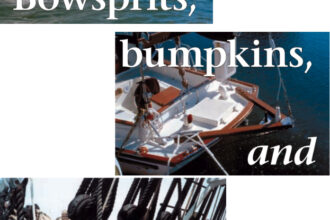
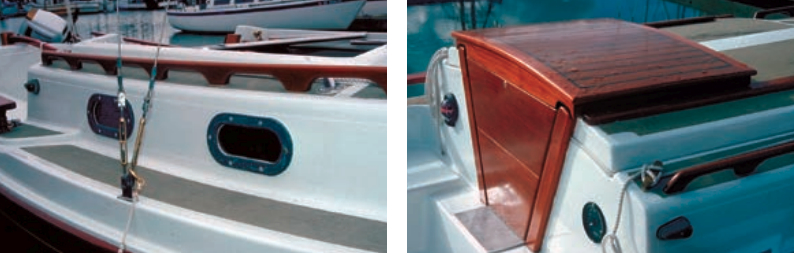
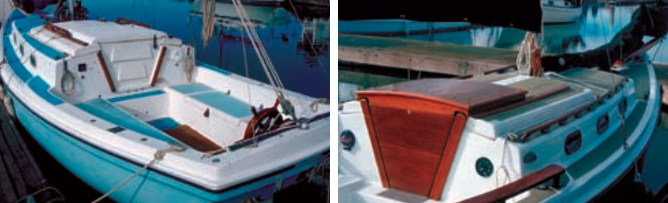
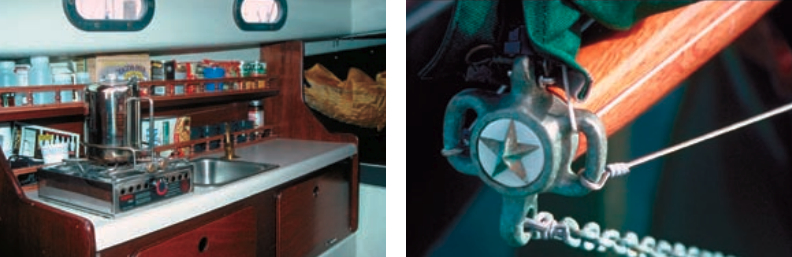
That first sail was 10 years and three boats ago. It was a foggy November day when I met Mike and Jake Fuller aboard their latest effort, Scallywag. Much had been changed from the original. According to Mike, the hull, deck, mast, boom, and stern light came with the boat, but little else remains of the boat they bought. Even the chrome has been stripped off the stern light to reveal the underlying metal. Mike and Jake prefer the patina of unpolished bronze. The original anchor platform has been replaced with a proper bowsprit complete with whisker stays. The fiberglass forehatch and companionway hatch have been replaced by teak finished bright. The detail work even extends to the boat’s Honda 7.5-hp outboard, now painted in the same dark green acrylic as the hull. The interior cushions and instruments were acquired in trade: Mike traded signs he painted for them.
The paint is flawless. Mike is a paint foreman and graphic artist. The mast, which even under close inspection looks wooden, is an aluminum section painted with acrylic enamel. The mast was already completely painted when Mike decided to experiment with his airbrush. “Five minutes later,” he said, “I had added a woodgrain effect. If I had known it was going to go that fast I would have added some whorls and knots to it!”
Faux teak
He was thinking of adding a teak rubrail. Realizing he had to draw the line somewhere, however, he decided to paint the original hard rubber rail to look like teak instead. The paint job looks so realistic, right down to the teak plugs, that I refused to believe it was painted. The “bronze” portlight frames are painted wood. One night Mike and Jake cut out and routed the wood, and the next night they painted the frames with a mixture of copper and bronze powder in a clear latex. Then before it had completely dried, they sprayed this with a patina paint to give it the green hue. Finally the ports were covered with a clear enamel. This is but a temporary measure while they wait for genuine bronze ports to be cast.
The detail work continues into the interior which the father-and-son team gutted to the bare hull, sanded, filled, and painted to a glasslike finish. They completely rebuilt the interior in mahogany. The accommodation features a V-berth forward, a dinette to starboard, and a galley to port with a small settee opposite the table. The area under the cockpit is used for storage. The stove is a simple one-burner Origo alcohol unit and, together with the removable Porta Potti concealed under the V-berth, is completely in keeping with the boat’s daysailing and occasional overnight purpose.
Unlike earlier boats which Mike owned and Jake helped with, Scallywag is a jointly owned and funded father-and-son project. The equality of ownership helped Mike recognize the coming of age of his son. It turns out that Jake is the more practical of the two, while his dad is the procrastinating perfectionist. It is Jake who says how much is enough and who sets deadlines for when the work should be done. “If it weren’t for Jake,” Mike admits, “we wouldn’t have gotten the boat into the water for another three years. It was Jake who set the launch date and made sure we met it.”
Talking it out
Both agree that decision-making has been easy. “The experience has been good for me,” Mike says. “I had to learn to listen to Jake’s suggestions, because we are partners. I couldn’t just go out and do something, like I had on the earlier boats. I had to consult with Jake first, and he has had a lot of good ideas.” Both father and son emphasize the partnership aspect of what they are doing. “There’s nothing like sanding fiberglass together to strengthen a relationship,” Mike says, and they both laugh. When asked what part of the restoration process he liked the most, Jake replied emphatically, “The sailing part!”
There are many remarkable restorations whereby a boat is brought back to showroom condition, but there are exceedingly few restorations that transcend even the builder’s original product. Unrestrained by the need to merely conform to the builder’s original intent of producing a boat built on a budget, this yacht is an expression of the Fullers’ vision of what a proper little cruiser should be.
One of Scallywag’s hidden charms is the pleasure of knowing there is not another like her. This boat is unique. How many of us can afford the luxury of a custom-built yacht these days? Mike and Jake have achieved this enviable status on a budget whose principal currency is composed of equal parts of mutual love and respect with a good portion of sweat added to the mix. Just as with boats, there are many human relationships worthy of salvage and restoration. Maybe what they need is vehicles to help bring people together in pursuit of a common goal, sharing adversity and triumph together. For Mike and Jake Fuller, Scallywag and her predecessors have been those vehicles.
Brian and his wife, Alexis, grew up in Nova Scotia and practiced law in Alberta until they bought a boat, sold the house, quit the profession, and left Canada. They have lived aboard in the Caribbean for five years and are looking for a larger boat with which to begin a charter business.
Thank you to Sailrite Enterprises, Inc., for providing free access to back issues of Good Old Boat through intellectual property rights. Sailrite.com