Heavy-weather sailing helps sort out life’s problems
Issue 23 : Mar/Apr 2002
A strange rattling; my eyes were blurred; blindly my fingers moved to the drawstring and pulled it down. Cracks of darkness alternated with the inch-wide white blinds. The clock pointed to 2:30 a.m. Another rattle, and the blinds billowed out toward me. I felt the wind slithering in between the gaps. To and fro the blinds danced, knocking against the knotty pine wall, then swooshing back out toward my bed.
“A front is coming in,” I said to myself. “The wind is shifting. I’m in luck.” Oldtimers around the lake called it a “northerner.” The wind shifts from the south and west to the north and strengthens; whitecaps soon appear on this deep-water lake in northern Michigan. I pulled the comforter over my head and went back to sleep amidst the clanging and cool Canadian air that fell on my 16-year-old body.
Later, waking up to the cool air of the approaching front, I gulped my breakfast and pulled on my yellow windbreaker and old blue bathing suit. I hustled into the utility room and put the sail on my shoulder while grabbing the tiller and centerboard with the other hand. Higgins Lake was churning: whitecaps clear across the three-mile width of lake and as far as I could see past the island to the south. Rolling in, depositing seaweed, odd pieces of wood, bobbers, sand toys.
Setting the sail, tiller, and centerboard on the dock, I pushed the Sunfish out into the water, its bow barely claiming a bit of sandy beach for stability. The sail went up first, which pulled the craft further up on shore. I pulled and pulled to turn the vessel around and head her into the wind, then with the bouncing of the boat and lapping of waves, I attached the tiller, jumped into the tiny cockpit, and set the centerboard all the way down at the same time. Like a corralled horse let out into pasture, we took off fast and straight, a bit off the wind. We headed for the island on a beam reach.
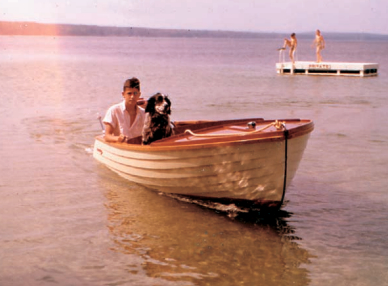
Enjoying day off
No need to look out for other boats. They stayed off the lake in this kind of weather. I was enjoying a day off from working as a clerk and stockboy at the local grocery store. I had weekend friends who returned to Detroit on Sunday night for their summer jobs. But I stayed up at the lake during the week, working, sailing, and hiking through the miles of old logging trails. Comforted by the solitude, I pulled in the sail. The boat heeled. I leaned out, my toes tucked inside the coaming of the cockpit. Parallel to the water, I knew one more gust of wind, and I’d be capsized.
Waves washed over the bow, the cockpit drain was open, but it was slopping inside the 2-foot by 2-foot indentation in the flat fiberglass hull. Too much water was coming in for the small open seacock to release it back to the lake.
When I first started sailing as a 12- year-old, it was on an old Sailfish my dad had found. Just a 13-foot flat wooden boat with two rails to hang on to. My brothers kept fiberglassing the bottom, but soon all that kept the water out was fiberglass. There was no wood left. After 30 minutes out from the dock, it would sink. Dad found a used Sunfish for sale. I mostly used it, as my older brothers were by then either married or attending summer school. They’d come up on weekends, sleep in, have a few beers, then take my dad’s Century Resorter out to the island for the Saturday afternoon party. The Sunfish was mine, although I would never tell my brothers this.
On this stormy day clouds, like airplanes, came in to land and passed over me one after another. I could see in their gray bottoms the threat of rain. I was running right into the storm. It only took about a half hour to be out of sight of my cottage, beyond the reach of my stepmother and other neighbors. I leaned out farther, right on the edge, right where I liked to be, thinly balanced between air and water, testing, experimenting, seeing how long I could ride this high before a pesky gust tipped me over. Just me against the wind, the approaching storm, and the whitecaps.
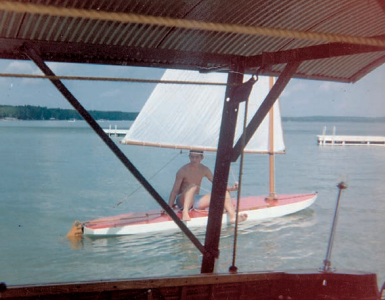
Capsize
But there is no winning out there. Just as I stretched to my limits, a free-flying thrust of air, squarely out of the north, hit the sail. The boat rose up. I leaned out. The sail flopped into the water, and I climbed over the side onto the centerboard, surrendering to necessity. This is how I released my inner turmoil into the wilderness of these deep, chaotic waters. As the boat heeled up and then crossed over, succumbing to wind and water, I found myself. Alone, unfettered by parental authority, impending college boards, the confusion of sex and love, I experienced life in its simplicity: right the boat.
After a long pull on the edge of the boat, the sail came up shimmering with water, showering me. I hopped on, my yellow windbreaker sopping and heavy. I pulled it off and tied it to the mast. The water was warmer than the air. I felt encouraged, heartened. I was warmed up, ready for the next round. As I pulled on the sheet, the sail came back to me, the boat climbed into the wind, heeling nicely.
Most of my friends prefered motorboats. The Johnsons and the Evinrudes for waterskiing, the Mercurys for speed. Their parents, arriving on a Friday night in Buicks and Oldsmobiles from the Motor City, walked the docks to their inboards and started up their throaty Graymarine engines. Maybe they would go out for an evening spin, open her up, go 30 to 35 knots. Speed and grace, those dark-brown, highly varnished Chris-Crafts and Centurys. Saturdays, their offspring would get control of these boats for visiting friends, waterskiing, partying. Sundays, maybe the parents would go out for a slow ride after a late breakfast. Then everyone would pack up and leave for Detroit. By 6 p.m. the lake would be quiet. Maybe my dog, Rip, and I would take the canoe out or the 5.5-hp Johnson on my dad’s duck boat for a final spin up and down the shore. Rip, an English setter, would lean way out in front, like a hood ornament, smelling, sniffing, occasionally barking . . . at what I never knew. He was in his own world, as I was in mine.
No competition
Capsizing was not a failure; it represented a reckoning. For me, to take on the storm involved no competition . . . no winners and losers. I knew, given the light weight of this boat and my 140 pounds, that a strong northerner would topple me. My goal was to stay out as long as I could and sail the triangle course so familiar to me: around the island, a long tack into the wind toward Higgins Lake State Park, and then downwind toward home, pulling up the centerboard, sitting as far back as I could, attempting to keep the bow from plowing under a wave and bringing on another capsize.
“Bill, why do you have to go out in weather like that? What’s wrong with you?” My stepmother, coffee cup in her hand, would watch me gather the sail, nicely varnished tiller, and centerboard. “You know I can’t help you if you run into trouble out there. No one else is up during the week. Don’t you think you are playing with danger?”
I would always murmur, “I know what I’m doing.”
When I turned 13, my dad had enough of my stepmother telling on me. “You know son, I know you are a good sailor, but I demand that you put one of your waterskiing life belts around the mast. That’s an order.”
No one in my family, none of my friends, seemed to understand the necessity of going out into the storm. In 1959, aged 16, I couldn’t find the words to express the need to go that I felt in my gut. But go I must. Waves, wind, vulnerable sailboat, me. A stark simplicity that involved no one else.
Smouldering standoff
In later years, I understood that I was working something out. My gut was in turmoil. I took up running in marathons. A fierce charge resided just below my stomach. More than anger, it was a smouldering, brooding standoff. I had no words for this forlorness. My father, like me, kept all that confounded him to himself.
That’s why I felt lucky at 2:30 a.m. on the eve of my day off. That’s why I needed the storm. I found great comfort that the mood of the storm matched up with the powerful twisting strains of my own inner life. I was at home on the rough water.
It is now more than 40 years later. Yesterday my home was rocked constantly, enduring another storm from the Gulf of Alaska roaring through the Golden Gate, into the San Francisco Bay, and pelting the sailboat I live on with rain, then hail, sleet, back to rain. I remembered my 16th year and my feelings of being at home on the water.
What’s changed? I still grieve the loss of my first love at age 16. I still yearn for the mother who died birthing me in l943. I still wonder how I might have had conversations with my dad before he died . . . about my mother, about his loves, about mine. I weigh a little more. Black hair turned gray. Trouble bending over.
After searching for years for a love that would surround and protect me, I had given up. Then one day, 2,000 miles from home, walking the docks of Portland, tears in my eyes for the beauty of those wooden boats, love found me. Gone now is the yearning, present now is the invitation to speak of matters of the heart. And my gut has finally unclenched.
Solitary again
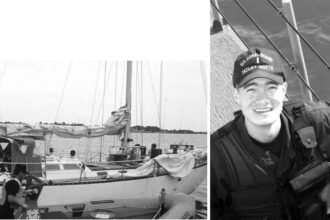
My sweetheart works in the city. Every day is mine on this old boat to do what the day offers. Sail. Write. Canoe. See clients. I have become the solitary individual that I once was at age 16. This afternoon, the Coast Guard is forecasting clearing skies, wind settling down to 15 to 20 knots an hour. I have an appointment with a young man who posted a note on the gate bulletin board: “Want to learn how to sail. Will trade manual labor.”
After years of living on land, farming, building houses, staking out pastures and gardens, I am now waterbound. This 33-foot, 25-year-old bluewater vessel reminds me of a German shepherd straining at the leash, plowing into wave after wave, taking on the storm, determined to tack toward Angel Island. Singleminded. She doesn’t mind drenching her captain, the rattling of dishes, the clunking of books on the cabin sole. I go along with her and endure the rattling of the halyards, the ruffling of the sails, the cold wind from the west. We are companions. I love singlehanded sailing. Just me and the water, the wind, and my vessel.
But it’s time to pass this passion on. Aaron is the young man’s name. I wonder if he has the yearning, the slicing energy to handle sails, tiller, and what the sea offers all by himself. Will I be able to tell him? Or will he be able to see it in the weathered palms of my hands, the glint of my eyes, the leaning out of my body to check our sail trim, to watch for the presence of freighters, to notice a change in the direction of the wind?
To take on the storm is to be delivered from a life of confinement, of certainty, of a conflagration of inner voices . . . all demanding. Once I pull on the sheet of that sail, land recedes, taking with it the grueling thoughts of a teenager or of a late middle-aged man. I must go into the storm to be delivered from the comfort of certainty.
Rip, the dog, always awaited my return, pacing the beach as he caught a glimpse of the white sail coming in fast. He would bark, jump up and down, and then wade out as I let down the sail, releasing the tiller and centerboard. A fit welcome back.
Aaron works across the estuary from where I live, “on that big Coast Guard boat, the Munro. But I want the water close by, the wind up against me, I want to be a juggler of the elements. The wind, the bay waters, and me. Simple. Not complex like that boat over there. That’s work. This,” he says, as he rubs his hand against the teak rail, “this is for me.”
Bill started sailing on a wooden Sailfish and moved on to a fiberglass Sunfish. Years later he purchased a coldmolded Flying Dutchman, then a wooden Lightning. Next came a Hunter 25 and then a Sunfish. When he wrote this article, he and his wife were living on the San Francisco Bay on a 1979 Swift 33. He’s writing a book, The Grace of Falling.
Thank you to Sailrite Enterprises, Inc., for providing free access to back issues of Good Old Boat through intellectual property rights. Sailrite.com