Simple (not too elegant) gauge for your holding tank
Issue 23 : Mar/Apr 2002
Our boat was built with a holding tank, but there was no provision made for determining how full it is. In the early years, we either pumped out too often, at some increased expense, or not often enough. We wanted a way to tell how full the tank was.
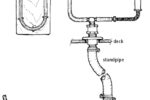
I knew our tank had a standpipe that entered the top of the tank, went to the bottom, and was used to empty the tank at a pump-out station. This is fine way to design a holding tank since there are no bottom exits to cause problems.
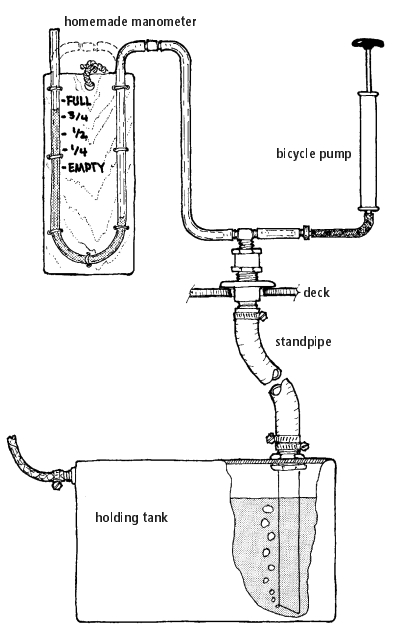
I devised (cobbled up actually) a manometer that could be attached to the tank. I used a basketball pump to pressurize the standpipe. As the pump increases the pressure in the standpipe, the level of sewage in the standpipe goes down. Finally, the level reaches the bottom, and adding more air simply blows bubbles in the sewage. It’s not that I wanted to blow bubbles in the sewage; I wanted to know the maximum pressure in the standpipe just before that happens. The manometer tells me the pressure in terms of inches of water column. The maximum pressure that can be achieved is a linear function of how full the tank is.
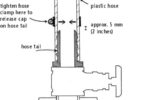
A manometer is a simple, but elegant, pressure gauge. When there is no pressure difference across its ends, the level of water in the U-tube is the same on both sides. When one side has more pressure than the other, the level drops on that side and rises on the other. The difference in height between the two columns is an expression of the difference in pressure between the two sides. The actual calibration to read pressure in familiar units is tedious and, in this case, unnecessary. Our manometer is simply a piece of scrap plywood with some clear PVC tubing lashed to it. We calibrated it by pumping out the holding tank to get an empty reading, and then filling the holding tank with water to get a full reading. We marked both on the plywood.
This method makes the assumption that sewage and water have the same specific gravity (weight for a given volume), which is not strictly true, but for this kind of work they are close enough. All the parts for this device can be purchased in a hardware store. The pumpout fitting connection is a PVC threaded pipe reducer. The rest of the parts are in the nearby bins. You need a threaded pipe-to-barb fitting, a barbed tee, a barb-to-barb fitting to close the ends of the manometer when it is not in use, a length of PVC tubing, and some lashing and scrap plywood. I don’t have to tell you to use a cheap pump of some sort; don’t blow into this thing.
This method will work with most solid tanks because pumpouts need a bottom exit of some sort. Don’t do this with flexible tanks. If you have a very shallow tank, you can angle one leg of the manometer to 45 or even 30 degrees from vertical and get better resolution. If you need to resort to this, you will want to mount a cheap level on the board to obtain satisfactory accuracy.
While not high-tech fun exactly, a swamp sounder will prevent you from leaving the marina for a weekend with a nearly full holding tank.
Jerry is Good Old Boat technical editor. We know we told him not to write about heads and such matters anymore, but as co-founder of this publication, he pretty much does what he wants.
Thank you to Sailrite Enterprises, Inc., for providing free access to back issues of Good Old Boat through intellectual property rights. Sailrite.com