A single-handed pioneer of Folkboats and self-steering
Issue 26 : Sept/Oct 2002
The folkboat was designed as a family racer/cruiser, but over the years it has earned an extraordinary reputation for seaworthiness, and many of these slim 25-footers have sailed around the world.
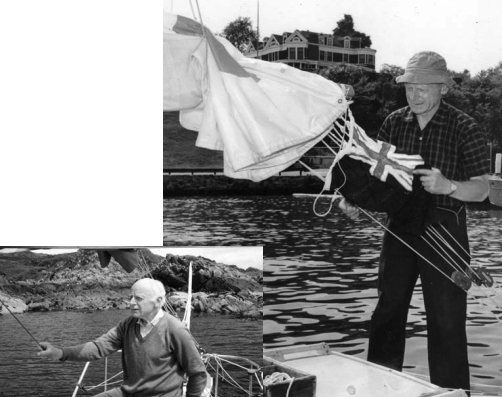
To find out when the Folkboat joined the ranks of bluewater vessels, we need to look back to the early 1950s and to the story of Colonel Herbert George (“Blondie”) Hasler, D.S.O., O.B.E., of the British Royal Marines. In addition to his love for extreme ideas, Hasler deserves credit for a number of achievements that have changed singlehanded sailing, ocean racing, and the world’s perception of Folkboats. To gauge his resolve and bravado it helps to know that he led Operation Frankton, one of the most daring commando actions against the Nazi occupiers of France. In December of 1942, 10 men in five folding kayaks were dropped off by a submarine at the mouth of the Gironde River near Bordeaux. The mission of the “cockleshell heroes,” as they later were called, was to paddle 60 miles upriver at night, in order to blow up enemy cargo ships in Bordeaux. Only Hasler and his crew survived after accomplishing the mission. They escaped and made their way across hundreds of miles of enemy territory to Gibraltar.
After his discharge from the military, Hasler became a liveaboard, but he had bolder, more adventurous things in mind than staying put in a marina. In 1953, he contracted the yard of Harry Feltham in Portsmouth to build a carvel-planked Folkboat hull with a special superstructure with three hatches that allowed him to sail single-handed while adjusting the sail trim and course from down below — without ever going on deck.
Hopeless expectation
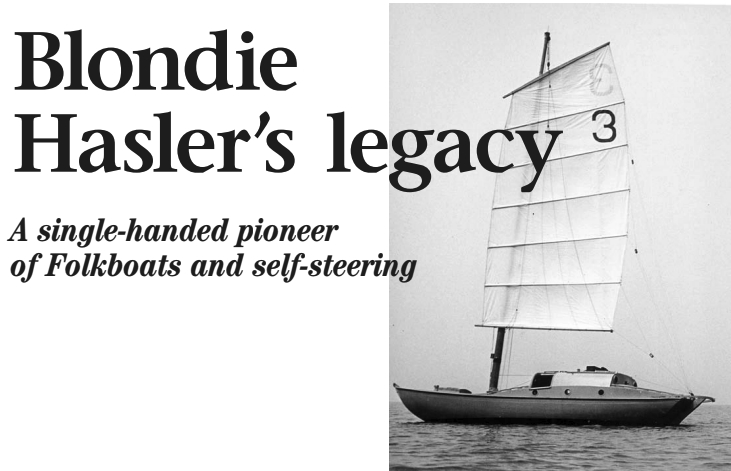
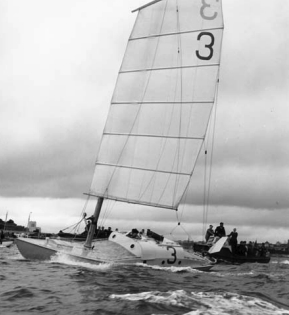
In the foreword to Phil Weld’s book, Moxie, Hasler describes the reasons for his choice of boat: “Until 1952 I had always sailed and raced in conventional boats, but I wanted to make long ocean passages and soon came to realize that it was hopeless to expect to be able to raise a crew of congenial friends who could get away for long enough at the right time. I would have to be able to sail single-handed, but I knew from experience that efficient single-handing in conventional boats calls for a nautical athlete with an appetite for continual hard work and exposure. I was nearly 40, lazy by nature, and preferred cunning to brute force. I got myself a new 25-foot Folkboat hull, named her Jester, and began with very little money to develop on her three things that I needed: a rig that could be handled at all times without going on deck; an enclosed cockpit with a watchkeeping position that allowed you to face out in the open air whilst protecting your head from rain and spray; and a windvane steering gear that would steer her on all points of sail and which could be adjusted from the cockpit.” The result was a boat that looked like a compromise between a Folkboat, a submarine, and a Chinese junk, but as history proved, it was functional, and Hasler had every reason to call Jester “a good joke.” She was built from mahogany over oak with heavy scantlings and had no aft cockpit like the original Folkboats.
The round hatch amidships was reminiscent of the commander’s hatch on the conning tower of a sub. The spray protection Hasler had in mind was provided by a rotating canvas hood that could be folded away. Instead of an internal combustion engine, Hasler opted for a long sweep that he stowed on the foredeck for sculling the boat in calm waters, a concept that North America’s most conspicuous cruising couple, Lin and Larry Pardey, repopularized a few decades later.
Dead end
His experiments with a single-hander-friendly rig initially led him into a dead end. His first try was a lapwing. In this configuration, the sail was wrapped around the rotating, unstayed mast and doubled back onto itself for sailing upwind. For downwind legs it could be spread apart to increase sail area, boomed out on two poles in wing-and-wing fashion. To reef it, the sail had to be furled around the mast. It all sounded good on paper but did not work well in practice, so Hasler started to look into junk rigs, which had been refined over thousands of years and seemed to fit his needs.
His solution for Jester was a balanced Chinese lug rig that had a sail area of 243 square feet, close to the original Folkboat’s. This rig had numerous advantages, aside from its simplicity. It automatically depowered in heavy air through the mast’s bend and the twist in the upper portion of the sail that spilled pressure. Because a portion of the sail always was forward of the mast, it also counteracted weather helm, a customary problem for long-keel vessels with small or no headsails. Consequently, the steering gear was under much less load. Finally, the sail could be reefed very easily and incrementally, panel by panel, without any effort or the need to tie reeflines. Hasler rigged sheets from the battens down to the deck and simply chose the reduction of sail area by pulling the appropriate line. The sail would slide down along the mast to which it was attached by batten parrels. The excess cloth was caught by lazy-jacks that ran all the way from the yard down to the boom.
Vertical tiller
Hasler’s most important legacy lies in the refined steering mechanisms that he developed for Jester. For manual steering, he used a whipstaff that was installed forward of the main hatch, so he could stand up, face forward, arms on deck, and direct the boat by pushing the vertical tiller with his knees.
His true act of genius has survived until this day, unbeknownst to thousands of sailors who have come to rely on windvane steering mechanisms. Like Jester’s rig, this part also saw two stages of evolution. First Hasler favored a trim tab that was attached to the trailing edge of the rudder. The windvane was set to the prevailing wind direction and would change the boat’s course if the wind direction changed, keeping it on the same pre-set wind angle. Hasler noted that this system lacked power sailing downwind, where it mattered most. His improvement included a servo mechanism to harness water and wind pressure, which then are used to operate the cables of the steering gear. This system was also adaptable to different conditions, sail configurations and hull shapes.
Hasler claimed that on the four Atlantic crossings he would eventually undertake with Jester, he steered only 50 miles by hand; he left the rest of the approximately 12,000 miles to his self-steering mechanism. Although many more refinements were to follow over the years by others, Hasler had laid the groundwork for reliable and practical self-steering mechanisms, which have become standard for thousands of single-handers and short-handed cruisers since.
Why does the world know so little about Hasler’s contribution? One reason may have been his lackadaisical approach to bureaucracy. He never bothered with patents, loathing the fact that this meant dealing with courts and lawyers.
Race to New York
Now that he had a fine seagoing vessel, still a Folkboat in dimensions, hull shape, and character, he needed to create an event to put it to the test and measure up to others. The year was 1959 and single-handed ocean racing, far from being as popular as it is today, was considered a game for lunatics and suicide candidates. Hasler’s idea was a single-handed transatlantic race to New York, but he neither had a club to sponsor it nor an opponent to race against. The solution arrived in the person of Francis Chichester, who had already made a name for himself as a pioneer in single-handed aviation.
Chichester was ready to take on the challenge with his 39-footer, Gipsy Moth III, and bet a half crown that he could beat Hasler and Jester to New York. Chichester, who suffered from lung cancer and at that time ran a store for nautical supplies in London, pulled a few strings and managed to convince George Everitt, the commodore of the Royal Western Yacht Club in Plymouth, to organize such a race.
The London daily newspaper, The Observer, agreed to bring in sponsorship and media coverage and so the OSTAR, the Observer Singlehanded TransAtlantic Race, was born and quickly was dubbed “the most sporty event of the century.”
Five boats were entered for the first race. Chichester and Hasler aside, the competitors included Valentine Howells, from Wales, who also sailed a Folkboat, Eira; David Lewis, a London doctor who was interested in the medical aspects of such a trip, entered Cardinal Vertue, a 26-footer; and a Frenchman, Jean Lacombe, showed up with a 21-foot plywood construction, Cap Horn.
Early pioneers
Compared to today’s racers in carbonfiber monsters (mono and multihulls) guided by electronics and satellites and competing for line honors in transoceanic races, Hasler and his colleagues were the pioneers rolling west in horse wagons. The amazing thing was that all five boats, inadequate as they may have seemed, finished the race despite having to deal with more than just their fair share of rough weather.
Chichester won his half crown and the race by posting a time of 40 days, followed by Hasler in 48 days. Lacombe came in last, after a whopping 74 days. Howells was beaten up in a ferocious storm that knocked him down so hard that his chronometer broke. He already was without electrical power so he had no light and no means to receive the GMT radio signal for the rest of the trip. Hasler, who sailed a more northerly route than Howells, also came out of a nasty storm that forced him to sail with the Number 4 reef for days on end.
After so much excitement, the OSTAR became an institution and, four years later, Hasler and Chichester were going at it again, this time in a fleet of 15 boats. The finish was moved to Newport, Rhode Island, and the pace was a lot faster. Our two heroes trimmed considerable time off their first crossings in 1960. Chichester finished in 29 days and 23 hours, and got second. Hasler took 37 days and 22 hours, and finished fifth. The big winner, a sensation at the time, was a French sailor, Eric Tabarly, with Pen Duick II. His time of 27 days and 3 hours set new standards. It made him an instant hero in France.
New record
Over the years, the event has endured, attracting fleets in excess of 100 boats and spiffy high-tech craft vying for prize money and record times. In 1992, when the race was called Europe Star ’92, a German lawyer, Karl Brinkmann, raced a Nordic Folkboat and finished in 37 days and 23 hours, an hour behind Hasler’s time in 1964. In the same race, a Bulgarian woman, Petja Christova, set a new unofficial Folkboat transatlantic record with 35days and 6 hours.
It should be noted that each time Hasler raced Jester across the big pond, he also sailed her back on her own keel. After the race in 1964, Hasler made the decision to sell her, but not before he pulled another stunt. Shortly after returning, he brought her up to Scotland’s famous lake of Loch Ness for a month of “monster patrols,” sponsored by The Observer. It was a typical Hasler gig. Although he claimed quite credibly to be a believer in Nessie, the affair was definitely tongue in cheek, mocking the establishment.
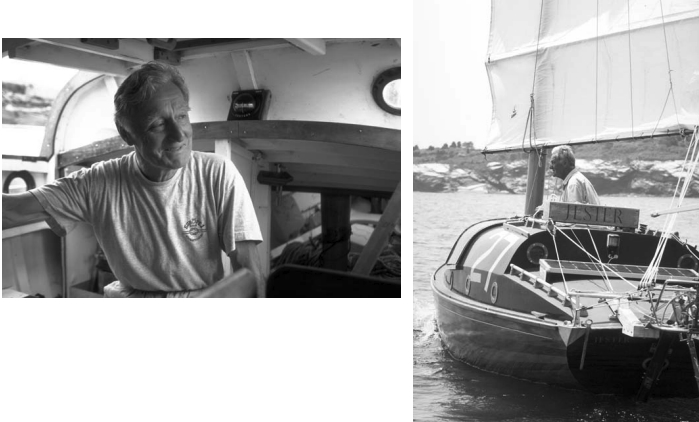
Jester’s saga was to continue under the aegis of her new owner, Mike Richey, a friend of Hasler’s and at the time the director of the Royal Institute of Navigation. Richey sailed her six more times in the single-handed transatlantic race, which he called “a race for every animal in the zoo.”
Richey did not race to win. More often than not he finished outside the 50-day time limit or he abandoned the race either to turn back or to head for other destinations. Single-handing was a way of life for him, like it was for Hasler, a way to make the trip count more than the arrival. “You spend a lot of time wishing you were somewhere else,” he said in an interview in WoodenBoat magazine. “But it is fun, a nice way of life. We spend much time looking for reality. It gives you a sense of reality.” Amazingly, Richey still was at it in his 80s, battling the ocean for months on end, confined to the cramped, stripped-out interior of Jester that offers sitting headroom only, just like the real Nordic Folkboat.
Rolled, dismasted
Eventually, all things must come to an end, even for a tough little warrior such as Jester. In 1986, on her 13th Atlantic crossing, Jester was rolled and dismasted 300 miles offshore from Brittany. A freighter picked up Richey’s distress signal and plucked him and the wounded Jester from the sea, documented by a photo that had the boat dangling from a crane, bow pointing skyward and the remains of the snapped spar sticking out.
The final act in Jester’s legendary existence came on July 15, 1988, during the next race, at the position of 38°08′ north, 58°43′ west, 470 miles out of Halifax. After a series of knockdowns in severe weather, Richey set off his EPIRB. The Coast Guard sent planes to check on him and coach his rescue by the MS Nilam, a freighter that diverted course. Richey had second thoughts about this rescue business. Yes, Jester was severely damaged, but she was still afloat. However, the forecast was bad and the coast was more than 400 miles to the west, under the given circumstances a week, probably more, of sailing on a wounded craft.
After much agonizing and weighing the options, Richey agreed to abandon Jester and transfer to the Nilam. After an unsuccessful attempt to tow her hull behind, she was cut loose, and Richey had to watch helplessly as she bobbed in the wake astern and slipped out of sight to meet her fate. Jester’s disappearance proved to be traumatic for her skipper. For a long time Richey held the belief that he was taking an easy way out by choosing the safe course of action.
“Men personalize their boats like no other artifact. I felt I had failed her, that I should have stayed with the boat,” he wrote about his emotions in the aftermath of Jester’s loss. “Better to pass boldly into that other world in the full glory of some passion than fade and wither dismally with age,” he borrowed from James Joyce.
Many fans
But not all was bad. Jester was more than any old boat. She was inseparable from the history of the OSTAR and single-handed ocean racing. And she had a large fan base. A trust was formed to finance the building of an exact replica for the next race in 1992, which also commemorated the 500th anniversary of Christopher Columbus’ legendary voyage to the new world. Nigel Rowe, who chaired the trust and otherwise was a pivotal figure in the creation of the OSTAR, summarized the reason for such an undertaking succinctly when he said that “Jester epitomized that spirit of adventure and courage that characterizes so much of Britain’s maritime history.”
The new Jester was built at Aldeburgh Boatyard in Essex, a shop that specializes in building small keelboats such as Dragons, cold molded and in fiberglass. The lack of detailed construction lines of the original forced the yard to use Folkboat drawings. The new version was cold molded from four diagonal layers of khaya with an outer layer of Brazilian mahogany. The frames were laminated, the floors were solid mahogany and the deck consisted of two layers of 1⁄4-inch marine plywood. The overall weight was similar to the original, but weight distribution, due to the light hull construction, was different. The most difficult part, according to the builders, was crafting perfectly fitting mast wedges for the unstayed rig so they wouldn’t work themselves loose. Richey also re-created the simple but effective original sail that he came to appreciate on all his previous voyages, joking that Jester had the “ideal geriatric rig.”
Fast passage
Richey and the new Jester participated in the 1992 race and sailed one of their fastest passages, finishing in 45 days and 15 hours and celebrating the skipper’s 76th birthday somewhere out in the Atlantic. The boat wintered in Newport, and Richey sailed her back to England the following summer to announce his retirement from that kind of sport, making way for a younger female skipper who, unfortunately, never got the hang of sailing and enjoying Jester. So when 1996 rolled around, Richey was at it again. After the race he laid her up in Newport for the winter and sailed back east again the following summer. En route he celebrated his 80th birthday, toasting his late friends and soulmates, Hasler and Chichester, who had shared Richey’s passion for the ocean, single-handed racing and a Folkboat’s seakeeping abilities.
What was an addict going to do when the 2000 race was about to start? Richey saddled Jester once again for his ninth race and the boat’s third. This time, however, they did not finish, due to a cooker that blew up, forcing them to divert to the Azores. Knowing there was no chance of making the time limit for that race, the skipper decided to sail back to Plymouth. They arrived at their home port safely after three months at sea, only to find that Jester’s free mooring had been seized by the authorities. After all those years and miles, what a sad joke. (Mike Richey wrote about his experiences in the 2000 race in Cruising World, February 2002 –Ed.)
Reprinted from a new book by Dieter Loibner, The Folkboat Story: From Cult to Classic, the Renaissance of a Legend, published by Sheridan House. For fans of the Folkboat and all her kin, this book is a treasure.
Thank you to Sailrite Enterprises, Inc., for providing free access to back issues of Good Old Boat through intellectual property rights. Sailrite.com