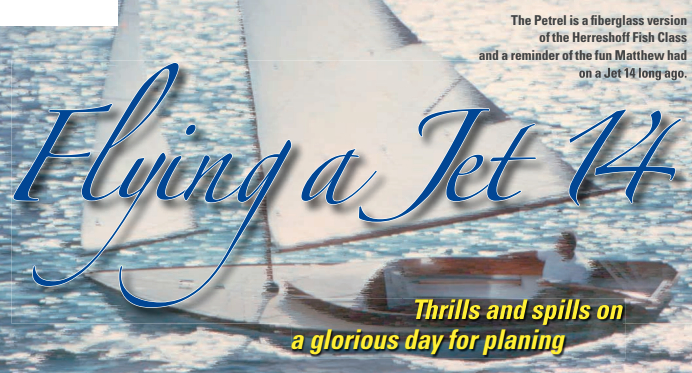
Thrills and spills on a glorious day for planing
Issue 49 : Jul/Aug 2006
I was fortunate to attend Tabor Acadamy, “The school by the Sea,” for those four tumultuous years preceding college. Rather than bore you with chemistry class and hormones, I’ll tell you about the sailing fleet at the school. In addition to a 90-foot schooner, there may have been 40 boats of diminutive size. There were Cottontails and Puffins and Silver Terns; there were Mercurys and WoodPussies.
And then there were three new Jet 14s: planing boats that scarcely kissed the water during their fl ight. They were built of wooden battens laid on a bias. They were light and sleek and strong and extremely swift. The cockpit was very narrow. There was no coaming on either side, just a hand-span width of decking to sit on. This decking was invaluable when you heeled; your whole lee rail could be submerged without a cupful coming into the boat. The centerboard trunk ran most of the length of the cockpit and housed a formidable steel plate. The genoa was a sweeper with a window in it. On a broad reach you could keep up with an airplane. Thankfully, there were hefty hiking straps and an ample hinged extension to the tiller.
On the day I remember best it was rather rough. The breeze was stiff and the launch driver — one of the masters — cautioned us as he dropped us off at our moorings. I was crewing for Mike. He was a senior and on the sailing team; I was glad to be teamed with someone as knowledge-able as he was. Off we went and immediately got her up on plane. We skimmed the whitecaps out to the point, where the small-craft-warning fl ag was crackling at the yacht club. But no one ever paid attention to that . . . it was scarcely ever hauled down the entire season.
Today it had valid reason to be aloft. Outside the harbor, in Buzzards Bay, the breakers were piling up. We wisely made the decision to stay inside. Even here, we had a basin about a mile across and more than plenty of weather to learn our limits.
Capsized
Sure enough, we looked astern and saw that one of the other 14s had gone over. The launch came charging out from the pier to help. The wind picked up; our sails were wet with spindrift. The foot of our low-cut genoa was dragging in the water; spray was running down inside our shirts. Towing the swamped boat, the launch crossed ahead of us. The two boys huddled, shivering, in her cockpit. “Sailing has been canceled this afternoon!” the master bellowed.
We pretended not to hear him. “What’s that, Sir?” we hollered politely and, porpoise-like, leapt the next wave and sped away. The master picked up his megaphone, but the wind was against him — we couldn’t hear a word. Our three boats were the only ones out when orders were given to cancel small-craft activity. “Head for the outer harbor,” I suggested. There we might revel for half an hour before the launch could complete her work and return to harass us. The wind was nearing 20 knots. I played the genoa carefully as we teetered on our beam ends. Hiked far out, I could see a few inches of centerboard clear of the water.
When we came about, we could see that the second Jet 14 was in trouble. In a moment she was over. The two boys stood on the centerboard and righted her, only to have her continually knocked down. The launch came pounding through the swells to her rescue. The wind was screaming, our rail was down. It was 6 inches under water, but we were dry. Life was glorious. There went my favorite hat! We flew to the mouth of the harbor and circled the schooner, as she lifted and plunged massively at her mooring. Here came the launch at her uttermost 14 knots, the master gesticulating. But now we were on a broad reach, and he wasn’t quite able to catch us. Our rooster tail diffused the rays of the avid sun, and we fled in regal splendor.
Thank you to Sailrite Enterprises, Inc., for providing free access to back issues of Good Old Boat through intellectual property rights. Sailrite.com