Scores of continual little changes make life easier

Issue 50 : Sept/Oct 2006
The long you live with a boat, the more you try to make things easier for yourself. Certainly the goal is a well-functioning boat that is seaworthy and safe. But making it easier for the sailors who are aboard is why we also add self-tailing winches, roller furling, and electronic navigational aids. In addition to preparing our boat for long-term cruising, the concept of making things easier was another factor in many of the changes we made to our Columbia 10.7. By going through different phases, sometimes these changes occurred more as an evolution. No other system on board has seen this concept of evolution more than our management of sails.
Initially, the mainsail was sheeted on the aft end of the boom, with a traveler on the bridge, right in front of the companionway. One of the first things we did was to change to mid-boom sheeting with a custom-made traveler installed on the coachroof. The groove in the bridge was glassed in. We added an optional four-part tackle to be attached to the boom end to flatten the sail when needed.
We always felt the boom was undersized and early on had it reinforced with a large bar of aluminum on the underside. In hindsight, we probably should have replaced it with a stronger boom because it collapsed when we were caught in a squall on the Caicos Bank going into Providenciales. We were lucky to get it repaired there by having it cut in half and welding in an aluminum sleeve that has held ever since.
When it came time to buy a new mainsail, we decided to go with full battens and a roach that goes out to the backstay. As the current literature indicated, the increased roach did not make us heel over more but gave a much stronger draw on the sail. Our next mainsail will probably have an even larger roach. With the full battens, we tried a number of lazy-jack systems. These didn’t work well for us because we had to point directly into the wind to raise or lower the mainsail, something we are prone to cheat on. We finally settled on the Dutchman, a system with two plastic lines strung through the main. When lowered, the main folds up like an accordion, never touching the deck, and we can raise and lower it moderately off the wind.
Sail inventory
Our mainsail has slab, or jiffy, reefing with three sets of reefing points. Fortunately, we have never had to use the third set. We also added a trysail with an extra track on the mast, but we never had to use it, as the main reefs were always sufficient. After many years we removed the topping lift and put in a Garhauer compression strut.
We also added two optional vangs with two-part tackles, one on each side. A snaphook attaches to an anchor on a pulpit stanchion. The other end of the tackle is permanently attached to the toerail with the tackle line running back to the cockpit. To use it, we detach the snaphook from the stanchion and hook it on to one of the boom bails. We use these vangs to control the boom in jibes or when sailing downwind wing-and-wing.
The headsail evolution aboard our boat was even more pronounced. Initially we had a custom-made double-forestay system with a 150-percent genoa on a roller furler to starboard. Our second jib was a 115-percent lapper hanked on the second forestay and stored to port in a deck bag. We had a set of reef points put in this sail but didn’t use them all that often since we found it was easier to just reef the main. When the time came to replace the lapper, we chose a blade that has a smaller foot and carries the sail area more vertically.
For downwind sailing we had a 3⁄4-ounce spinnaker that was also stored in a deck bag to starboard. A spinnaker sock was added to make it easier to set and lower the sail. Although this was a fun sail for those lazy days in the Great Lakes, we used it only once in the Caribbean. It seemed we were always hard on the wind in the strong Caribbean trade winds. When we were finally going downwind, the wind was just too strong to carry the spinnaker. We ended up taking it home when we went back one Christmas.
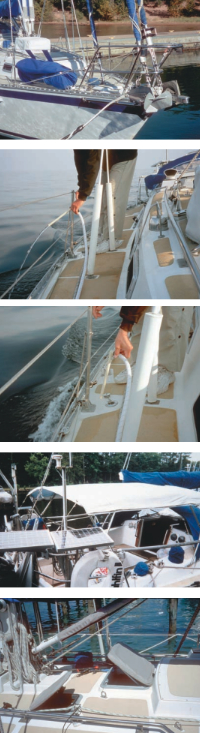
Moveable jackstay
For heavy-weather sailing we had a moveable jackstay that was stored against the mast. It could be moved forward when needed. A staysail was stored in the cockpit locker that was then brought forward and hanked on the jackstay. We also added running backstays that could be set when using the staysail. With a single- or double-reefed main, this sail combination was dynamite, especially when close-hauled.
When the old genoa wore out, we purchased a reefable sail with built-in luff pads. Unfortunately, this made it too easy to use the genoa in a variety of conditions so we left our other sails neatly stowed away. When we got to Grenada one of the first things we did (along with sailors on four other boats) was to order a furler for the staysail. This addition was done mainly for sail management; we really don’t sail the boat as a cutter because the headsails aren’t clewed high enough. However, with the staysail in place ready to go, we find that we use the sail more often, especially when hard on the wind. This is because the sail track is mounted well inboard on the cabintop and the staysail can be sheeted very flat. The downside of this system is that when tacking the genoa in light air, we need to roll it up a bit to get it through the slot.
We still weren’t using the blade as much as we liked, so a year later we added another furler for this sail. We were still able to use the side-by-side system for both furlers by staggering the drums so the blade-furler drum is positioned a little above the genoa-furler drum. They are far enough apart that one sail rarely binds on the furler of the other. With our three headsails all on furlers it is easy to change from one sail to another, an advantage we especially like on night passages.
Deck hardware
For years we had two telescoping downwind poles stored on the deck in chocks. Because they were unwieldy to handle, we moved them to the mast on tracks. Now they are fairly easy to set since the sliding end attached to the track bears much of the burden. With two headsails on furlers and the ease of setting the poles to each side, we have used them simultaneously when going downwind wing-and-wing. The furlers and poles make it easy to balance the rig as needed when wind conditions change.
To make it easier on ourselves, we also changed our primary winches to self-tailing winches. We added a number of winches as well: one on the cabintop for reefing the main, two winches under the dodger for controlling the staysail or mainsheet, and two additional cockpit winches for controlling the spinnaker tack or a second headsail. Custom-made turning blocks were built that could simultaneously deliver the sheets from two different headsails.
Originally the Columbia 10.7 came with a couple of different sizes of rigging. To standardize, we changed all rigging to 5⁄16-inch-diameter wire. We also changed all ends to Sta-Lok terminals. With all the rigging the same, we only need to carry spare wire for the longest stay in case we have to make a repair where rigging wire isn’t available.
Anchoring gear
When it comes to anchoring, there is a lot of diversity. Our own system evolved over time. Initially we had one 35-pound CQR as our primary bow anchor. In a few years we added a second CQR and made a new stainless-steel anchor platform with two bow rollers. After a few more years we traded one of the CQRs for a 33-pound Bruce. Years later the second CQR was traded for a Delta plow. The Delta is similar to the CQR but comes with a non-moveable shank and is a very fast-setting anchor. Although we favored the Delta for many years, the Bruce gradually became our anchor of choice for most situations. When we left for extended cruising, we carried a spare CQR down below in case we lost one of our primaries.
There was also an evolution in the type of anchor rode we used. In our Great Lakes days we proudly boasted of 50 feet of chain and 200 feet of 5⁄8-inch nylon rode for each anchor. Both primary rodes were stowed in a divided anchor locker.
When we left to go south we increased the chain to 70 feet on each anchor, thinking that was more than enough. It only took riding out the remnants of a couple of hurricanes and dragging in the Chesapeake to convince us that we needed more chain. We quickly switched to 140 feet of 5⁄16-inch Hi-test chain and 150 feet of 5⁄8-inch nylon for each of our primaries. For most anchoring situations this means we are essentially anchoring on all-chain. It was a nice surprise to realize that we didn’t have to carry 300-feet of chain on each anchor to be “anchoring on all-chain.” With all-chain, we could no longer tie off the rode on a cleat so we added a chain stopper to protect the windlass and a snubber to keep the chain from jerking with boat movement. When we were in Venezuela we had all the chain re-galvanized at an incredibly low cost. This added a number of years to the chain’s life.
Electric windlass
For years we retrieved the primaries by hand. Then we tried a mechanical windlass with a 3-foot lever. However, it seemed to take forever to bring up anchor and rode. Thus, we changed to an electric Simpson-Lawrence vertical windlass with a chain gypsy. Our final addition to the chain locker was a wash-down pump, another system that serves double duty. With different sizes of hoses, we can also wash down the whole boat. We even use this system with a hose equipped with filters for filling our water tanks when cruising in the crystal-clear waters of Lake Superior.
Our secondary anchors are stored on the stern pulpit. The first anchor we added was a 12-pound deep-set high-tensile Danforth with 6 feet of chain and 150 feet of 3 ⁄8-inch nylon. This anchor seems “to dive for China.” Once it held a four-boat raft when the wind switched. The second anchor is an FX-37 Fortress with a detachable rode (12 feet of 3⁄8-inch chain and 150 feet of 5⁄8-inch nylon) stored in a bag in the cockpit locker. This anchor is particularly good for digging into sand and turtle grass and is dynamite when we bring it forward and put it on one of the 140-foot chain rodes.
To complete our anchoring arsenal, we carry a rode rider with two detachable weights: 15 and 25 pounds. These have been particularly useful in riding out the last vestiges of hurricanes on the East Coast. We also have a couple of floats with trip lines for use in areas known to have underwater debris. In addition to the cockpit anchor light, our masthead anchor light is connected to sensors so it will turn on and off automatically at dusk and dawn.
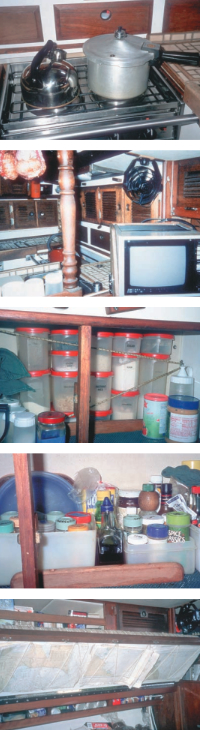
Cooking and refrigeration
In spite of having two large vented propane tanks in the stern, our boat came with an alcohol stove. Another early change was to install a propane stove. With a smallish U-shaped galley, we chose a two-burner stove. Rare is the time we need a third burner because we do a lot of cooking with a pressure cooker, which can be set aside. The two-burner stove has served us so well that when the time came to replace it, we installed another. The oven can hold a 9 x 12-inch cake pan and can even bake a small turkey. An added benefit of its smaller size is that we use less propane.
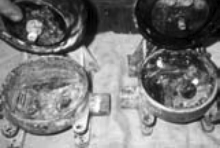
One of the most important additions that has influenced our cruising and given us the independence we like is the installation of engine-driven refrigeration, particularly a large (3-cubic-foot) freezer. Suspecting insufficient insulation in the original icebox, we completely removed the original box right to the hull. Because we wanted 80 percent freezer and 20 percent refrigerator, a new divided box was built that included 4 inches of closed-cell insulation backed with foil. We made our own holding plates (three) using stainless-steel hospital pans inserted with coiled copper tubing and then sealed off on the back with a welded stainless-steel plate. These were placed in the freezer with a spillover hole to the refrigerator.
We chose engine-driven refrigeration, rather than electric refrigeration, because we didn’t want to be dependent on our ship’s batteries at anchor and we are rarely in a marina for shorepower. This proved to be a good choice for us, particularly during the years we were in the Caribbean, as running the engine twice a day during those long periods of anchoring was also good for the diesel. In the tropics we saw many sailors with electric refrigerators who had to resort to large solar panels and wind generators in addition to running their engines twice a day. By building our own refrigeration we have been able to service the system ourselves most of the time. The downside of engine-driven refrigeration is that we have had to empty the freezer during the few times we’ve been up on the hard or have left the boat in a marina to go traveling.
Electronics and power
One of our hardest decisions was whether to get a windvane, autopilot, or both. An important factor was having the dinghy on davits. This made installing a windvane difficult. Another was that we wanted a reliable self-steering system for all conditions — even in light air and when we were motoring. After much research we decided that a robust belowdecks autopilot was better suited to all our needs. Our system consists of three components: a control head, fluxgate compass, and upgraded ram that delivers increased power to the rudder. This system became so important to us that we bought another complete autopilot as backup with interchangeable parts.
It’s hard to believe that when we first started sailing all we had was a compass and depth sounder. We can even remember when Loran-C first came on the market. Thus we went through yet another evolution of Loran-C, SatNav, and now a couple of generations of GPS. We also added radar, which we finally had to replace when we were in Isla Margarita, Venezuela. Before we went on our last trip to the Bahamas in 2003, we installed a 10-inch color electronic chart plotter. We cannot say enough about this new addition. With charts from Lake Superior to the Bahamas, we found the chart plotter especially helpful in the tight areas of the Intracoastal Waterway.
VHF radios are standard on most boats today. Yet, when we first started sailing, many considered them to be an unnecessary luxury. To complement our main radio we added two hand-held radios that were especially useful when traversing congested waterways. Just before we left on our first trip to the Bahamas and Caribbean, we installed a single-sideband radio for long-distance communication. We used 2-inch copper ribbon laid next to the hull for a ground plane. The backstay served as the antenna with the addition of two insulators.
Running power tools
We added a 1,000-watt inverter to provide power for a computer and printer. It is also very useful when we need to run power tools at anchor.
The power supply necessary to meet all our electrical needs also went through years of evolution. In the early years just running reading lights at night was enough to put a serious dent in our ship’s power bank. After much trial and error, we ended up with a three-bank system: two banks of two house batteries each (105-amp flooded deep cycle) and a fifth separate battery dedicated to starting the engine.
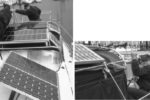
We also mounted two solar panels on the outboard side of each davit. Our reasoning for going with two smaller panels was to reduce our loss if one got damaged. We have found over the years that this is not a problem and, with the newer, more efficient panels made today, we would probably go with one large one on each side if we were to do it over. We have to admit that running the engine twice a day to charge refrigeration is a decided advantage in keeping up our boat’s power supply.
Our Columbia came with a Yanmar 2QM20 engine. With only 22.5 horsepower, we felt the boat was underpowered, especially as we continued to add weight to the boat. When it came time to purchase a new engine, we upgraded to the Yanmar 3GM30F, which has 27 horsepower. Years later, when a wet/dry compression test revealed that the rings had gone bad, we decided to get a third engine rather than have the Yanmar 3GM30F pulled and torn down — a very elaborate and costly repair. At this time we considered an even larger engine, one of the Yanmar HM series with 36 horsepower.
Our experiences with tides and currents had shown us that a larger engine would be very helpful, but it wouldn’t fit without extensive modifications. The domino effects of all the modifications we would have to make to put in a larger engine were too much, and we purchased another 27-hp Yanmar. Yes, there are times we would like to have more horsepower, yet we continue to enjoy the fuel frugality of the smaller engine.
Heat management
Cruising in the cold waters of Lake Superior, we needed heat, especially on night passages. This was another evolution. We ended up going through five cabin heaters before we settled on the Wallas, which is made in Sweden. This is a forced-air system that we installed in the forecabin and vented though the hanging locker to the main cabin. Even outside the Great Lakes, we used this heater when cruising in early spring and late fall.
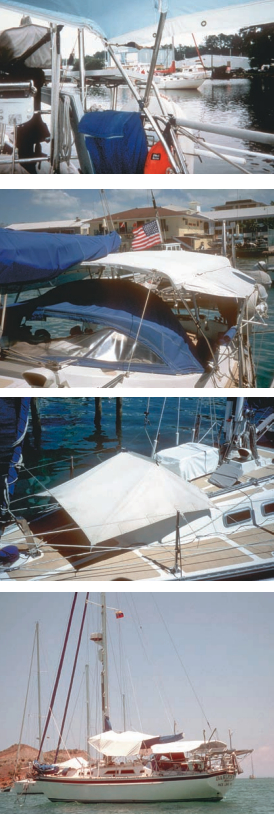
On the other side of the coin, keeping cool provided us with one of our biggest challenges when we were in the south. We learned that the heat in the Bahamas and Eastern Caribbean is nothing compared to the heat in South America: Trinidad, mainland Venezuela, and the offshore islands. Not only were the heat and humidity debilitating, but also the ultraviolet light at those latitudes was quite destructive on plastics, fabrics, and people. Our Bimini became an essential piece of cruising gear.
We had read that keeping airflow through the boat was extremely important. With this in mind, we purposely built the Bimini to overlap the dodger and to be about 10 inches higher than the dodger to allow for airflow. With the idea of preventing heat absorption, we avoided dark fabrics and had ours made of Weblon, a white plastic fabric with a light blue underlining. Reading had told us that the light blue color would reduce the harsh glare reflected off the water. We were able to use shortened back bows by mounting them on the stern pulpit. The front bows were installed on a track so the Bimini could be collapsed and slid forward to be stowed in front of the dodger. This feature was particularly helpful in hurricane preparation.
Since the sun is directly overhead for just a short time, its pervasive rays would often stream in under the Bimini. At first we tried to solve this problem by hanging up large beach towels on the offending side. But the real solution came with canvas twist fasteners. With these, we were able to add wings that are held out to each side with struts and shock cord. This system worked so well that we had a set of clear plastic side curtains made for each side with bottoms that hook onto the toerail. These were particularly useful when we were hit by a cold beam wind or rain.
Deck cover
We had a large deck cover made for aft of the mast and overlapping the dodger. It was constructed with side flaps and set high enough to allow for airflow. But since it was quite an undertaking to hoist, we only used it for those times of long-term anchoring. We had another deck cover made for forward of the mast, but this one never worked all that well, and we gave it away. An adjustable rainhood over the forward hatch worked better for us, especially in the rainy season.
To protect the plastic hatches and winches, we had covers made of Sunbrella. Likewise, we protected the life raft with a Weblon cover. We ended up buying a new dinghy in Trinidad. To protect the dinghy fabric from ultraviolet deterioration, we also had a cover made of Sunbrella for it.
We tried a wind scoop for the forward hatch to get air down below. But that didn’t work very well, and we gave it away as well. Instead, we resorted to Hella Turbo fans in the cabin: two in the forecabin and one each for the galley and nav station. These latter two have the advantage of double duty: they can be turned and directed into the main cabin. The fans draw little power (200 milliamps), and we almost always had one or two on when down below. They were so important that we carried two more as spares.
Never finished
It is interesting that in solving boat problems there are so many choices. It would be pretentious to suggest that ours are the only solutions. Through the years, by the process of trial and error and learning from our mistakes, our boat has evolved into one that is very comfortable for us and our type of cruising. Now, after 27 years and over 50,000 miles, we are still on the Columbia we bought in 1978. In addition to annual maintenance, we are still making improvements to Dahlfin II, our home on the water. Just this year alone we pulled the mast for repainting and changing hardware, upgraded our cabin heater to a new Wallas, and installed a new custom-made stainless-steel traveler. In spite of the joy we get from working on our boat, we are well aware that there comes a point when it’s just time to “go cruising.”
(Part 2 of a two-part series. Part 1 appeared in July 2006.)
Thank you to Sailrite Enterprises, Inc., for providing free access to back issues of Good Old Boat through intellectual property rights. Sailrite.com