Get to know your boat’s capabilities
Issue 53 : Mar/Apr 2007
We motored out of the little anchorage in the North Channel of Lake Huron into a stiffening afternoon breeze. We were beginning to learn our lessons: light air in the morning, much more wind in the afternoon. We set the 110 jib and rolled down to a broad reach. The boat stayed flat and very much in control as we flew at hull speed all the way to our marina. We never touched the main. It stayed flaked over the boom in its cover.
I used to believe that a properly managed sloop would always fly a main and jib, with offwind sails being added when the wind was abaft the beam. That is certainly how they are raced, but I have come to believe that is not how our sloop should be managed when we are cruising.
Although I loved to fly spinnakers in fully crewed racing boats, our 30-foot masthead sloop did not come with one, and I never thought Karen and I would enjoy dealing with such a large unruly sail by ourselves. I could have opted for a “cruising spinnaker” or an asymmetrical, but neither one will sail dead downwind with any grace, so I’ve never wanted either of these. Instead, I bought a long telescoping whisker pole and put the jib to windward when we were sailing deep enough for the main to mask the jib. The big genoas give up very little to boats with spinnakers, but it takes some rigging and is complicated to jibe. Still, I’d changed my mindset a little: we didn’t need specialized offwind sails.
We moved the paradigm a little further when we began to use either the main or jib alone and found that this practice was worth considering in some situations, particularly if there is enough wind to move the boat well with just the one sail. For our boat, the bottom of that wind range coincides with the first outbreak of whitecaps. As a practical matter, particularly when you are not racing, hull speed is hull speed. Once you have reached hull speed, you can press the rig, hull, and crew much harder without gaining much additional speed. In cruising mode, there is no reason for that.
On a dead beat with both working sails, the boat will always point higher and sail faster. But as the breeze freshens, and we have to shorten sail anyway, there are times when we think our best choice is to simply drop one sail.
How and when
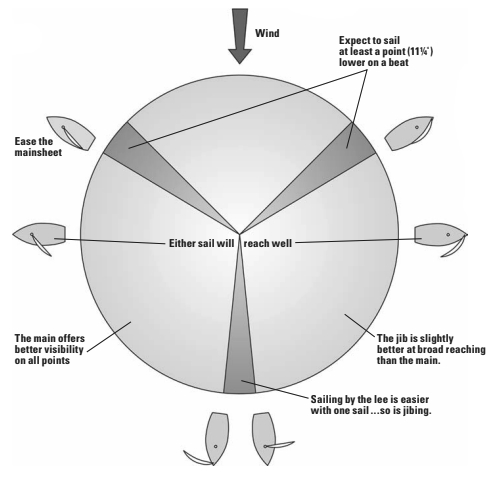
On our boat, either the main or jib will sail every point from a beat to a run (see diagram above). The main is frequently a better choice than the jib on points from a beat to just freer than a beam reach. When beating with the main by itself, it is necessary to free the sheet. The sail is not in the deflected flow of the jib. When beating — with a 150 or 170 and the main — we often have the boom dressed parallel with the keel. When beating without a jib we ease the sheet until the boom is almost out over the leeward corner of the transom. If we pinch up too much or oversheet, the boat slows to a near stop. We expect to sail at least 10 degrees lower when beating “bare headed.” While we prefer to sail the deep courses from a broad reach to a run with the jib and no main, we will sometimes choose the main for this work if we need unobstructed forward visibility — when we are going through shoal areas marked by buoys or when we are in high traffic areas, for example.
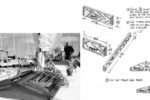
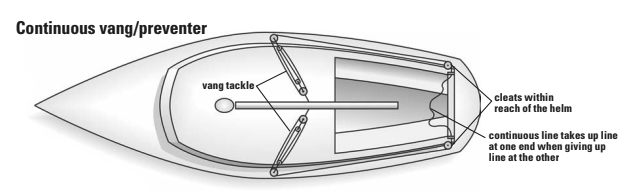
We employ a double-vang system on our boat (see illustration on facing page). There is a vang tackle running from the boom to the toerail about two feet behind the shrouds on each side of the boat. It is attached to the boom so the fall is straight down to the rail when the boom is broad off. One continuous line is threaded through both tackles. As one vang takes up line, the other vang gives up line, so there is not much line in the cockpit. This system functions as a vang and as a preventer completely eliminating the need for a traveler. For more on rigging this system, see my article in November 1998 (available as a PDF file on our first back-issue CD). After we thought we had invented this rig, we began to find references to it in the writings of more experienced sailors. Some of them endorsed it; others were sure it was a bad idea. The detractors contended that the boom would catch a wave and take the mast down. The proponents of this rig recognized the inherent safety and excellent sail control.
Experienced sailors
Oddly, all who commented one way or the other had excellent sailing qualifications. One who liked the rig had raced around the world singlehanded. In the case of our boat, by the time our main has two reefs in it, the boom end is so high that we would have to roll beyond 60 degrees to catch a wave with it. We have used the rig for more than a decade and value the ability of the helmsman to set a preventer in only a few seconds. It is so easy we always set the preventer when the main is freer than a close reach. The inherent friction in the rig makes a flying jibe a very slow controlled evolution that is prevented completely unless the windward vang is released. I mention this here because we believe that every sailboat should have and use a preventer of some sort for crew safety. Other preventer systems require the crew to move around on deck just when it would be better if no one left the cockpit.
Of course, if you are sailing the freer courses from a broad reach to a dead run with a jib and no main, a preventer is not needed. The jib can be quite large to compensate for the lack of a main, and we find that very little, if any, speed is lost doing this. The boat simply goes up to hull speed, and that is that. Unlike sailing with a spinnaker, the boat is extremely stable and easily controlled sailing downwind with only a jib. Our boat has a very short boom and does not have much tendency to round up when sailing downwind with just the main. Even so, when sailing with a jib by itself there is no tendency to round up at all. The boat is so stable in this configuration you will need to be careful not to carry too much canvas and overload the rig or bury the bow. Your only clue may be that you are going too fast.
Easy jibing
Jibes are remarkably easy if only the jib is involved. Pull in the new sheet, turn to the new jibe or even a little beyond it, release the old sheet when the sail blows through the foretriangle, and trim the new sheet a bit. If you do choose a fairly large headsail, you could find that you have broken the very sensible rule of “never sailing downwind with more canvas than you can carry upwind.” You might need to shorten sail from run to reach or beat when sailing with just the jib in heavy air.
We have read that it is not a good idea for some boats to sail without a mainsail. Boats that do not have double lower shrouds with one set led aft are thought to lack the necessary support for the mast. It is believed that, in some circumstances, the mast might begin to pump and eventually fail. Our boat has single lowers that are in an athwartships plane with the mast, so they offer no support against pumping. In fact, our mast does pump when the boat is moored in a slip in a crosswind. It is annoying if we are aboard, but the boat has been doing that for 30 years. Whenever we sail without a main I watch the mast for pumping, but we seem to have a very stout stick, and there has been none. If you sail without a main and you don’t have both fore and aft lowers, make sure your boat does not have this problem.
We have come to think of sailing our sloop with a single sail as just one more option in the menu of choices that we can make to match the rig of the boat to the specific conditions of course, wind, and sea.
Thank you to Sailrite Enterprises, Inc., for providing free access to back issues of Good Old Boat through intellectual property rights. Sailrite.com