Practical lessons gained from a cruising life
Issue 61: July/Aug 2008
Looking back over the years, it’s easy to spot lessons we gained from cruising, lessons I’ve been asked to share as part of Good Old Boat’s 10-year anniversary celebration. But I wonder if the insights are a result of travel or just basic lessons acquired from raising a family. Dave and I realized early in our relationship that we tend to look at problems differently from others and also that we are inclined to accept unusual solutions to ordinary problems.
We built our house, for example, like a boat in the woods. It’s powered by solar panels and propane. During the two years it was under construction, our family of five lived in our self-built garage without such amenities as hot water and a shower. Much like living aboard, we had battery-powered 12-volt lights and a wood stove for heat.
Now we’ve moved into the house, and even though our children miss cruising, they’ve seen the advantages of living a shoreside life, and so have we. A “normal” high school education, complete with afterschool activities and numerous peers, is a great contrast to an adventurous traveling life.
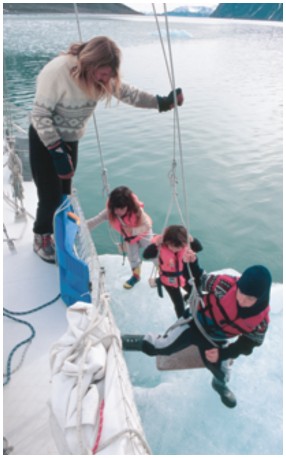
Whether cruising high latitudes or going to high school, most of the important lessons our children have learned have not been from books. As we make the philosophical transition from life on board to life on land, it’s useful to consider the lessons we’ve learned along the way.
Our perspective changes
Perspective is like a piece of glass. Sometimes you can see through it to the big picture, and sometimes all you can see is your own reflection. After five years on land, we’ve finally achieved a clear view of our cruising life. In the midst of our adventures we were too caught up in daily challenges to contemplate alternative lifestyles. But now, when I see mothers pushing their babies around in high-tech strollers, I realize that we really did raise our children differently. But differently from whom? In the islands, mothers tied their little ones to their backs with a piece of cloth; we had a fancy front pack. We were living the life of luxury.
Later, when we met other families ashore, they often wondered how we squeezed all our stuff onto our boat, dealt with privacy, and coped without conveniences such as a car, a washing machine, and running water. We didn’t realize we were coping without anything! Now that we live in a house, I finally understand their astonishment. We have storage for stuff, the kids have their own bedrooms, and I don’t know how we’d get around without our car. If I contemplated putting everything from our house onto a boat, it wouldn’t work. But some of our cruising ways have stayed with us: we don’t collect too much stuff, our needs are broken down to the basics, and we revel in being self-sufficient.
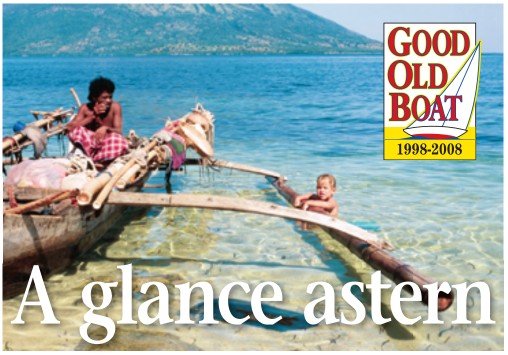
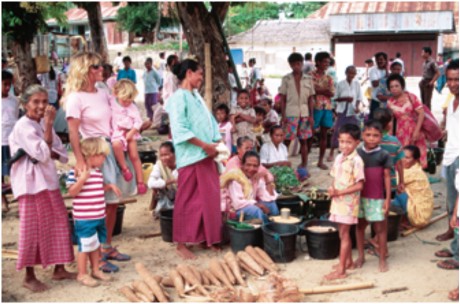
While cruising, our perspective changed along with locale. When we visited remote Indonesian islands, locals would paddle out to our 25-foot boat and lounge in our “voluminous” cockpit. We offered coffee with canned milk and sugar. When asked if they wanted a refill, they were completely taken aback. Were we so rich that we could offer two cups of coffee? They marveled over our scented shampoo, sunglasses, and fishing lures. Just a matter of weeks later, yachtsmen in South Africa stood on a wharf looking down on our boat. Through the open hatches, we could hear them talking: “Look at that tiny boat . . . everything on it has been broken and fixed at least once . . . imagine being at sea tossed around in that tub.” We were the same people, but we were unbelievably rich in one place and pitifully poor in another.
The perspective shift that occurs during the beginning of a passage is probably the most difficult to prepare for. Going from frantic-preparation mode to the relative idleness at sea requires an adjustment period. The brain is still in high gear, but there is comparatively little to do. We learned to prepare for this change by anchoring in an uninhabited bay for a few days before setting sail. When the mind and body acclimatize to the quiet life at sea, events are reduced to basic levels. Life is peaceful and fulfilling. Unfortunately, this unique state of mind ends the moment we enter a new harbor and our feet touch land. Everything on shore seems overwhelming at first. Then slowly we reacclimatize. Around and around it goes.
It’s easier to do without
Having a lot of stuff isn’t a prerequisite for a successful voyage. In fact, it’s easier to do well with less. Here are some items that Dave and I did without: paper towels, disposable diapers, new charts, fancy electronics, and specialized sailing clothing.
I remember reading in a cruising handbook that if you cut your rolls of paper towels in half, they would last twice as long. The author wondered how Columbus could have possibly sailed without paper towels. I could have told her: he used rags. Then he washed them and used them again. Paper towels were definitely out of our budget.
Charts were another story. Whenever we could, we bought updated charts. Sometimes we used extremely old charts, photocopies, and even tracings. We found that foreign libraries often had stacks of charts for reference (useful for tracing or for making photocopies). Basics such as clothes and books are necessary but can be taken along in limited quantities. Books don’t have to accumulate aboard, since every cruiser is eager to trade for something new. And fewer clothes mean less to wash. With less stuff the boat is lighter and space can be used for important things such as food, water, fuel, and spares.
Just because there is empty space in your life does not mean it has to be filled.
Consider the source
Information about a destination can be gathered from cruisers who have already been there: where to clear in, which dryer works for free, and where to buy the cheapest rum. Although we frequently collected information from other cruisers, we learned to scrutinize the source. Someone from a large yacht might recommend an expensive marina. The owner of a small boat will usually point to an adequate anchorage. The trick is to filter the information and mold it to our own situation.
We also found that information becomes outdated quickly. Seasoned cruisers in the Caribbean advised us to carry bolts of cloth when traveling through the Pacific islands: “Natives will trade fruit and beautiful carvings for it.” Luckily, we didn’t have enough money to buy cloth. By the time we got to the Pacific, the natives had enough cloth. They wanted gold jewelry, perfume, fiberglass, and resin. We traded cassette tapes of rock music for fruit.
Another important lesson we learned was that negative people tend to give discouraging opinions, while positive people think everything is great. Either viewpoint can be erroneous.
Fix it yourself
When something stops working, we take it apart and try to fix it. This is especially true of the engine. Often the repair is quite simple. If it can’t be fixed, at least there’s an understanding of how the equipment works. Maybe replacement parts can be ordered. The more gear we have taken apart, the more discerning we have become when buying something new. Quality products are generally easier to dismantle.
We learned that it’s usually worth-while to spend the extra money and buy good quality items. Gear is designed to make our lives safer and more convenient. I would rather do without something than buy a cheap reproduction that is going to prove unreliable.
Speak the language
We had a better time when we tried to learn the local language. It doesn’t take much to pick up a few words of any language, but it will bridge an enormous gap. With just 10 or 20 words, we could reach out across cultural boundaries, especially on small islands where locals were shy and didn’t speak many words of our language. In Indonesia, we made an effort to learn our numbers (for bargaining) and basic niceties (hello, goodbye, please, thank you, and so on). Being able to speak French in the French islands opened up doors (and jobs) for us. A smattering of Spanish was also useful here and there. (Now that our kids are teenagers, Dave and I have had to learn an entirely new language.)
Have child ambassadors
After we had children, we were received much better in every country and in every culture. Cute babies are especially good ambassadors; very few people can resist them.
We learned that a young couple with kids is less threatening than a young couple without kids. When our kids entered local schools, we had automatic friends in the parents of our kids’ friends. We became part of the local society while volunteering at schools, attending sporting events, and celebrating holidays with other families. We enjoyed being involved and having the opportunity to experience how other societies operate.
Get away from the crowd
We learned the value of getting away from the cruising crowd in the anchorage. Although we’ve had excellent times hanging out with fellow cruisers, our best memories come from times spent on our own. Sometimes, as in Panama, we had to take risks to get off the beaten path. At the time of our canal transit, Noriega was being ousted. There were rioting and civil unrest in the streets. “Don’t go out of the Canal Zone,” people warned us. “Stay inside the gates. Don’t walk to the grocery store.”
We took the challenge and walked to the store. Life outside the gates seemed fairly peaceful. Since we didn’t want to hang out by the yacht club, we walked to town, boarded a local bus, and toured the distant hills. We met some villagers, had fresh octopus for lunch, picked pineapples, climbed a mountain, and were followed around by groups of children. A memorable day. Back in the Canal Zone, cruisers were nervous. There was a strange group energy: the Canal Crazies.
We found that by getting off on our own we could have a more spontaneous day. We didn’t have to plan events, meet at certain times, or worry about cock- tails. This philosophy served us well. It is much easier to get to know locals when you are not part of a big group.
Send simple letters
When writing to friends and family, we have learned to keep it simple. As the recipient of many form letters and email travelogues, I can say that my favorite letters are the short ones that are filled with insights and irony. Be careful not to bore your friends with temperatures, wind speeds, and sail combi- nations. Forget the history lesson. The best stories revolve around people you meet and the funny situations you get into.
Beware, however, of giving experiences away too cheaply. Dave and I work hard for our adventures. We spend a lot of energy getting into situations that make us wonder why we ever chose a life under sail. Before giving away the best stories, we want to savor them, turn them around in our heads, find the irony, the humor, the perspective. It’s a way of learning something about ourselves. If given away too quickly, our stories cease to be ours and deep understanding may never come.
Now that we have embraced land life, Dave and I are looking forward to making a new transition: back to boat life. This time it will be different. This time we’ll be taking all the lessons we’ve learned on land and applying them on the boat.
Jaja Martin began sailing with her father in New Jersey and met Dave in the Caribbean, where they started their circumnavigation. For more insights into the Martin’s lifestyle, visit www.iceblinksail.com.
Thank you to Sailrite Enterprises, Inc., for providing free access to back issues of Good Old Boat through intellectual property rights. Sailrite.com