‘New’ anchor light maintains old tradition
Issue 58 : Jan/Feb 2008
One of the pleasures of a traditional-style boat, such as my Persistence, is the encouragement she gives us to practice the old skills of seamanship and to do many of the tasks commonly dealt with these days by flipping switches or up-linking or downloading or interfacing something. We have no weatherfax, autopilot, or computerized charts. We do have radar, radio, and a depth sounder, though we did very nicely without any of them one wonderful summer in a previous boat. Because of our hands-on style of cruising, our whole experience is deepened and given extra levels of meaning that might otherwise be lost. Take our brass, kerosene-burning, anchor light.
No matter that Coast Guard rules and good common sense require one, many boaters don’t seem to bother with an anchor light. However, a sailor has only to grope into a strange harbor once after dark to realize how frighteningly difficult it can be to see an unlighted vessel at anchor. A late-night row back to your own boat after a serious social hour or two elsewhere can be a “sobering” experience all by itself. It’s a small thing, the anchor light, a simple little insurance policy. A small electric light fixture, a switch and a bit of wire would do the job, but the twice-daily ritual of our lantern is symbolic of what our way of voyaging is all about. Reduce it to flipping a switch? No thanks.
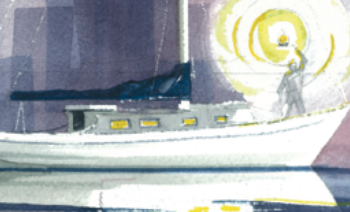
Each evening, the anchor light is brought from its corner of the cockpit locker. It is opened and filled, the wick pinched free of carbon (oily fingers surreptitiously wiped on pants) and lit. It is then re-assembled, clipped to a shroud, and hoisted on its own lanyard where it sways easily until morning. My wife’s first task on the dewy deck of morning is to lower it, blow it out, and return it to its little corner of the locker.
Wendy and I are not just a couple of old fuddy-duddy traditionalists resistant to change or oblivious to progress. For more than 20 years I doggedly carried a battered old kerosene railroad lantern that worked just fine. It never blew out and it was pretty bright.
Trash and treasures
When Persistence came to us, neglected and forlorn, she was stuffed with moldy decades’ worth of accumulated detritus. Among the trash and treasures, we found a wonderful heavy old brass anchor lantern made of thick metal. It was made in Germany who knows when. It had that nice pale green patina that only time and salt air can create. It had a heavy cast-glass lens that focused the light just like the lens in a lighthouse. It even had a ring on the bottom for securing it from wild swinging. It was a real piece of gear for a real boat.
Were we resistant to change? Did we stay locked in the past? Not on your life! We “upgraded” in a heartbeat. Progress and modernity had sought us out and we embraced it as some might embrace another hundred gigabytes of . . . whatever. We’ve kept the old railroad lantern as a spare, of course, and if all goes well with the “new” anchor light for a few years, we may permanently retire it. For now, though, the more advanced technology has won the field. Glancing across the night harbor or rowing home in the dark, I have the same smug satisfaction of any other cutting-edge guy. We may resist being up-to-the-minute but there’s nothing wrong with being up to the 1940s.
I run it aloft, secure it with a certain little hitch that works particularly well, and look up to see its band of yellow light reflected from the mast. Even in the middle of summer when it never really gets dark — even when we’re so far up the inlets that we haven’t seen another boat for days — still, every evening before bed I set it out and still, every morning Wendy goes to the dew-wet cockpit to lower it and make wet footprints on the galley sole as she starts the morning coffee. The anchor light is one of the slow metronomes that mark our days.
Brooke Elgie and his wife, Wendy Stern, have cruised the “upper left corner” of North America for many years. They primarily cruise in Alaska, where they have adopted the town of Tenakee Springs and are building a home.
Thank you to Sailrite Enterprises, Inc., for providing free access to back issues of Good Old Boat through intellectual property rights. Sailrite.com