Hefty downgrading leads to happier sailing
Issue 58 : Jan/Feb 2008
While climbing the ladder to the deck of my old wooden sloop with yet another can of paint, a disturbing thought occurred to me. I stopped and looked out over the dozens of neglected and unused boats in the boatyard. It was then that I knew I was going about it all wrong. In thrall to the demands of boat ownership, I was no longer calling the shots. Seeing all those unused and neglected boats in the yard, I knew that many others had come to the same conclusion: when you spend more time fixing and sanding and priming and painting and upgrading than you do actually sailing, it just isn’t worth it.
I walked back down the ladder and never went back.
I sold our boat the next week and tried to remember what attracted me to sailing in the first place. There is the love of the sea, of course, the indescribable sensation of a full sail and the sound of water flowing past the keel . . . the smell of kelp and salt . . . exploring new places by water . . . the skill and sport of sailing itself . . . and those so-rare commodities, solitude and silence.
But nowhere did I yearn for hours of backbreaking work on the bottom of a hull surrounded by toxic dust; the endless draining of the bank account; purchasing inordinate quantities of environmentally hazardous and expensive chemicals (I never had need for carcinogenic, aromatic hydrocarbons until I owned a sailboat); and the constant vigilance required to keep an aged, wooden vessel seaworthy and reliable.
Where had the dream gone awry? The problem was in the boat itself. None of the things I looked for in sail- ing required a deep-draft full-keel sailboat, much less a wooden one. Like many others, I always thought I wanted a bigger boat, even though downsizing in the rest of my life has made me a more contented person. I did not know why my love of boats had blinded me to that philosophy, but I was determined to bring my love of sailing into line with the rest of my life.
Large variety
I went shopping for a dinghy. I was surprised at the variety of dinghies out there, but it seemed there were two designs: dinghies used as tenders and dinghies used for racing, the latter being far more common. Those I judged as unacceptable for my purposes, due to their instability and lack of comfort.
Most larger daysailing dinghies, better suited to the “messing about in boats” philosophy, were made of wood and homebuilt. There had to be something simple, seaworthy, fun, and inexpensive.
While walking along the shores of Okanagan Lake, I noticed several catamarans pulled up on the beach in front of the Kelowna Sailing Club. I looked them over: GRP pontoons, vinyl trampoline, aluminum spars, simple rigging. I climbed onto one . . . comfortable enough at 16 feet. I had heard of Hobie Cats, but I knew nothing about them. But there was something I really admired about the lines of the vessel, the comfort, and the stability offered by twin pontoons.
As it happened, there was one listed in the local paper for sale: an early 1980s model. It had been epoxy painted with upgraded rudders and sails in very good condition and was offered for $1,500, including trailer. I was hooked.
Our first launch at Crescent Beach was quite an affair; my wife and I took a long time to figure out how to raise the mast and set up the rigging and sails. Now I can do it in less than half an hour, but that day the gulls giggled at us.
Did I mention I knew nothing about Hobie Cats? This boat had a stick and sails and a rudder, so I figured I knew what I was doing. A sailboat is a sailboat, right? There was a 10-knot breeze that day, gusting to something over 15. I had just climbed onto the trampoline when the wind gathered in her sails and she took off under me as if her pontoons were twin rockets that someone had lit beneath us. It was only my panicked reflexes that saved me from being dumped in the water, leaving my poor wife aboard . . . a fast-diminishing dot headed for Seattle.
Wailing cry
My cry of “Aieeeeeeeeeee!” carried over the water like the wail of some kind of grotesque waterfowl that had seen the other side of death and was deeply distressed by the vision.
I had no idea that anything on water could move so fast! A very good speed for our old sloop would have been 6 knots, but we were doing at least three times that. I have since seen a video showing a guy waterskiing behind a Hobie Cat. ’Nuff said.
Ducks scattered, the patapatapat of their stubby little wings skipping as they ran frantically across the water ahead of us. I envisioned catching whole flocks in our jib, like sardines in a gill net. I threw out the mainsheet and we ploughed to a stop, our eyes as wide as hubcaps.
As far as I can tell, most Hobie Cat owners prefer to race their vessels in regattas; instead, we found the perfect weekend sailer. With a draft of only a few inches, I can take this boat anywhere. As long as you can feel air moving with a wetted finger, she will move, loping along at a few knots. And when the wind comes up, you have a choice: go like stink, maybe even flying a pontoon, during which that same eerie shriek sometimes finds it way out again, or just ease the sheet a bit and run circles around a Zodiac for an afternoon. You don’t have to get wet unless you want to.
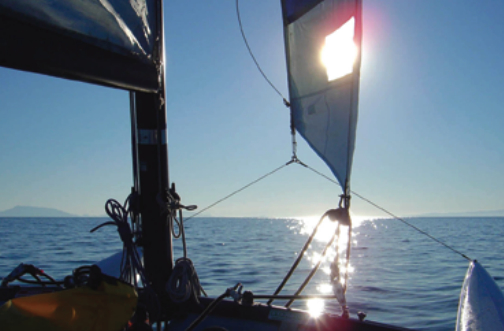
I’ve found the sailing I was missing. Many a long day I’ve stretched out on the tramp, foot hooked over the tiller, drifting along a shoreline somewhere. There I’ll be: lying on my back bobbing in the swell, staring at a blue sky while playing childhood games of what the clouds look like, with the multi-hued, sunlit sails a dazzling display of color. Occasionally, I’ll turn around and check what’s ahead. After all, it’s the other guy I have to worry about.
Motion of the sea
With such a small, light boat so close to the surface of the water, I feel the motion of the sea, like a paddler does in a kayak. Everything is so quiet I can hear the peeps and churrs and twerps of the sea ducks that do not seem disturbed by our presence. So simple to helm, so simple to maintain, so simple to just bob around on the ocean. It’s also possible to scream along when the mood strikes. There have been wild bronco days out on the Strait of Georgia in a steep chop with water flying in our faces, when we were having the time of our lives.
I’ve never felt so safe in a boat, never relaxed so much. There’s so little to worry about. I remember the questions that occupied my mind while sailing our keelboat. Is the bilge pump in order? How are the through-hulls and clamps? What’s the depth? Is the engine tuned right? How’s the gas? What are the current and tide doing? What’s the direction of the wind? What’s the state of the GPS batteries? Does the anti-fouling need to be done this year? How about deck paint? Is the hatch leaking again? And there is the ongoing battle against rot. The list seemed endless.
When sailing the cat, I have often let go of the tiller and tied down the sheets and allowed current and wind to take me where they will. Sometimes I’ll let it go aground and my wife and I will jump off and explore a new beach. Like kayak sailing, it is easy enough to pack aboard a tent and camping gear in waterproof bags and explore the Gulf Islands. If the wind dies completely, we can paddle or just bob about and wait for something to happen. Sometimes we’ll read a book. There’s no hurry. The trampoline feels like a mattress anyway.
In the year we have owned our cat, I have bought a couple of spare stainless shackles and spent $40 repairing our jib. Our trailer insurance is around $150 a year. I have spent far more hours snooping along the coast and exploring lakes — even in December — than I ever did sailing our old sloop.
As I’ve aged, I’ve found that contrary to the mainstream values of our culture, less is far more. So it’s not surprising that simplifying sailing has led me to so many more hours of what sailing is to me: unfettered time on the water with a sheet in my hands and a sense of absolute freedom. The sea and the wind are free and are what it’s always been about after all.
Since penning his article, Nathaniel Poole pushed out the kids and moved from a 3,000-square-foot house to a 36-foot sailboat. He lives aboard with his wife in Victoria, British Columbia, writing historical novels and dreaming about simpler days aboard the Hobie Cat.
Thank you to Sailrite Enterprises, Inc., for providing free access to back issues of Good Old Boat through intellectual property rights. Sailrite.com