Drawing has many charms and practical uses
Issue 60 : May/Jun 2008
We keep a ship’s log on board KUMA that records our position, wind direction and speed, tides and currents, engine hours, and other information relating to the safe and efficient operation of the boat.
We’ve also noted uncharted rocks and sandbars that caught our keel. We’ve described good landfalls and narrow escapes, the retrieval of errant halyards and the time Beth hooked a spiny dogfish that we had for breakfast. (“B catches 28-inch shark. A beauty! She cleans it too — cuts into steaks and soaks overnight in vinegar to get rid of uric acid.”) All of this makes for excellent reading in front of a winter fire.
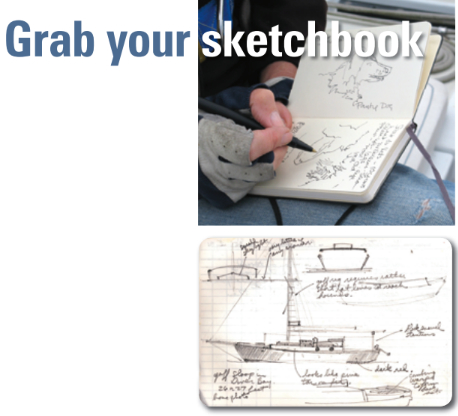
Along with these entries there are myriad sketches that rekindle past summers as surely as our written remarks do. A sailor/doctor/friend once told me that medical students taking exams in surgery used to be required to draw their answers, diagrams and illustrations being considered better proof of knowledge than words.
Moored or anchored
It’s important to remember that whatever our love of sailing — of crossing oceans, racing, or running down a late-afternoon breeze to a familiar harbor — our boats will be moored to a dock, anchored, or in the yard for the vast majority of their lives. But with a little effort, a sketchbook can help us wile away some of the happiest hours afloat. Finding pleasure with a pencil or a pen is equal to that which results from completing a good varnish job, and it lasts longer too.
After we’ve dropped the hook and backed down, I like to put the kettle on and sit in the cockpit for an hour or two with an eye on a couple of verticals off our beam — a flagpole and a mast or a tall fir — to see if we’re dug in. With a good cup of coffee in hand, I look around the anchorage at other boats. I think about their underwater shape and windage, how much scope they’ve got out, and whether it’s all chain or mostly nylon. I wonder where they’ll be at the change of tide and when the wind comes up hard.
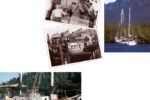
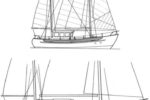
With all this looking and musing, I sometimes find a boat that strikes my fancy. It might be old or new, big or small, dead common or eccentric, one that’s just arrived or one that hasn’t left its barnacled mooring buoy in years. I often draw such a boat. I might take a photograph too. But if it’s a really good boat, I like to draw it. It seems to stick better that way.
Later on, rowing the dinghy about the harbor, I have a closer look and sometimes chat with the boat’s skipper, who’s apt to be surprised at how much I know about his boat. At the end of the day, I’ve often found an idea or two to build into Kuma.
Draws everything
My wife, Beth, is an artist http://elizabethsmithprints.com and draws everything in sight: the harbor and its trees; our dog, Scout, who’s usually asleep; a cleat; other boats moving about the anchorage; and sometimes one of my more exciting adventures in the dinghy.
Drawing in this way is not about making a picture; it’s the doing it that counts . . . rather like whistling a familiar tune without expecting that anyone will listen carefully.
Drawing, like anchoring, takes a certain will and practice but no particular talent. That may or may not come later. But like anchoring or tacking smartly, the more you do it, the better you’ll get. Doing it over and over will reward out of all proportion to the effort.
Sketching out what you intend to do before you do it is just common sense, but drawing for pleasure causes you to slow down, to look more carefully and longer at whatever it is that catches your eye. It seems to fit rather naturally into the sailor’s life of waiting for tides or for the weather to clear, for the wind to get up or to get down, or for the soup to boil. It’s why sailors have made model ships and etched on the teeth of whales. It’s a good way to pass the time.
Thank you to Sailrite Enterprises, Inc., for providing free access to back issues of Good Old Boat through intellectual property rights. Sailrite.com