A cruiser goes racing and finds common joy
Issue 60 : May/Jun 2008
After three years of living aboard and circumnavigating the world, Evans and I sold our Shannon 37, Silk. I cleaned out the last of the lockers and said goodbye to a vessel that had become both my protector and companion. After that, I felt dislocated. Rudderless. I missed the unique partnership Evans and I had shared aboard Silk, the camaraderie of the sailing community, and the challenge of the open ocean. Not long after that, while visiting my scow-racing sister in Madison, Wisconsin, her racing friends asked me why I sailed around the world, and I found I had no words to explain it, nothing that would make them understand.
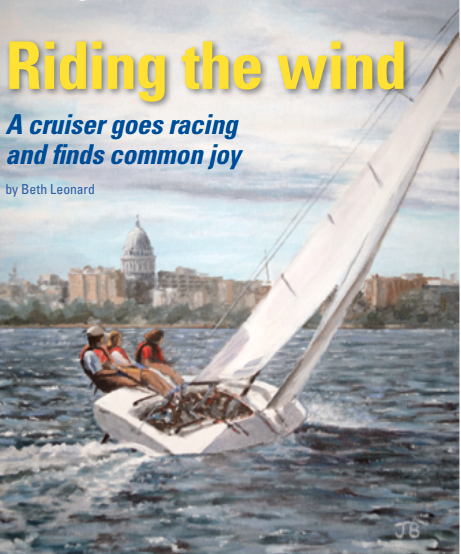
While I was visiting my sister, Leigh, she and her partner, Steve, wanted to take me sailing, but this would be their kind of sailing, not mine. At Burrow’s Park on Lake Mendota, I looked out at the wind-whipped lake and the orange racing buoys and wondered how this could possibly compare to an open ocean passage. I looked at the M-20 scow that we were about to race around those marks, and I found myself thinking that Zephyr had nothing in common with Silk, our ocean-going, centerboard ketch. Instead of a lead keel to keep the mast uppermost, this 20-foot catamaran-like dinghy had two leeboards and no reefing lines, yet there were numerous other lines that Silk did not have. Still, when Leigh tugged on my arm, I shook off my discontent and headed down to the dock where Zephyr waited, the wind rustling her hanked-on sails.
Steve stepped aboard and raised the sails. I know that sound well, though it is one that always meant trouble on Silk. The flogging main and jib snapped and crackled in the 20-knot wind, and even Steve’s yell was lost in the cacophony of sound. But Leigh understood and pushed me aboard. I stepped onto the tiny foredeck feeling the light boat shift and shimmy at my weight, hoping she wouldn’t duck her nose and buck me right off. Then I was in the bathtub-sized cockpit, and Steve was telling me to stay low while we headed off on a starboard tack.
Getting away
“Ready?” Steve yelled above wind and sail.
“Ready!” With a shove, Leigh came aboard while pushing Zephyr’s nose toward the weeds that mark the shallows on the edge of the shore. The wind filled the sails, Zephyr dropped her shoulder, and we were cruising toward those weeds only a few boatlengths away. “Ready about,” Steve cried. And to me: “Just duck under the boom as it comes across.”
“Ready,” Leigh called back. “Ready,” I croaked. “Helm’s a lee!” And Zephyr pivoted and pointed at the wide-open lake while Leigh and I porpoised under her boom and came up on the other side. Now we were sailing. “Trim, trim, trim,” called Steve, while Leigh fought to find hiking straps with her feet while reeling in the jibsheet. “Puff coming,” called Leigh, and the wind hurtled into Zephyr, putting the lee rail well under water. “Bailers aren’t open!” exclaimed Leigh. “Later, later,” called Steve. We were into waves now, not Silk waves; if they were Silk waves they’d be 10 feet tall. Zephyr’s nose buried into one, and she sounded, shaking the water from her in great arcs of foam. Another wave covered her bow, and I had an image of Silk, decks awash with green water, bow rising up to meet the next assault. Here, I was not sailing over the water, I was in it, and I was one with Silk and Zephyr both as the bow was buried once again.
I was aware of other boats around us, and then Steve was bearing off. “OK, clean her up!” he called. Leigh dropped to the bottom of the cockpit and coiled floating lines while reaching for the bailers. A puff hit us, and she immediately lunged toward the windward rail. “Got it, I got it,” sang Steve. In a short minute, the cockpit was back to normal, and they were trimming in perfect synchrony as we raced at breakneck speed toward a motorboat. Steve brought her head to wind, lathered and shaking, while he read the course and wind information written on a postage stamp-sized board on the side of the motorboat. Then he bore off and she danced sideways before the wind caught her and whipped her again into her hard-pressed gallop.
Before the start
A gun went off, and Leigh called, “Got it!” while she fumbled with her watch. “Ready about,” called Steve. “And again!” “Once more!” Then, “We’ll just wait here for a minute.” I just had time to see an orange race mark to our port and the motorboat to starboard. There didn’t seem to be anyone but us in the immediate vicinity. Then Leigh started a countdown, “Ten, nine, eight . . . ” and Zephyr leapt from under us, moving faster and surer than she had since we got out on the water. As we flew over the line, I heard only the wind in my ears and the rush of water at my feet. Zephyr was flat out, unburdened by extra weight in her cockpit, running like a steeplechaser, leaping from wave to wave.
“Trim, trim, trim,” called Steve. “I need her trimmed. I can’t hold her on course if she’s not trimmed.”
“Got it,” Leigh responded. “Wind ahead!” Zephyr staggered a bit, then we were all hiking out and she found her feet again. “And more!” My back was parallel to the water; the waves were awash with sparkling sunbeams. “Still more!” Leigh called. Foam was running in streaks from the white-whipped wavetops, and some far-away part of my mind clinically noted, “Force 5 to 6: time to reef.”
“Ease, ease, ease,” chanted Steve as we rode up on the gunwale, water foaming in a great arc as a wave washed over the leeward rail. He reached for the backstay adjustment and, as he pulled on it with a grunt, I watched the mainsail contort and wrinkles appear in its top third. Zephyr flattened out joyously, and we were absolutely flying — faster, surely, than we ever managed in Silk — as the water rushed by above and below me.
Wind dropping
“A lull,” called Leigh, even before the boat flattened further and we rolled upright with it. Two beats, three, four — “Wind line in three seconds!” And our bodies fell back in unison, ankles straining against the wide strap in the cockpit, butts rolling over the edge of the gunwale as we levered our shoulders out over the water. This time Zephyr didn’t even hesitate, she just kept running at speed, the fresh wind a welcome partner and the flattened seas an easier track. “Ready about!”
“Ready!” “Ready!”
Zephyr spun about but seemed sluggish as she tried to forge into wind and sea on the other tack. “The board, I need more board!” Steve called urgently. “Sorry honey, I’ll go for it now,” Leigh responded, as she handed me the jibsheet. “OK, I got her — go, go, go!” Steve urged. To me he said, “You can flip her as easily as I can, so just hold it gently. I’ll steer to you.” Leigh dropped down to the lee rail, her hand on the line that controls the lee board, and I saw Steve easing the main as Zephyr’s delicate balance changed with the shift in weight. “Come on back up please, dear,” he said through gritted teeth. Then Leigh was reaching for the windward rail and pulling herself back up with one hand, her other hand controlling the jibsheet even before I released it. Zephyr flattened and resumed her mad rush with a delighted whoosh of churning water.
We tacked again and when we came up on the other side, there was the mark. “Once we round the mark, I’ll tell you where I want you.” I nodded, and for the first time really watched Steve. Traveler, tiller, sheet; ease, trim, ease, turn; his eyes were on the mainsail even as his hands caressed Zephyr’s heart and soul. A quick glance at the mark. “Ready to ease . . . ” “Easing!” Then we were skating around the mark at the same time that Zephyr was coming upright. Leigh dropped the sheet into the cam cleat and was already moving forward, pole in hand. “I want you back here with me,” Steve said calmly. I moved back behind the traveler into the aft part of the cockpit and perched on the gunwale, trying to stay out of the way of the sheets, lines, cleats, and tiller.
Up spinnaker
“Ready?” Steve called. He was standing, the crosspiece of the tiller against the back of his legs, feet wide, eyes on the foredeck, hands handling guy and sheet. “Re . . . dy” barely reached us from the foredeck, blown off the bow of the boat by the wind now over our stern. Then Steve was hauling on a halyard and the spinnaker was uncoiling from its lair belowdecks, a great blue and white snake gyrating into the air, writhing and twisting in the wind. A belly appeared with a smack, and Zephyr’s bow was being pulled up, out of the water.
Leigh was back in the cockpit. “Want me to handle the sheet?” “Take it.” Leigh grabbed it next to the block, pulling it from Steve’s hand and then she was trimming, easing, trimming, easing — her eyes glued to the luff of the great sail looming over our heads. Everything seemed quieter to me suddenly, but I could tell by their rapt attention that what came before was easy compared to this. The boat was humming, a resonance from the gunwale that I could feel as much as hear. She became skittery like a car on an icy road. Steve was driving with a finger, a touch, feeling her respond, waiting for her. Not a word was spoken for what seemed like a long time, but I didn’t ask questions. We were poised on the edge of control, kicking up a wide foaming wake in our stern, running with the waves bounding down the lake, racing through this leg twice as fast as the one that came before.
Suddenly I was on Silk again, rounding South Africa, running dead downwind in 45 knots with only the staysail up. The wind was a knife frosting each wave front with white streaks of foam. Silk in my mind and Zephyr under my body merged and sang to me as only a sailboat in the throes of a passionate encounter with the wind can. This is not sailing — this is flying.
Hands full
“Time to jibe,” Steve called. With his third hand, Steve took the sheet from Leigh while she went up on the foredeck. The sheet became the guy just as Steve brought the wind across the stern of the boat. The spinnaker barely flinched, then filled on the port side. Zephyr skated off to that side, and Steve’s hips swayed, moving the tiller ever so gently in one direction while his hands rapidly eased, then trimmed, the sheet. Somehow, Leigh was back in the cockpit and handling the sheet while I was still wondering how we stayed upright.
The bright orange mark began looming larger and larger. I could sense the urgency even before the activity started. “E-Scow ahead. Let’s get it down now.” As Leigh moved forward, Steve had time to say to me, “We’ll slow her down as we round the mark or else the mast will just keep right on going and we’ll all go swimming.” He was managing the sheet and guy once again, with eyes only for the billowing spinnaker. Then Leigh was thrusting the spinnaker pole back into the cockpit and grabbing the guy to pull the foot of the sail to her. “Ready!” Magically the halyard was released, and Leigh was gathering tack and clew together, chasing the wild wind out of the unmanageable sail, stuffing it back into its den as the sail collapsed. Almost before it was away, Steve was calling, “Trim, trim, trim!” and Zephyr was coming up toward the wind, reaching with all of her heart, closing on the mark at a breakneck pace, driving through the water with spray cascading in white sheets from under her bow. She was just on the edge, but Steve had a wild grin on his face. “Screaming jib reach!” he cried, as the mark came to our bow.
Everything changed. “Slow her down, slow, slow . . . ” Even as the sails were eased, she came up toward the wind, tossing her head and skittering as she reluctantly heeded his hands. “Now, now, now — and go!” They were both trimming, hands a blur by their ears, sheets flying, as Zephyr spun and headed up, gathering speed, facing wind and waves once again.
Soaked through
The mark receded quickly behind us. The wind bit, cutting through sodden clothes. I felt Leigh shivering next to me as she called, “Wind line, five seconds.” A wave hit and the bow submarined. “Can’t see,” called Leigh. “Got it,” I heard from over my shoulder. “Wind’s here,” I called just as Zephyr rose restlessly under us. But we had the feel now, and together we held her, while busy hands trimmed and eased, trimmed and eased. We were driving into it, wind and water part of us, flowing over us, around us, through us. The bow was high and dry, and we were moving faster than on the first leg as she met each wave and seemed to float above it. We were halfway down the course before the second M-20 rounded the mark. “They just can’t hold her down!” yelled Steve as the boat behind us heeled dangerously then rounded up.
“Take the sheet,” urged Leigh. I looked at her wide-eyed. “I’ll help. Take it.” I turned to Steve who simply nodded once.
My hand closed on the sheet and suddenly Zephyr was talking to me in an echo of Silk’s voice. “Trim, trim, trim.” “Ease . . . ” I watched the telltales on the jib and listened to Leigh’s voice and felt Zephyr in my hand like a well-trained horse. There was no separation between me and Zephyr and Steve. It took all three of us all of the time to keep striding wildly over these waves instead of being flipped under them. There was no forgiveness here as there was on Silk — no safety margin. There was only upright or over, flying or crashing, on the edge or beyond it.
We drove hard to the windward mark, eased again, spinnaker up. We skittered, skated back to the jibe mark, checked our speed, doused the spinnaker, and headed up once again. I lost track of the other scows, lost track of the motorboat, lost track of the feel of anything except Zephyr doing what she was born for, what she does best. We were riding a thoroughbred, attuned to the least change in stride or tension, linking arms as we moved in unison on the windward rail. We and Zephyr were one in that magic space between control and crash, running the edge with wild abandon.
Finishing line
The windward mark loomed in front of us for the last time, and I felt the same mixture of exultation and disappointment I used to feel at landfall aboard Silk. Leigh and I porpoised under the boom one last time, and I came up to see the motorboat just to starboard, the mark to port.
A voice boomed out, “Six-fifty-two, you are first! Congratulations!”
“Ease, ease, ease . . . ” chanted Steve. The race might be over, but we were still riding a wild thing.
Back at Burrow’s Park, we found that others had not managed to avoid going over the edge. The blue E-Scow that was ahead of us at the end of the first downwind leg was awash and being worked slowly into a dolly so she could be bailed out. An M-20 was being sailed dry after turtling around the second leeward mark. But there were no complaints. Like sailors after a landfall, everyone was aglow with that indefinable exhilaration that comes from touching the wellspring of our fear and our passion, the source of all excellence in human endeavors.
What drove me to sail around the world? Anyone who’s sailed a boat like the M-20 on a screaming jib reach in 20 knots of wind already knows the answer.
Beth Leonard and her husband, Evans Starzinger, have sailed more than 100,000 nautical miles, most of those in the high latitudes on their current boat, Hawk. As this issue went to press, they were in Ushuaia, Argentina, on their way to the Falklands and South Georgia and the South Sandwich Islands. Next they’ll head north up the Atlantic toward Antigua. For more on their travels, visit their website: http://www.bethandevans.com.
Thank you to Sailrite Enterprises, Inc., for providing free access to back issues of Good Old Boat through intellectual property rights. Sailrite.com