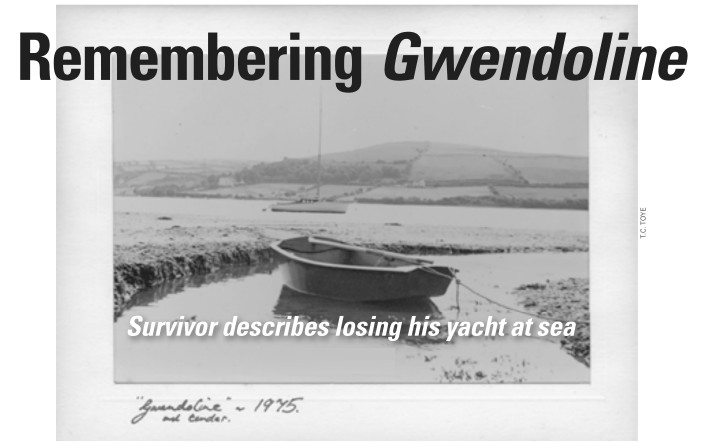
Survivor describes losing his yacht at sea
Issue 61: July/Aug 2008
It was a long time ago. One might imagine it would haunt, cling with the chill of a sea mist on a night watch, but it does not. We survived, and that day is not the only memory, just one among many . . . but that log was never signed off. I was not her first master, but I would be her last.
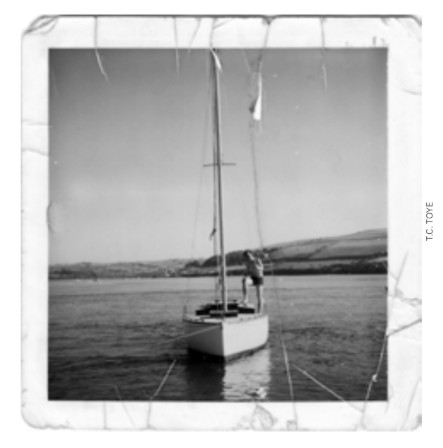
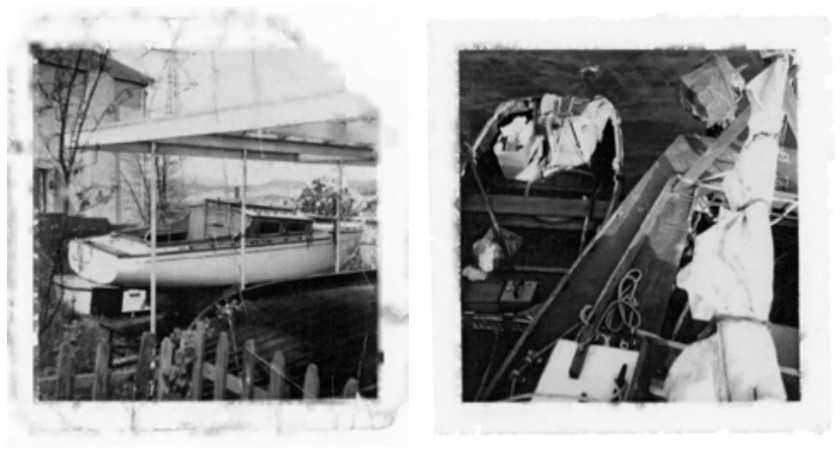
The story began in a backwater boatyard, one of those timeless places where nothing much seems to happen. Gwendoline was a small Sterte-class cruiser/racer, less than 20 feet on deck. Designed by Fred Parker, she had been carvel-built by Kitson’s of Poole, England. Through her peeling paint I could see a pretty boat of good lines, white with the ghost of a once-gold sheerline and red bootstripe, her topsides raised to a flat deck forward over powerful bows. The deck stepped as it ran aft, dropping into a reverse sheer running down to a neat little transom over a pleasing tumblehome. At the step there was the bulkhead of a low cabin trunk. Her diminutive coachroof had once been white.
I looked her over. The yard boss looked me over. I guess he knew this young man, fresh from Oxford’s Dreaming Spires, with more dream than substance, did not possess the 500-pound asking price. I went off to do some thinking at a little tea shop overlooking a winter-quiet harbor crossed by rainsqualls and cat’s-paws, but I was already lost to the romance of the place and that little ship.
“Er . . . would you take 365 pounds . . . er . . . delivered . . . please?”
His eyes were steady with a weary certainty. “That’s all you’ve got, isn’t it?”
I nodded. He shook his head, in despair rather than in refusal, I hoped, and we both shook hands. I’ll never forget that pivotal long-ago moment. I had become the owner and master under God of my first real ship.
Emotional stake
Her transom, I found, was soft enough to push a finger through. That quickened my pulse to a panic rate. Already I had an emotional stake. There was a deciduous fall of rust around her rudder stock, among other obvious — and more numerous, less obvious — signs of her age. It could be done. I had a job, not exactly an executive position, but it would finance the repairs piece-meal, and by the following spring Gwendoline was just about fi t for trials. I wanted a shakedown sail before committing another winter to a longer, strategic, and more costly refit.
The sun was shining on a fine morning as she slid off the chocks, and I felt the intoxication of the deck of my own vessel alive under my bare feet for the first time. It felt of a reassuring inertia, ship-like, quite distinct from the canoes and open boats of my youth. I walked along the sidedeck because I could, and marveled at how the deck lifted as much as dipped under my manly weight. Her ballast keel was a massive chunk of solid iron, and her skipper had the physique of a stalk of early asparagus.
Her spars were bare, sails not yet bent on, but she had an auxiliary: a fine British Seagull outboard on an outrigger bracket. I wrapped the cord and it started on the first pull. Fairly bursting with pride, we chugged away to a waiting mooring out on the saltings. Her bilges were dry by the lenient standards of the time, but I “pumped ship” because I liked the sound of the words.
Her first sailing trials went well. She could be a little stubborn in stays, the yard boss had warned me, and she had scared the life out of her previous owner by torpedoing, bows under, if she was put about too harshly, but she was kind to me. She was fast, weatherly, and I loved her.
One night I stayed aboard. Conditions were cramped: a hard bunk, barely sitting headroom, a single Primus kerosene cooker, and a brass oil lamp for company. It blew a gale and she was pitching and rolling even at her mooring, but not a drop came aboard. Sharp, cruel seas slammed into her sides and, belowdecks with a lantern, I understood the meaning of “shiver me timbers.”
With minimal accommodation for her displacement, by any practical standard she was the worst of many worlds, but tread softly, this was a young man seeing visions. She was the guardian of his dreams and in the dispatch of that duty she would acquit herself with distinction.
A mystery leak
After a few weeks spent daysailing in the bay, I decided to cruise down the coast a little. Once clear of the headland, the sea got up. Gwendoline sailed like a witch at first, but then became sluggish. She felt suddenly heavy. A glance belowdecks revealed that sea water was already over the cabin sole and rising quickly. The pump could not cope with it. I got a life vest on, hauled up and readied the dinghy, and prepared to abandon if I had to. I hove-to, ignored the inadequate pump, and set-to with a bucket and strong incentive. I was gaining. Finally the bilges were cleared and there was no sign of a leak. It was a mystery.
I released the foresail, then let draw. Gwendoline began to shoulder through the seas once more, heading for home. Within minutes the water was over the boards again. She was a centerboarder, so if the water were to rise over the open top of the trunk she would be gone — but not without a fight. Beat to quarters, full plain sail, and the Seagull fired up and growling, this would be a close race.
We rounded the headland and came into the calmer waters of the bay. Again I emptied her bilges, after which there was no sign of that mysteriously intermittent leak. When we got back to the mooring, a matter of a couple of miles, the bilges were still dry. For the rest of that summer I would sail her with one eye on the cabin sole, never far from home, and I would get to know her as well as one may know a beautiful lady with a dark secret.
That autumn I had her hauled at the yard and the awful truth was revealed. She lifted, but her keel at first did not. Then it followed reluctantly, on stretched keel bolts. The cause of a leak that only occurred in a seaway was that the ballast keel was swinging on bolts rusted as thin as needles.
The yard owner was a friend of mine, a little roguish perhaps, but a good friend and a fine traditional boatman. He replaced all but one of the bolts from bar stock the old way, cutting, then heating them to an orange glow before tapping them down onto an anvil to cone out the end. He ended up shy of one very long bolt, hard to find in those austere days. To illustrate quite how long, he pointed to a similar one used to fasten the attendant’s cabin to a heavy post in the nearby municipal car parking lot. It was long.
The perfect bolt
A telephone call that evening brought the relief that a perfect bolt had been located. The next time I visited, the parking lot attendant was drinking his morning mug of tea, his back pressed to the wall of a cabin that was sagging precariously away from its post . . . Gwendoline’s keel was once again secure.
The rest of that winter was spent steaming in new oak ribs, meticulously attending to every inch of her boards, and equipping her for more serious sailing. High on the list was a modern, large bilge pump. By the spring I would know every inch of that boat.
The re-launch was a new beginning. She was smart, sound in every board and timber, and taut as a drum. She sailed well too. Now there were charts on her table, a Walker log ticking at the taffrail, and a newly swung compass. I took her out to sea and she went like a thoroughbred. Down the coast we flew, creaming easily with poised insouciance past the scene of our mysterious alarm, no more than a ripple in our wake now. She dipped her rail and danced to the wild music of the ocean.
The coast unrolled its beauty in a tapestry of color, flecked white with spring lambs. Sea air was perfumed with gorse flower. Mile upon mile the pencil line trekked across the chart. Then the coastline opened to reveal a wide bay and a harbor. We had made our first port and, with that, the discovery that this boat could take us to far places.
On the return passage the wind got up for a while, gusting at times to gale force. It was a broad reach, so I furled the main and ran under a genoa headsail. As long as it lasted, Gwendoline showed her mettle, steady between 5 and 6 knots. Night was falling as we entered the bay and the wind dropped to a breath, the ship ghosting upriver. A shadow moved; a friend waved from the beach where he sat cross-legged. There was haunting music, the magic of a flute beside still water.
Learning her tricks
During the remainder of that season I would discover the boat’s capabilities and mine. With her centerplate down, she was very close-winded; with it raised a little, she was steady off the wind; and with the board up, she would still respectably perform all required evolutions under sail while drawing less than 2 feet.
I had heard of two Stertes crossing the Atlantic. In the right hands, maybe. Gwendoline would certainly look out for me in a blow. She would also steer herself if the wind was forward of the beam. She was a good boat, I was young and fit, and it was time to spread our wings: I was beginning to think of a passage from Wales to southern Ireland.
The two are separated by St. George’s Channel, a few hours or more out of sight of land, pleasant enough in calm conditions but, when the weather turns there or as far away as Biscay, as treacherous a stretch of water as one could wish to give a wide berth. The seas of the Atlantic Ocean are constricted into a chaos and, like rats with no escape, peaks rise and lash out at each other or any vessel in their capricious path.
Preparation would have to be thorough. I laid up Gwendoline early that autumn so I could proceed with the maintenance. Before the winter set in, she was tucked away under a green canvas tarpaulin, caulked, painted, and her brightwork varnished.
While I was doing this work, a young lady stopped to see me at the boatyard. Tracy was a talented artist who created meticulously detailed ink sketches of wild places. She had heard I was planning to cruise the south coast of Ireland and asked if I wanted a crew. She would work her passage and, in return, she would see places she wanted to sketch. She could neither sail nor navigate but said she would learn if I could teach.
We met for dinner one evening. I had thought it through and agreed, provided she really could learn the basics in short time and, in a matter of days, she did. I have never met anyone before or since who could absorb and master the principles of navigation and seamanship so quickly. Perhaps it was her artist’s eye for recording detail. In no time at all she could manage most onboard sailing chores, lay off a course with due allowance for set and drift, take bearings, recite the collision regulations, and steer by wind or compass. I could not have wished for a better crew and willingly rigged her a second bunk, a pipe cot athwartships above the centerboard trunk.
Heading to sea
Through the spring and early summer I sailed Gwendoline coastwise, tuning her rig and adding fall-back rigging, spares for the engine, navigational equipment, and a powerful hand lamp. The table and floor of one room at my home were covered in everything one could imagine for a tricky cruise in a very small sailboat.
One Sunday in August, we slipped our moorings and headed for the western horizon. In the clear air, the empty vastness of the ocean was humbling. The nearest land dead on the bow might have been Florida. I streamed the log and took the departure.
In the confused sea off the headland, Tracy was queasy and I didn’t feel so great, but that could have been nerves. Working out a few figures for the coming hours, I asked if she could take the first watch, then retired to my bunk and slept. When I awoke I felt much better, the light was fading, and I would take over for the night watches. On the west coast of Wales I could see the Strumble Head light group-flash four every 15 seconds and just about make out some land features for a fix. It confirmed the log; Tracy had steered a good course.
We shared a companionable hot drink in the cockpit. She went below and slept. Then followed the best sail of my life. The breeze strengthened to perhaps Force 4 and Gwendoline flew through the darkness, throwing clouds of phosphorescent spray that set the sails aglow. Droplets twinkled on my jacket, and the back of my hand was bright enough to illuminate surrounding objects. A steamer overhauled us a couple of cables to starboard, lights shining, her wake a blaze of phosphorescence under a perfect canopy of stars. It was a night I shall never forget.
The wind strength was increasing and by first light there was menace in it. I had left Tracy in her bunk as she had been feeling sick most of the night, but she rose and helped me tuck in a reef. Visibility was poor. Dead reckoning put us near Tuskar Rock, Ireland, although I had been unsuccessful in picking it up on the RDF. Not wishing to close that inhospitable coast in uncertain conditions, we altered course, swinging south, hoping to resume a westerly track toward the Coningbeg Light Vessel as soon as our reckoning put us south of the rocks.
Fateful decision
That decision, which I believe I would make again if faced with the same situation, would place my crew and myself in grave danger and cost me my boat.
After many hours at the helm, I felt sick and weary. Tracy took the watch and I dropped into my bunk. Almost immediately there was a loud bang; the centerboard trunk to which my bunk was fastened quivered violently. I knew it was not a rock, it felt alive, but Tracy could see nothing in the water. The echo sounder indicated off-soundings. Then Tracy reported that she could see a fin, encrusted with barnacles and higher than the deck. It disappeared.
No doubt I should have sprung from my bunk and gone on deck and, sitting in my study now, it seems incredible that I did not. But I was sick, and the lethargy that accompanies that sensation has to be experienced to be appreciated. Also, it was futile; the sighting of the fin explained the impact on the keel and there was nothing I could do. The moment, I thought, was past. We had come up on the back of a mature basking shark and it had responded angrily before departing. (Many authorities claim that the basking shark, numerous in those waters, is a plankton-eating gentle giant. Others say they have witnessed aggression in these creatures, particularly in that region where several reports to that effect were made that year.)
Sleep came, but after less than an hour I was suddenly awake, my heart pounding. I no longer felt sick, but I was wet. There was cold water lapping against my bunk. I worked the pump until the bilges were dry, but Gwendoline was making water fast under the keelson, through the garboard I guessed, while the weather was deteriorating rapidly. Our charts were soaked, floating in useless fragments around the cabin.
Treated as a joke
A French fishing boat hove in sight. I called her on the emergency frequency of 2182 kHz. Her skipper was chatting to a friend on that frequency. I used the alarm button to break through. I am reasonably fluent in French so I explained our plight in that language and requested a position. The response was to treat it as a joke, the skipper mimicking the sound of the alarm. I shall not dwell on this, but it happened.
The wind was rising. Tracy took the helm while I furled the main and replaced the working headsail with a stout canvas spitfire jib. As I was returning to the cockpit, the yacht rolled heavily, jibed all standing, and the boom cracked my skull. In my memory, I tried to break my fall, then scrambled up at once, but the truth was that I lay senseless on the cockpit sole for several minutes. Tracy made sure I was breathing and returned to keeping the boat afloat. When I came to, sick and a little irrational, I gave a few course instructions that Tracy wisely ignored, then lay down again.
The situation was grave. We were somewhere to the south of Ireland with an injured skipper, aboard a small sinking yacht, in conditions fast rising through gale to storm. None of this had been forecast by the British Meteorological Office. When I recovered my senses sufficiently and sent out a Mayday, in reply I heard three more Mayday calls from other vessels in distress. The air was full of urgent evidence that we were not the only crew caught out.
Then the ground wire of the emergency radio parted. Despite its lead sinker, the force of the wind had blown it out of the water and it had tightly wound itself several times around the propeller of the raised outboard, rendering useless both engine and radio.
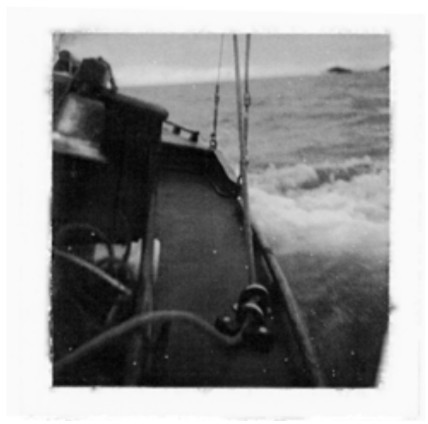
By this time there was a full gale from the north and we had no option but to run off before it. A hundred miles to the south across the Celtic Deep lay the rocks of the North Cornish coast, a lee shore to be dreaded in a northerly gale, but the problem of navigating around Land’s End in a storm, with no charts, was academic. We were cold, wet, sick, and weary; we would never have kept pumping her out that long, and our inflatable raft would have taken us out into the Atlantic approaches.
Fervent prayers
Neither of us said what each of us was thinking. There was almost serenity, there in the vortex of a storm. Tracy silently helmed the boat. I brought the outboard in from its outrigger, not that it could have powered us against that solid wall of air and spray.
Going below for the toolbox, I found myself on my knees and out of sight of Tracy. I said a prayer. I am afraid my Maker only hears from me when I am in trouble, but we needed Him then. I was fearful and feeling the weight of my responsibility at having involved another person. As I would later discover, Tracy had taken advantage of the moment to say a few words herself. It was not that we were self-conscious, but neither of us wanted to erode the presumed fragility of the other’s morale.
Then, incredibly, the miracle. A few minutes later, while I was unbolting the propeller, Tracy sighted another vessel. There were huge banks of sea mist streaking across the water and a ketch had appeared between them. I raced to the flare locker. It was going to be a long shot. I braced myself in the forehatch with two Icarus rockets. The first missed by a mile, but it gave me a trail to correct my aim. The second exploded above the cockpit of the other boat. The ketch sailed on. Once again we were alone.
Some time later she returned. Her steering gear had been damaged by the storm but the crew had rigged a jury tiller and come back. At first her skipper was reluctant to take us aboard, an evolution that might endanger both boats, but he could see blood on my face from my head wound and that we were clearly in a sinking condition, and he gallantly helped us.
Challenging rescue
Steadying the two vessels by sailing alongside each other, it was possible to get Tracy aboard the higher rail of the ketch as the sea lifted Gwendoline just before it lifted the other vessel. But when I left the helm to make my leap, the boats veered apart. I hit the topsides, missed the upper rail, grabbed the lower one, and water closed over my head.
As I hauled myself up, three people rushed to get hold of me. In their good-hearted enthusiasm, they failed to notice they had my arms on either side of a wire shroud that was threatening to cut my head off. I shouted to them to let go, which they took to be narcosis of the deep, and pulled even harder while urging me not to give up. Then their skipper saw what was happening and pried one of my arms loose. I flew over the rail like a cork from a bottle.
Norman, the skipper, was a doctor sailing with his wife, Sheila, their son, and nephew. Sheila and the boys were exhausted and seasick. He took a look at my head, told me it was likely a mild concussion, and asked if I could help him sail the boat through the night to Penzance in Cornwall.
We never made Penzance, but in watches 15 minutes on, 15 minutes off, we did make Milford Haven after sailing through the worst conditions either of us had experienced. The wind reached a steady Storm Force 10, gusting through 11 to Hurricane Force 12. Even in that high center cockpit, I awoke several times floating in my life vest, still secured by my harness, seeing then the whole vessel emerge from beneath the sea. When the storm jib was caught aback, the flexing of the deck was clearly visible. After nightfall, there was pitch black interrupted by occasional blinding whiteouts. Seas the size of houses would burst aboard and, in the brilliant white of the spray, only the gimbaled compass gave any indication of horizontal. It was a nightmare.
Like most nightmares it ended with the morning. The storm was over as we came gently to a visitor’s berth in Pembroke. We took our leave of this family of quiet and kind people with just a brief exchange of thanks and courtesies. We have never forgotten them.
Bronze release pin
Hunger supervened, spurred by the aroma of steak from a quayside restaurant. Full marks to the waitress who said nothing of our appearance. Tracy looked pretty good, but as I left I caught sight of myself in a mirror, caked with salt and dried blood. In the pocket of my torn jacket was the bronze release pin from the Seagull; I still have it in my study. My thoughts went back then to my final sighting of Gwendoline dipping her rail for the last time, her tan sail still drawing, very low in the water and sailing fast toward the open Atlantic.
Did I lose my nerve? To say so would be dramatic but untrue. I am not sure I had that much nerve to lose. And once ashore, fed, and rested, the search for a new boat began with the indecent haste of youth, just as soon as my insurance company congratulated me on getting my crew and myself out alive and wrote the check.
Now Gwendoline III is stationed in the creek awaiting a refit, a task I plan to enjoy as much as the sailing, which will not happen before she is as fit for sea as may be. Tracy returned to her art and her horses and seemed none the worse. We still chat when we meet in the supermarket and, just once in a while, there is something in the eyes and we quietly remember that we are bound by an event few have experienced and fewer survived. We each know the limits of our courage and are not ashamed, yet rarely do we speak of it. I believe I owe her my life.
Long-remembered objects
After many years I would still pat my pockets and look around for that pen, that magnifier, that flashlight . . . and then recall that it had been left aboard, along with my grandfather’s binoculars and that old army compass. One person remarked that she thought the worst part must be the loss of personal possessions. It was a cliché, said only for want of the scarcely expressible. But even so, the comment vexed me. As if any possessions could be more personal than my lovely vessel.
Now there is no haunting feeling, but rather a humbling sense of proportion and the many more good memories than bad that I have recounted here. I learned, perhaps, greater caution and a keener sense of the responsibility that one takes on with another soul aboard. I also learned that boats are more seaworthy than their human complement, that onboard comfort is an important factor of seaworthiness, and that with the best preparation we had simply been at first unlucky, then very fortunate, in happening across another ship and her noble crew.
And that the only distress call that was heard, and answered, was heartfelt prayer.
Geoffrey Toye , a writer and journalist, lives in a beach house in Wales and has been involved with small craft for more than 40 years. Good Old Boat has produced an audiobook version of his novel, Telegram from the Palace, a work of sailing fiction full of conspiracy and intrigue.
Thank you to Sailrite Enterprises, Inc., for providing free access to back issues of Good Old Boat through intellectual property rights. Sailrite.com