Desert soldier buys Internet boat 7,000 miles away
Issue 60 : May/Jun 2008
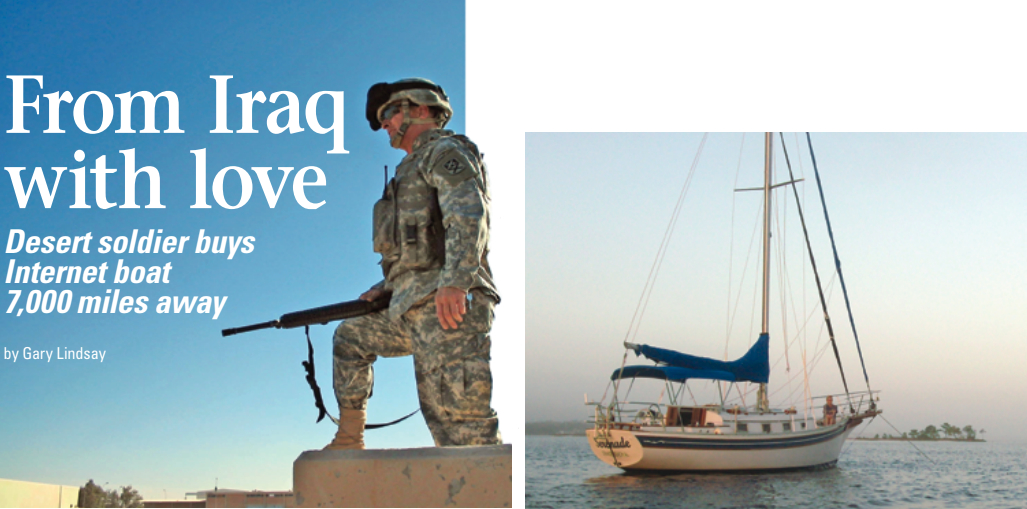
In the military you rarely do anything without first conducting a risk assessment that consists of a matrix listing possible hazards and mitigating factors. Despite being stationed in western Iraq with the U.S. military, I embarked on one of my boldest adventures without one.
Spellbound by visions of sparkling waves and billowing sails, I threw caution to the wind and purchased a used 32-foot cruising sailboat sight unseen through the Internet. The purchase was further complicated by the fact that the boat was nearly 500 miles away from my home on the Alabama Gulf Coast, and I, even farther — some 7,000 miles — separated by lots of blue water and nine time zones.
I have been obsessed with sailing since I was 13 and first daysailed in a 16-foot Flying Fish. Girls rated only slightly higher on my list of obsessions. Heaven was the two together.
I had sold my previous boat, an older 25-foot Hunter sloop, a few months before deploying to western Iraq in July 2006. During deployment I sought refuge from the daily grind by perusing the online boat listing services whenever I was able . . . dreaming about the next boat I was going to buy.
My wife, Sheryl, and I share the dream of many weekend sailors around the world: to purchase a sturdy sailing vessel capable of bluewater passages and to experience cruising to the horizon of our desires. Before I left the States, we had talked about waiting several years before we purchased our dream boat. Our children are in college and we both lead busy lives. But the dream buoyed me, and I thought, “It doesn’t hurt to look.”
So I set out on the Internet, during my downtime in Iraq, to find the best boat to fulfill our desires. As additional references I had packed along books by Lin and Larry Pardey and other sailors. The mail brought a bimonthly fix of Good Old Boat magazines to feed my thirst for sailing knowledge and escape.
Nothing’s perfect
What I found through an exhaustive analysis of boat listings, esteemed opinions of the world’s greatest sailors, and my own preferences is this: there is no perfect boat. Some are better suited than others to cruising. Some are better built. But most boats can be turned into bluewater cruisers of a sort with enough effort and money. At this stage of our lives, Sheryl and I could not afford something in the 36- to 42-foot range offered by one of the respected builders of proven cruisers. But with money I was saving, we could afford something smaller yet capable of open-water passages.
“To heck with delayed gratification,” I thought. Life is short. It could end tomorrow, as I had too often been grimly reminded during wartime service in Iraq and Afghanistan. Part of my desire was purely selfish: I wanted a boat waiting for me when I got home. Other soldiers buy a Harley as their reward when they return from deployment. I would buy a chariot of the seas.
Lin and Larry Pardey helped me decide. Their mantra is that a smaller boat is easier to handle, less expensive to buy and maintain, and can equal or surpass the seaworthiness of larger vessels. At the urging of these and other advocates of the “go smaller, go now” sailing set, I was ready to find our Seraffyn.
Sheryl and I had debated and pretty much arrived at shared conclusions about the type of boat we wanted. We favored more traditional looks and designs found on such hallmarks as the Cabo Ricos, Island Packets, and Cape Dorys. I preferred a shallow-draft, fullkeel boat because of the thin waters of our home cruising grounds and future plans to visit the Bahamas and other shallow-water Caribbean haunts.
The cutter rig appealed to me partly because of its dashing looks and partly because it offered more sail combinations. We both thought having more than one head was a waste of space and potential maintenance trouble. On deck, we wanted bulwarks, wide sidedecks, a wheel, and seats you could sleep on in the cockpit. That’s a lot to require of just one boat. And as a further challenge, the price had to be $50,000 or less.
Came to conclusions
After hours of browsing the Internet brokerage sites (Yachtworld.com is the best) and reading reviews and owners’ websites, I came to some conclusions. I initially liked the Pearson 365 because it has great accommodations and seemed well-built, but I was troubled by the V-drive from the engine to the propeller shaft and reported problems with tanks in the keel sumps. I loved the Shannon 28 with its classic charm and sterling reputation, but my wife thought it too small. I briefly toyed with the idea of a Gulf 32, a full-keel, pilothouse cutter still in production, but didn’t like the cockpit and the sliding hatch on the almost flush foredeck.
Finally, the lines of a Bayfield 32 caught my eye like the fetching smile of woman. The clipper bow and bold bowsprit spoke of oceans to conquer. Her cutter rig was versatile and a sight to behold under sail. A large foredeck, wide sidedecks, and an ample, well-drained, but not overly large, cockpit fit my criteria. The boat has a lot of brightwork, but despite the prospect of a lot of sanding and varnishing in our future, I liked the look. It even has a beautiful teak taffrail at the stern, which doubles as the base of the mainsheet traveler; a nice touch, I thought.
Bayfield, a Canadian manufacturer, had a reputation for sturdy, well-built boats. Ted Gozzard designed the 32 and other Bayfield boats before he went on to found Gozzard Yachts. The Bayfield company is no longer in business, having built its last boats in 1989 (see profile of Ted Gozzard, November 1999).
The Bayfield 32 appeared capable of offshore cruising and adequate as a liveaboard platform for a couple. And the price range was in our ballpark. As my interest in Bayfield 32s grew, I spent considerable time studying the offerings of this model on the Internet. I found two or three in Florida, not too far from home, that had been tricked out for extended cruising with every conceivable piece of equipment needed. But I wanted to outfit my own boat.
Bare minimum
A modestly priced offering in Charleston caught my eye. It was a 1987 model with the bare minimum of equipment and electronics: a VHF, depth sounder, wind meter, and handheld GPS. But it appeared to be well cared for and had an ivory hull with beautiful lines. It also had a 27-hp Yanmar, while most Bayfield 32s came equipped with a 15- or 20-hp motor. A photo of the boat under full sail imprinted itself upon my mind’s dream screen. She was named Pleiades, a constellation of stars I could see in Iraq’s night sky.
Through Peter Dodds, the broker at Charleston Yacht Sales, I found out more about the vessel. She had been stored on shore for nine months following the owners’ purchase of a new Island Packet. The seller was eager, if not downright anxious. I entertained thoughts of sailing her back to the Orange Beach/Pensacola area when I returned to the U.S. in late summer. As an alternative, I could have the boat hauled home by truck. Peter provided me with what turned out to be very accurate estimates of transport and preparation costs.
Ultimately, I made an offer that would allow me to spend the considerable sums it would take to transport the boat and still not exceed the boat’s retail value. The offer was accepted, so I discarded the idea of trying to deliver her to our home waters myself. I wasn’t yet familiar with the boat; I didn’t have time to prepare; and the prospect of a 1,200-mile voyage during hurricane season was fairly daunting.
I researched yacht surveyors in the Charleston area and sought estimates. The quotes varied by as much as $6 a boat foot. I looked at websites and studied the answers I received when I explained my situation. I had tapped my brother, Phil, who lives in Georgia to conduct the sea trial for me. I settled on David Hill of Carolina Yacht Services as my surveyor. His fees were reasonable, he expressed himself well during our email communications, and he was willing to work with my situation. He also had the proper certifications necessary for insurance and loan acceptance.
Minor problems
David found the boat to be structurally sound with only a few minor problems that needed to be corrected. I finalized the deal, and we closed through the mail. I began making plans to get the boat home.
The broker’s estimate of $3.50 a mile for transport was pretty darned close. One company submitted a bid almost $500 less than the others. That made me wary. I checked out all the companies through the Better Business Bureau site and found the lowest bidder had at least two recent complaints that were never resolved. So I chose a firm out of Pensacola and emailed them about our plans. They happened to have a hauler delivering a boat to Connecticut in just a few days that would be empty coming back. He could swing by and pick ours up two days after we completed the purchase. The cost would be nearly $200 less since I would catch the truck on the “backhaul,” and we quickly agreed on the deal.
On a Thursday, I hastily emailed Tim Recks, manager of Charleston Boatworks, where the Pleaides was being stored. The pickup was scheduled for the following Friday. Despite the short notice and an upcoming race week, Tim said he would have the boat ready for transport when the truck arrived.
I had also solicited bids from marinas in my home area for estimated costs to re-step the mast, re-rig the boat, and paint the bottom. I learned that de-rigging the boat, preparing it for travel, and then re-rigging her would cost as much or more than the transport itself. I could have mitigated those costs somewhat if I had been available to assist in this process, which can be labor-intensive.
I narrowed down my list of boatyards by turning to the Better Business Bureau once again. Troendle Marine, located at the Pensacola Shipyard Marine Complex, was listed as a BBB member with a good record. The marine complex is also listed as a Florida Clean Boatyard. Prompt and accurate replies to my email inquiries scored points with me.
Troendle Marine co-owner Barbara Troendle won my heart when she emailed me a little note with the quote. “Will you be here when your new baby arrives?” she asked. After a brief moment of panic, wondering whether my wife had kept something secret from me during our last phone conversation, I realized she was
Took photos
The transport of the Pleiades from Charleston to Pensacola was uneventful. Bill Troendle supervised the unloading and Barbara took photos to send to me. I was able to call from Iraq and catch Sheryl as she was climbing aboard the boat for the first time.
“It’s beautiful!” she gushed on the cell phone. The layout down below pleased her. “You did well with this one.” Sheryl has definite ideas about what she does and does not want belowdecks. An adequate galley and comfortable sleeping space are high on her list. She was satisfied and noted that the boat had been well kept.
Through a detailed work order supplied by Barbara, we agreed upon the work to be performed on the boat. Troendle would re-step the keel-stepped mast, tune the rigging, paint the bottom, and install a new mast boot to stop a persistent leak.
One of the most symbolically important tasks we decided to have them complete while the boat was in the yard was removal of the old name and installation of the new. Sheryl and I had chosen the name for our next boat awhile ago. We even bought wine glasses etched with the new name. These were waiting for a home.
Our new boat was to be known as Serenade, literally described as a song of love. To me, sailing is a musical experience.
The boat was ready for launching in a few days. There was just one problem we had not solved: getting the boat from the boatyard to our home marina a few miles away. My wife was not confident enough to handle the helm herself. Our salvation came in the form of fellow sailor Gene Reddick, a stranger who volunteered to pilot the boat to its new home when he heard of our predicament.
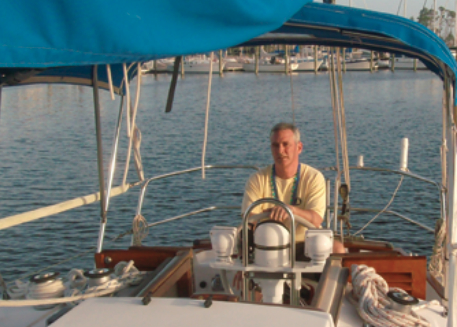
As I write this in Iraq, the boat is ready and waiting, Sheryl teases that I probably look forward more to seeing the boat than her when I get home. It’s not true, but I do long for them both.
A warm wind blows off the desert and ruffles the fronds of the few coconut palms scattered around the dusty base I inhabit here. A helicopter clatters noisily overhead. I close my eyes and envision standing at the wheel a few months hence in the cockpit of Serenade with my wife and lover, breathing in the salty air and thrilling to the pure, sweet music of a righteous sail. A redemption sail for my soul.
Gary Lindsay and his wife, Sheryl, have sailed together with (and without) children for most of their 23-year marriage. Gary is Master Sergeant with the Army National Guard and returned home last August. He and Sheryl hope to sail north on the ICW and down to the Bahamas and Caribbean in a few years.
Thank you to Sailrite Enterprises, Inc., for providing free access to back issues of Good Old Boat through intellectual property rights. Sailrite.com