Pearson Ariel hull #1 sets sail again
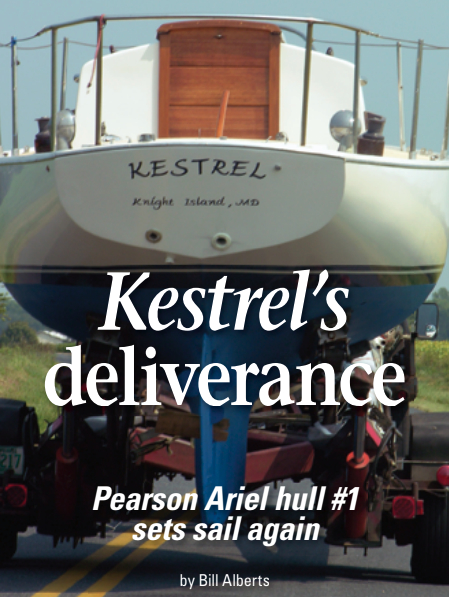
Issue 64 : Jan/Feb 2009
A few years ago, when my wife, Ann, and I were searching for a boat, we happened upon a beauty. We were in Oxford, Maryland, for the weekend and found ourselves strolling around the docks. There she was, an Ericson 29, polished, painted and looking mighty good in the afternoon light. A “For Sale” sign was posted in her shrouds.
Ann and I called the owner and he invited us aboard for a look. Since it was a fine afternoon, he asked us if we wanted to take a sea trial right then. Of course we said “Yes!”
The sail was effortless. The boat was exciting, very clean, responsive, and apparently well cared for. We drove home talking excitedly and decided to make an offer. That night, I called John Griffiths for advice. John is a friend, a boatbuilder, and a retired boat surveyor. I respect his judgment. I wanted him to tell me only good things about our choice. However, John is not inclined to praise boats. He tends to point out their faults. It’s the surveyor’s instinct, I suppose. In this instance, his comment was “What year?” When I told him, he said, “She’s got bad decks.”
I remember thinking, “You haven’t even seen her yet. How can you say that?” I stiffened . . . listened . . . and then went ahead with my own plans. The owner accepted our offer and we were off into the heady world of yacht buying. The first thing I did after we sent in our deposit was to arrange to have her surveyed.
Detailed report
Seven hundred dollars’ worth of survey later, I was given a very detailed report. The bottom line: she was in great shape except for one thing . . . she had bad decks. In fact, the word the surveyor used was “saturated.” When I looked into how much it would cost to repair them, I was given estimates that raised our purchase price by 50 percent. We withdrew our offer. Chastened, I decided to listen to John in the future.
That fall, John sold his C&C 40, Moonlight. He and his wife, Sandy, had decided to swallow the anchor and sell while their classic cruising yacht was still in top condition. She went fast and John found himself without a boat. Then, by coincidence, while in Oxford on an errand, he came across Kestrel, Pearson Ariel hull #1, vintage 1963. And he took her home.
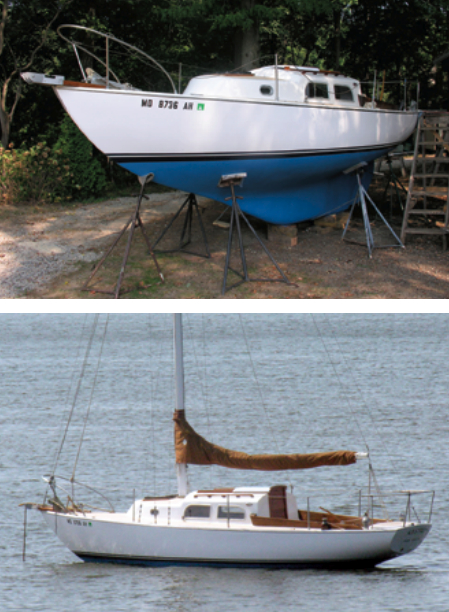
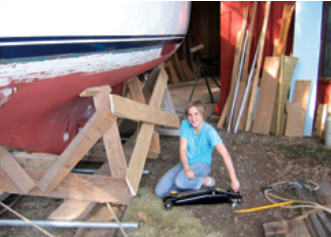
When I first saw Kestrel, I was quietly stunned. She was a wreck. Even my inexperienced eye could see that it was going to take a huge, sustained, effort to get her back into the water. Her decks and coachroof were bad. The original Atomic 4 engine had been submerged and left to rust. Everywhere I looked I could see work to be done, and I knew that what I could see was nothing compared to what must lie beneath it.
Now, if anybody on this planet knows about boats and rot, it’s John Griffiths. He certainly knew that Kestrel would require a tremendous amount of work. As time went on, when I commented on how one job just led to another, seemingly endlessly, he smiled. “It’s a hobby,” he said, “You don’t want to rush it.”
Three-inch hull
I remember sitting in the cabin with him after he had removed the old bookshelves. He showed them to me. They were the better part of an inch thick. As he held out the wood to me, he said, “Look at that. They don’t build them like this anymore . . . don’t have to. Back then, they didn’t know. These boats were overbuilt. The hull is 3 inches thick in places along the keel.”
Weeks later, when I visited again, I found that John had removed the old engine, cut away the top skin on the decks and coachroof, re-cored the decks, and glassed over everything. Yet, after all this work, the boat still looked awful. It was overwhelming to contemplate the work that lay ahead. The look on my face must have been transparent. John said, “Do the worst jobs right away, when you’re still in love. Don’t start with the brightwork.”
He certainly didn’t. The work went on: New portlights. A new hatch was fitted and bedded in. Since the Ariel’s mast is deck-stepped and the original strong beam had sagged, John built another: an arch made of solid cherry that he had harvested, milled, and seasoned right on his farm. He took the supports straight down to the keel, so the mast is now better braced than when Kestrel first came off the line.
He removed the old Monel water tank. The quarter berths were made into settees with the angle of the backs adjusted for comfortable seating. Lots of little storage cubbies were also incorporated into the seatbacks. The woodwork was all of cherry and poplar from the farm.
Rebuilt Yanmar
He found a Yanmar 2GM that BoatU.S. had for sale as a write-off. It was judged to be irreparably damaged. John took it apart piece by piece. I remember seeing it all laid out on his bench: springs and bolts and bits and pieces . . . hundreds of them, it seemed. I wondered if he would be able to put them all back together again, not to mention whether or not the finished product would run.
He was able . . . and it does run. Like a clock.
So Kestrel was repowered. A new fuel tank was added beneath the cockpit sole; the engine beds were made and glassed in; the drive shaft and stuffing box installed. John made a new rudder and replaced the old rudder tube and shaft bearing. He made a stainless-steel tiller-stop to keep the rudder from slamming over in reverse and running afoul of the new three-bladed prop, a bigger prop than the original because of the larger, slower-turning diesel.
John drilled holes in the keel and let out gallons of water that had collected in voids around the ballast. After letting it dry for the better part of a year, he injected vinylester resin into the voids until they were completely filled.
He built a beautiful, heavy-duty, double anchor roller on the bow. After making careful measurements, he had a stainless-steel pushpit constructed, and added stanchions and lifelines all around. One winter, John’s old friend and fellow sailor, Mike Arms, came over and spent many days painting Kestrel’s hull, but before he did, John removed the rubrail and re-bedded and re-fastened her hull-to-deck joint.
Fixed bit by bit
At one point, John and I were sitting in the cockpit and he mused, “They made all kinds of mistakes on hull #1. Then, they fixed them bit by bit as more boats came off the line. Remember how thick the hull is at the keel? Other spots, it’s too thin.” He laughed. It didn’t matter.
After the hull and decks were painted, John made a cockpit grating out of teak. He added a Gusher bilge pump that could be handled from the cockpit. He installed the instrumentation for the engine and framed it in cherry, rebuilt the slides for the hatch, and made mahogany double handrails for inside the cabin and for the coachroof.
He painted the mast with Awlgrip and replaced the standing rigging; added new, heavier-than-stock chainplates; rebuilt the lazarette hatch; and added a waterlift muffler for the Yanmar. He removed the old head and glassed over the holes where the seacocks had been. His plan was to sail Kestrel as a daysailer, not a cruiser, so a Porta Potti would do. Likewise, he didn’t feel that he needed a sink or an icebox. Those were torn out and new cabinetry built to replace them. A new electrical panel and all-new wiring followed, as well as an engine cover that also provides steps up from the cabin to the bridge deck.
The work went on and on. I began to wonder when, if ever, John would launch Kestrel.
Mike said, “The problem is, he has no plan to campaign her. He may just tinker with her forever.” After five years, a hip replacement, and gall bladder surgery, it began to look like Kestrel would stay in the shop, almost ready to go, with no one to sail her.
Sudden change
But that all changed suddenly. In August, John’s son, Trevor, and his fiancée, Gwen, hatched a plan. They would quit their jobs and sail Kestrel south for the winter . . . if John would agree, that is. The original plan was to go to the Bahamas, but anywhere south would be fine.
Young . . . in love . . . no kids . . . Well, why not?
I have no doubt that there was a sparkle in John’s eye when he learned of the idea.
That was it. The ice broke and things began to move in earnest. With the prospect of giving Kestrel to his son, to open the door to the cruising life that John and Sandy had shared for so long, the Griffiths’ family shipyard went into high gear.
The Porta Potti came out and a new head was installed, along with a holding tank and a diverter valve for pumping out at sea. New seacocks were installed where the old ones had been removed. All that cherry was varnished and re-varnished. New LED lighting was installed and an additional battery bank was added for onboard electronics.
A depth sounder was added, and the sender glassed into the hull beneath the port settee. A mattress was made for the V-berth and an insert added to cover the toilet and make a double berth. John made a dinette table that can be folded and put away in the hanging locker. Kestrel now carries 22 gallons of water in 2-gallon collapsible jugs. For dishwashing, there is a collapsible camp sink. A two-burner camp stove completes the galley.
Ready for launch
John made a sea hood for the hatch, and added a small spray-dodger. Sandy, Trevor, and Gwen worked tirelessly to complete all the little jobs that needed attention before launch. By the second week in October, Kestrel was ready to be moved out of the barn and back into the world . . . even if it was only the landlocked world of the farm. Trevor, Gwen, and John went to work with pipes for rollers and a small tractor for power. Some leverage provided by a large block, a length of very stout rope, a hydraulic jack, and a lot of youthful energy, tempered by John’s knowledge and patience, were all the other ingredients necessary.
I watched that “birth” and assisted the midwives whenever necessary, as they hauled Kestrel out of the barn where she had been gestating for so many years. But mostly, I was there to photograph that baby as she was presented to the world afresh.
When she was launched the following week, her bottom freshly painted, her name on her transom, I was again there to document the event. It was exciting to see her touch down in the Sassafras River, a tributary of the Chesapeake Bay, and to ponder the world of possibilities that lay before her and her new owners. It was a privilege to be a part of the process. Because one man saw something beautiful beneath all that rot, something worth the effort it would take to save her, and because that same man ultimately had the wisdom to let her go, to give her away, Kestrel is free to soar once again.
I said a prayer as that beautiful little pocket cruiser splashed. “May she protect her crew as they have protected her.” I’m quite sure she’ll do her utmost. She comes from good stock.
Since childhood, Philadelphian Bill Alberts has spent summers on the upper eastern shore of Maryland. A musician, teacher, and writer, he has had the good fortune to be able to earn a living doing what he loves. He and his wife, Ann, sail their boat, Haabet, out of their home port of Hack’s Point on the Bohemia River in Maryland.
Thank you to Sailrite Enterprises, Inc., for providing free access to back issues of Good Old Boat through intellectual property rights. Sailrite.com