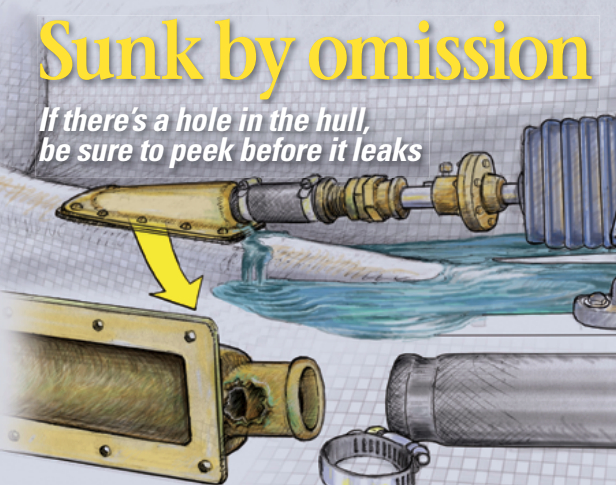
If there’s a hole in the hull, be sure to peek before it leaks
Issue 65 : Mar/Apr 2009
Every inboard-powered boat has a number of holes through its bottom. The cooling-water intake, the rudder, and the shaft log contribute a minimum number. When a boat springs a leak, these are the first places to check. But what if it’s next-to-impossible to get to the rudder-packing nut or to the the shaft log and its packing nut?
A trimaran tied up next to my boat sank three times. On each occasion, the outer hulls, or amas, held the boat up while the main hull filled with water. Twice, the owner pumped the boat out. After the third sinking, a major storm came through our area and flooded the boat (and the amas) and left it on the bottom. The owner gave it up as a lost cause and a few months later the wreck was lifted from the water with a crane and cut up for removal.
Since the owner was both elderly and unwell, I made an arrangement with him to pull off what was salvageable to sell. Among other items to be saved, I cut out the rudder assembly (in very good shape) and also removed the shaft-log and packing-nut assembly. When I disconnected the hose from the fixed part of the assembly, I discovered the reason the boat sank. A section of the shaft log was simply gone — there was a hole where there should have been metal.
This, of course, was in the aft part of the boat that was difficult to reach because there was little room to get around the engine. The shaft log had probably not been inspected since the engine was installed in the boat.
The trimaran was built in 1991 and had been floating in the harbor for a number of years. In 2005, the surge from Hurricane Dennis put the boat ashore with no damage. It had since been re-floated and was being restored when the sequence of sinkings began. Since the boat had been floating fine up to that point, my best guess is that when the owner got the engine running, the turning of the propeller shaft finished the weakened metal in the shaft log and started the leak in the gap between the missing metal and the rubber hose. I believe the lesson here is to make sure that you can get to every one of the underwater fittings on your boat and to check them regularly.
As a youngster, C. Henry Depew learned to sail on an Optimist Pram. Flying Juniors followed during the college years. Later he bought and rebuilt a blizzard of sailboats (nine in six years). He is active in the United States Power Squadron and sailboat racing activities with the Apalachee Bay Yacht Club.
Thank you to Sailrite Enterprises, Inc., for providing free access to back issues of Good Old Boat through intellectual property rights. Sailrite.com