Marina auctions offer good old bargains aplenty . . . but caveat sailor!
Issue 67: July/Aug 2009
Auctions of abandoned boats are potentially an excellent source for sailors looking for smaller and inexpensive good old sailboats, the kind that are perfect candidates for restoration. Often, these forlorn boats bear proud names, and they’ve all seen better times. Some of them will see good times again and make their new owners happy people.
Occasionally, boatowners, for whatever reason, stop paying slip fees, and their boats become liabilities for the marinas where they are berthed. They occupy slips, produce no revenue for the marinas, and often become eyesores. To dispose of them, many marinas, after going through the necessary legal steps, hold periodic auctions. Their purpose is more to clear the slips than to make money.
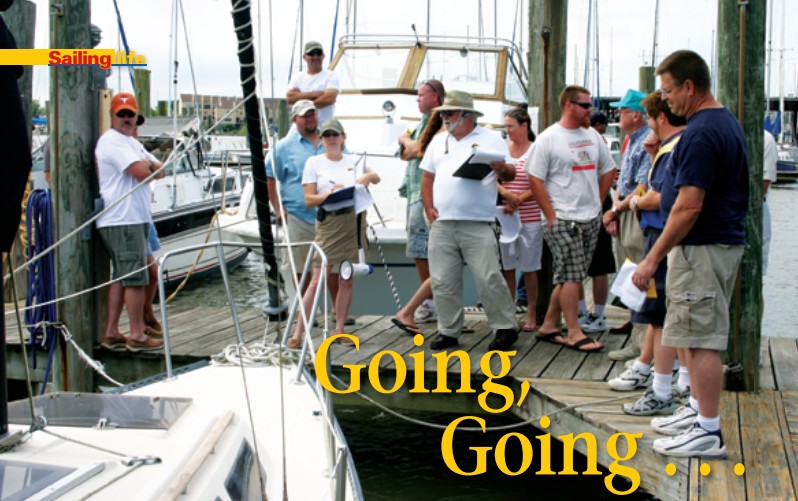
At a recent auction at Watergate Yachting Center in Texas, 15 boats were offered, all but one of them sailboats. The marina, the largest in the state, has more than 1,100 wet slips and is situated on Clear Lake, off Galveston Bay between Houston and Galveston.
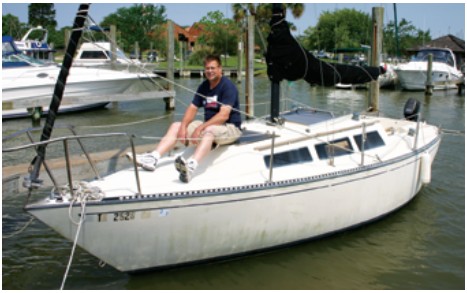
Ten of the boats in that auction were sold. Prices paid for the sailboats ranged from $1,500 for a 24-foot, 1983 S2 7.3 to $50 each for a 1983 cat-rigged Pearson 23, a 1985 Starwind 22, and a 1965 Columbia 24. The remaining five boats attracted no bids and later were broken up for parts and scrap. One man, who’d come to the marina to go sailing and stopped by the auction out of curiosity, wound up buying five boats.
Lots of red tape
“It’s a lengthy process to get to the auctions,” says Wendy Larimer, legislative coordinator for the Association of Marina Industries. “There’s a lot of red tape proving they’ve done everything possible to find the legal owner and get payment from him.” Once that has been done, the marina has to go through more legal steps before it can auction off such boats.
In the case of the Watergate auction, some of the boats belonged to the marina. “People have actually given us the title to a couple of them,” Pauline Mahoney of Watergate Yachting Center told me, “because they didn’t want to deal with them anymore.”
“Unfortunately,” Wendy says, “auctions generally do not bring in enough money to compensate the marina for what it has lost in slip fees. Often, the boats are in such bad shape that salvaging them isn’t even an option, so the marina owner has to pay to have the boat removed and destroyed.”
When a boat is sold at auction, the marina collects its fees from the proceeds. Lien holders are next in line and any money left goes to the former owner, if he or she has been located.
Buyer’s risk
Such auctions are very much buyer-beware events. The Watergate auction is perhaps typical. Boats are sold “as is, where is, no warranty, no guarantee.” All sales are final.
Bidders register at the marina office shortly before the start of the auction. Prospective buyers can look at the boats in their slips in the days before the auction, but they cannot go aboard because most boats remain private property until the auction occurs. Would-be bidders can look inside boats of interest immediately before the auction.
The auctioneer sets a minimum bid on each boat. There is some flexibility — that amount can be, and frequently is, reduced for the less-attractive boats. The marina itself reserves the right to bid on any of the boats.
Each winning bidder has to put down a $500 deposit (or the full price of less-expensive boats) in cash, certified check, or money order at the time of the sale. The balance is due the afternoon of auction day. Since such auctions generally are held on a Saturday, getting the cash can take some planning or cause some last-minute scrambling. A high bidder who can’t come up with the balance forfeits the deposit.
It’s anybody’s guess how many marinas around the country hold boat auctions and how frequently. How do you find out about them? Generally, they’re advertised in the legal section of at least one of the area’s newspapers. Some marinas maintain mailing lists to notify individuals of upcoming auctions. Sometimes, area newspapers — those that have sailing or boating writers — publish advance stories on auctions and report on them afterward.
Perhaps the easiest way to learn about them is to call one of the marinas in your area and ask. If that marina doesn’t do auctions itself or doesn’t have one scheduled in the near future, the staff might know of another marina that does have an auction scheduled.
A boat for $150
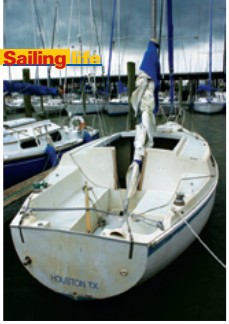
At the Watergate auction, brothers George and Ed Holmes, who live near one another in the Clear Lake area, acquired a 1982 Sovereign 24 for $150. It was the second boat they’d bought at auction with a view to restoring it.
The year before, they’d found a boat trailer sporting a “For Sale” sign. It also had an older Hunter 25 on it. They tried to buy just the trailer, to no avail. But after some negotiation, the owner offered them the boat and the trailer at a price they were prepared to pay for just the trailer.
Ed, an office-machine service technician, says he didn’t believe the Sovereign they bought this time had been out of the water since before its last registration renewal in 2000. “It had an inch-thick beard below the waterline and its own little ecosystem,” he says.
“With advances in design, materials, and engineering since these boats were built, you can sometimes make them better than they’ve ever been,” Ed notes. “It’s a great pleasure to see them return to new or better-than-new condition.”
Two bargain boats
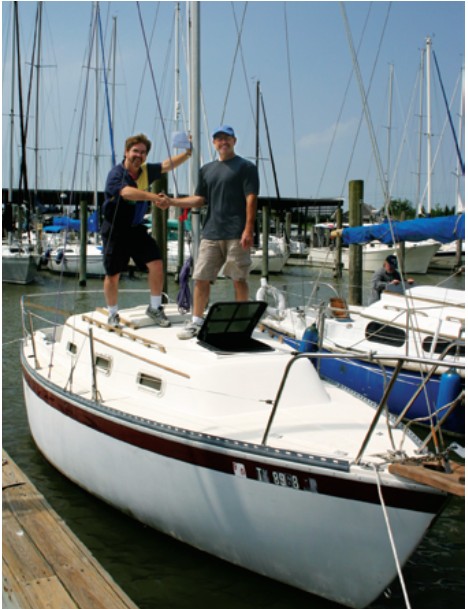
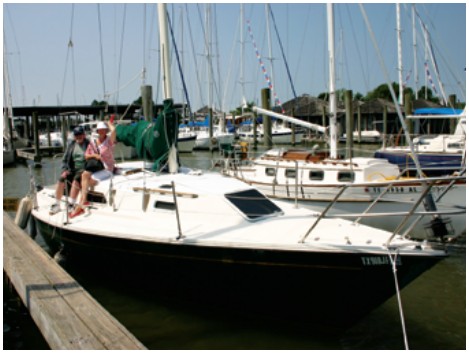
Another buyer that day was Chuck Vastine, a shipping foreman who works in Galveston. He bought the S2 for $1,500 and a Pearson for $50. He sold the Pearson a week or so after the auction. The S2 was his restoration project. It came with an outboard and was in remarkably good condition for an auction boat, though it was in need of cosmetic work. Chuck says he’ll sail it during and after the project and then perhaps offer it for sale.
Johnny Nimmons, a technical research associate at a Shell Oil Company facility in west Houston, bought the only powerboat in the auction, a 28-foot 1980 Wellcraft, as well as four sailboats. He bought the Wellcraft, at $2,000, for his wife, Elizabeth, to ensure domestic tranquility. For himself, he bought a 1982 US 30 for $1,000. It has a rough interior that he’ll restore. He also purchased, for $300, a 1968 Westerly 30 which, after spending some time and money on it, he later sold.
As if three boats weren’t enough, he also bought a 1978 San Juan 24 for $200 for his 25-year-old daughter who was just getting into sailing and, for $100, a 1968 Coronado 25 that he planned to use to entertain members and families of the Houston law fi rm where his wife works.
Johnny had sailed as a young man but had been away from it for many years. His family lives at a residential airport, and his avocation has been flying antique aircraft.
“The marina, after all these years, is a nice change of pace,” he says. The US 30 “is like having a little condo on the water. The whole family has been excited. We had a great time. It was a fantastic week for us.”
But, as much as he’d been looking forward to being back on the water that day, Johnny never did get to go sailing on that auction Saturday.
John Ira Petty worked for almost 30 years at metropolitan newspapers and for 15 of them wrote a weekly sailing column. He holds a 100-ton master’s license with sail endorsement.
Thank you to Sailrite Enterprises, Inc., for providing free access to back issues of Good Old Boat through intellectual property rights. Sailrite.com