The diagnosis was elusive and surprising
Issue 101 : Mar/Apr 2015
Our passage up France’s Seine river from Honfleur to Rouen was uneventful. We ran all day with Entr’acte’s engine humming along at 3,100 rpm. With 180 miles yet to travel before we would leave the current of the Seine River behind and enter France’s tranquil canal system, during our stay in Rouen I inspected the engine very carefully to avoid further problems with blockages (see “Dead in the Water,” January 2015). Then off we went toward Paris.
At Amfreyville, we entered the first lock. As we prepared to exit the lock, our temperature alarm sounded. No water was coming from the exhaust, and my heart sank as I immediately shut down the engine. The lock keeper pointed to a large mass of cut grass and weed that had floated into the lock from upstream. We warped Entr’acte to the head of the lock away from the weed, re-started the engine and — voilà! Beaucoup de l’eau! False alarm! Off we went in the company of Dolphin II out of the UK, with whom we had shared the lock. Hour after hour, we both slugged along at 3,100 rpm making a slow 2.5 knots over the bottom. It was late May and the Seine was still in flood. Paris seemed a long way off.
The cruising guides show many opportunities to tie up between Rouen and Paris, but these are widely spaced, hard to find, and in some cases — despite what the guides claim — no longer exist. By late afternoon, the crews of both vessels were becoming anxious. The sun was going down and the promised tie-ups did not appear. We had only two options left: a set of steel pilings set among the trees close to shore or a “promised” marina just half a kilometer ahead on the left among a small group of islets. Due to current, traffic, and water depth, anchoring was not a safe option.
We could see boats tied up behind the island, but neither the chart nor our three cruising guides showed any way in. The charts and guides do not show any depth information and there were no channel markers anywhere. As we cleared the headland, Dolphin II headed directly toward the boats and immediately ran aground. At that moment, our alarm sounded again and, sure enough, we had stopped discharging water. I shut down the engine and we drifted downriver out of control back toward the pilings. Dolphin II got off the bottom quickly, towed us to a piling, and disappeared into the dark in search of deeper water.
No apparent cause
First thing in the morning, I removed the water pump and, to my surprise, the impeller was completely intact. I reinserted the impeller, and on starting the engine was relieved to see a healthy water discharge. We hung onto the pole for 20 minutes with no problem and decided that we must have picked up more river debris in the intake — a common occurrence on rivers and canals. We disconnected from the piling and set off into a beautifully crisp, clear morning toward Paris and in search of Dolphin II.
Three hours later the alarm went off again. We moved toward shore and let go the anchor, right next to a large, very descriptive sign that said: “No Anchor!”
Here we sat in a 4-knot current out of everyone’s way and in no danger as barge traffic passed from both directions. The no anchoring sign was a bit unsettling, but we made a pact that when we went to jail I would get the upper bunk, and I calmly set to work to solve this problem.
Again, I removed the water pump and inspected the impeller very carefully. It had seen less than 20 hours of service. It looked and felt perfect, supple rubber, no cracks, no broken blades, no deformity in any blades, perfect! I next removed the thermostat. New though it was, sometimes you get a bad one. I was surprised to find it open! To cause overheating, it would have to be stuck in the closed position. As a gamble, I re-installed the old one.
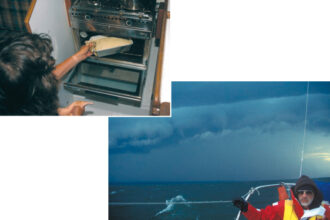
On starting the engine, we could see the usual abundant discharge of water at the stern. After idling for 20 minutes, we were cautiously under way, keeping the rpm to a modest 2,200 and traveling as close to shore as possible. At the lower speed, it was a slow go of only 1.5 knots against the current, but we were making progress . . . until 1400 when we heard the sound of the exhaust change from the usual “whoosh, sploosh” of water to the metallic “pong, pong, pong” of a dry exhaust.
This time, the anchor bit just as the alarm sounded and we shut down the engine. This was no longer fun. I had a spare water pump I had just rebuilt. I installed the spare and we were off again. By late afternoon, we found Dolphin II tied to a floating pontoon. They motioned us to tie up astern. As we went into reverse to back down, that now familiar and unwelcome “pong, pong, pong” sound returned and just as we made fast to the dock the alarm sounded once more.
This was embarrassing! Entr’acte had become “the catastrophe boat,” badly maintained and always in trouble. Were we now the boat to avoid? I was getting angry!
A more thorough probe
Somewhere inside the cooling system there had to be a blockage. Slowly and purposefully, I removed every hose from the cooling system and pulled a dockline through each hose to clean out any salt deposits (and there was indeed much to remove.) I did not stop there. I next removed both engine zincs, the thermostat, and its cover. Probing the depths of the cooling system with my fingers produced no debris that might clog the system.
I next took a hose and poured water into and through every opening in the cooling system, first from the top down and then from the bottom up. I exercised the greatest care to not pump water into the cylinders. That would have been a disaster. I was pleasantly surprised to see water running freely through all the openings of the engine block. There was no evidence whatsoever of any blockage or obstruction inside this engine. Finally, using a piece of stainless-steel wire, I probed and cleaned the orifices of the thermostat cover and again found nothing amiss. Leaving no stone unturned, I once again opened the water pump to check for possible debris, but saw nothing untoward in there.
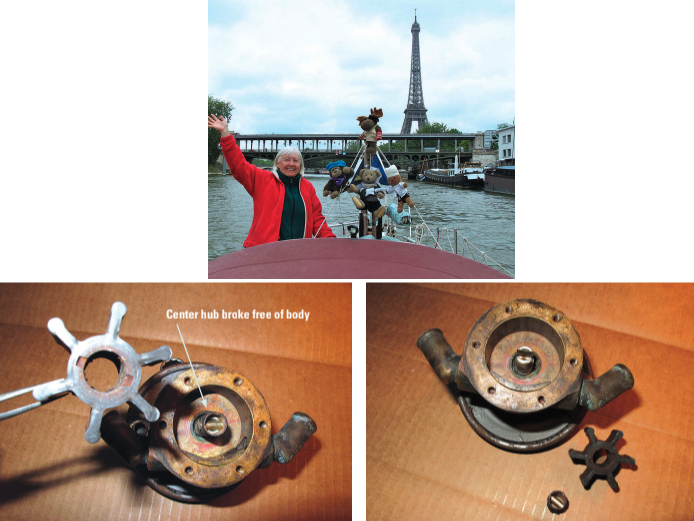
And then King Neptune smiled on my efforts. Just before replacing the cover plate on the pump, I turned the pulley as I was looking at the inside of the pump and was stunned to see that, although the pulley was turning, the impeller blades were not. I rotated the pulley once again. The blades remained motionless while the center spindle of the impeller was turning.
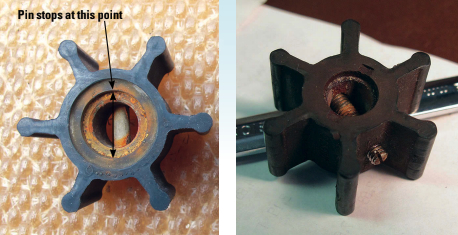
I pulled out the impeller. Lo and behold, the rubber blades came apart from the center spindle, leaving the spindle behind. I have never been so relieved. But how could this be?
Our new batch of impellers differed substantially from the former design. In the old design, the drive pin passed all the way through the body of the impeller, much like the shear pin on an outboard motor’s propeller. The new design has a much shorter drive pin that only passes through a center hub that is somehow bonded to the outer body. It was this bond that had broken loose.
Everything was suddenly clear to me. The problem was a direct result of the event several weeks before when both passages of the exhaust mixing elbow became clogged. With the water passage blocked, when we pushed the engine to 3,100 rpm, the stress on the water pump impeller must have been severe enough to weaken the bond between the center spindle and the outer body of the impeller. The bond, although weakened, still had enough friction to turn the blades once the blockage was cleared. Eventually, the spindle began to slip at high speed, although it could still maintain traction to work normally at lower rpm . . . until the bond failed completely. There was no way to foresee this type of fault without looking and testing specifically for it. Since I had never seen or even heard of such a failure, I did not look. I will be watching for it in the future.
Paris at last
Our final two-day run toward Paris was tense. With a new impeller, the engine was back to normal, but we were gun-shy, traveling close to shore at a low rpm and always on the lookout for an emergency anchorage. Local advice was to enter Paris just after sunrise to avoid the chaos of workboats, barges, and tour boats. Our plan was to stop for the night five miles outside Paris just after the final lock. If we got under way at 0600 the next day, we could enjoy a leisurely entry into Paris, snap some great once-in-a-lifetime photos, and arrive at the Paris Arsenal Marina by 0800, before everyone else was awake. It was great plan but, alas, this was not to be. Despite the numerous locations shown in the guides, we could find no place to stop. Every available space boldly displayed “No Tie Up” or “No Parking” signs, so we carried on, always on the alert for the sound of the engine alarm.
Entr’acte passed the Eiffel Tower exactly at noon amid as much river traffic as can be imagined: boats of all sizes zooming around from every possible direction, each on its own mission. It was truly a spectacular sight. One mile from the marina, we approached the final hurdle, a “one-way-traffic” bridge. Traffic is controlled by signal lights that switch from red to green at set times every hour. If you miss the green light for your direction, you must wait. We drove hard against the current but — just as we reached the bridge — our light turned red and the downstream traffic began. We moved off to starboard and spent a very long hour holding station in the current just off a stone wall from which protruded a large, ancient, and inviting steel ring. At the first sign of trouble, we agreed, we would grab that ring no matter what. An eternity later, our light turned green, and Entr’acte crept under the bridge and locked through into the marina without further drama.
Into the canals
Two fabulous weeks later, Entr’acte departed Paris, leaving the river and current behind to enter the Canal Lateral à la Loire. On board were our friends John and Paula of the yacht Mr. John, who were taking a break from their Pacific wanderings to make this canal trip with us. John is a retired container ship captain and a good man to have on board.
For two days Entr’acte made a steady 4 knots through flat water at a sedate 1,600 rpm. I related the drama to John and confided that I had been ready to spring for a new engine at the first opportunity . . . but since discovering the bad impeller, I told him, “Everything is now OK and our engine troubles are a thing of the past.” The words were barely out of my mouth when the alarm sounded again. Fortunately, the canal was narrow, and it was a drift of only a few yards to the bank and an easy tie-up.
After a long lunch while the engine cooled, I removed the thermostat from the engine. This was the last trick I had up my sleeve, the only move I had left. If this did not work, the engine would go over the side. It’s not good for the engine to run it without a thermostat, but it is far better than constant overheating. For the next five days the engine performed flawlessly, but I was going crazy. Why was this happening?
I could not believe that our engine went from extremely reliable to completely unreliable overnight. Over the years, I have discovered that most problems have very simple solutions, but this one was baffling! I had done everything, tried everything, cleaned everything, changed everything. There was nothing left! By then I feared that, even if I were to change the entire engine, it would probably still overheat.
Minus the thermostat, things seemed to settle down as we drifted calmly across France, but I knew it was a short-term solution. It nagged at me day and night. I was missing something fundamental.
One gorgeous afternoon, Entr’acte sat 5,000 feet above sea level in the most picturesque setting imaginable. Wild horses grazed in the field next to us. On the other side of the canal, acres of grapes stretched forever toward a magnificent chateau in the distance. All was right in our world. We had just finished lunch and the afternoon entertainment was moving both thermostats from hot to cold water, timing them and watching them open and close. No problems there!
Inspiration and a solution
It must have been the relaxed atmosphere, because that night I finally slept like a log. Suddenly at 0200 (why is it always 0200?) I bolted awake. I had it! I was so excited I had to fight to keep from tearing into the engine room right then. It was so simple. What a dunce I had been.
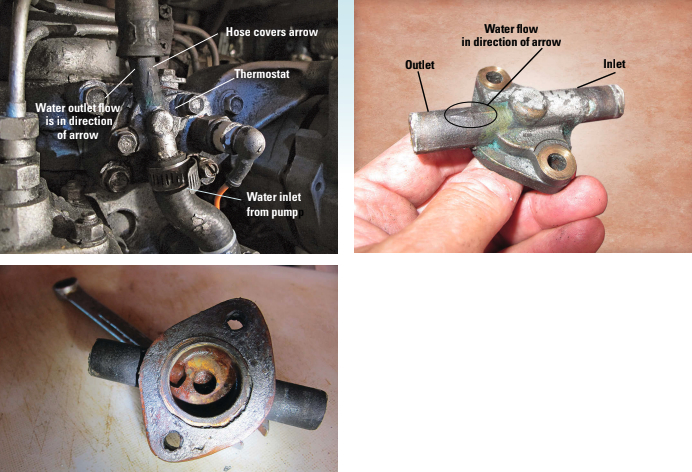
After breakfast I dove into the engine room, praying for all I was worth. I removed both hoses from the thermostat cover and looked closely at the cover itself. Yes, yes, yes! Sure enough, embossed quite clearly on the cover but hidden under a hose was an arrow to indicate the proper flow of water. The cover should be mounted with the arrow pointing up. I had mounted it upside down.
The thermostat cover has two ports, an inlet and an outlet. Viewed from the outside, the hose barbs appear identical. Inside the cover, however, the orifices are not only of a different size, but each is oriented differently to the flow of water. The water is supposed to flow through the open thermostat into the engine. With the cover inverted, the water pump was pumping seawater into the outlet and directly onto the top of the thermostat, rather than through it. This restricted water flow into and through the engine. Some water could flow, but only enough to cool the engine at low rpm for a short time. The temperature would gradually rise and finally set off the alarm, especially if we raised the rpm for any reason. As far as the engine was concerned, the thermostat was constantly closed.
When dismantling the cooling system to clean out the hoses, I had been under quite a bit of stress and inadvertently installed the cover upside down. The cover can be installed easily in either orientation, hence the arrow. But in the heat of battle, that arrow is very easy to miss, especially when it’s completely covered by the hoses.
Confession: I knew about the arrow and that the cover had to be mounted with the proper orientation. Over the years, I have even reminded others to watch out for it, but through a simple confluence of events, circumstance, and stress, I assembled it backward and paid the price in frustration.
Now all is well. Entr’acte’s engine is back to normal and runs for hours and days on end as happily as it did before. It’s magic!
Ed Zacko is a Good Old Boat contributing editor. He and Ellen met while playing in the orchestra of a Broadway musical. They built their Nor’Sea 27, Entr’acte, from a bare hull and since 1980 have sailed across the Atlantic four times and the Pacific once. Ellen and Ed now split their time between cruising in Entr’acte and playing in the jazz clubs of Spain, France, and Morocco. Follow them at www.enezacko.com.
Thank you to Sailrite Enterprises, Inc., for providing free access to back issues of Good Old Boat through intellectual property rights. Sailrite.com