Eliminate fire drills with a drag-proof system
Issue 106 : Jan/Feb 2016
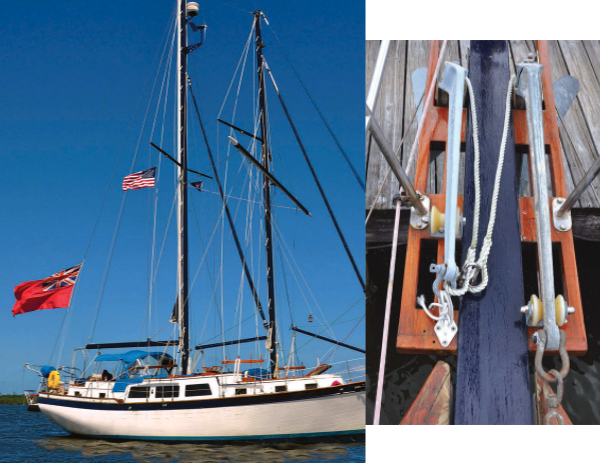
When I was new to boating, many, many years ago, I quickly learned it was far better to anchor securely than to stumble about on deck at 3 a.m. on a blustery, rainy, dead-black night while trying to haul in and reset a dragging anchor. I soon devised a drag-proof method of anchoring. Years later, I still use the same system on Britannia, my 45-foot schooner.
The normal tactic to avoid dragging is to lay out a good length of rode — about five or six times the depth — but this doesn’t guarantee that a single anchor won’t drag. If you have to haul in about six times a 40-foot depth in order to re-set the anchor (especially in the conditions described above), that’s an awful lot of rode and effort.
The main objective with any anchor is to keep it flat on the bottom where it has the best chance of digging in, even if it was not doing so at the beginning. An age-old method was to weight the chain about halfway along the rode with what is generically called a kellet, which offers no actual holding power by itself but works by keeping the rode low and allowing it to bounce so tugs on the rode can’t as easily pull the anchor out. One commercially available kellet is made in New Zealand. Called an Anchor Buddy, it’s a heavy casting with a roller in the middle that lets it down the chain or line. At one time, a special snatch-block chain roller was available that rolled down the chain to the bottom with a heavy weight attached, but I haven’t seen those in years.
Two-anchor technique
I devised my own, dare I say, more sophisticated method using a second anchor. I’ve found this to be drag-proof even in the most severe conditions. I firmly believe a main bower anchor should be as heavy as the anchorman can reasonably handle, irrespective of boat size — within reason of course. It is possible that the modern anchors we have seen over recent years don’t need to be as heavy as the old styles, but for me, heavier is better.
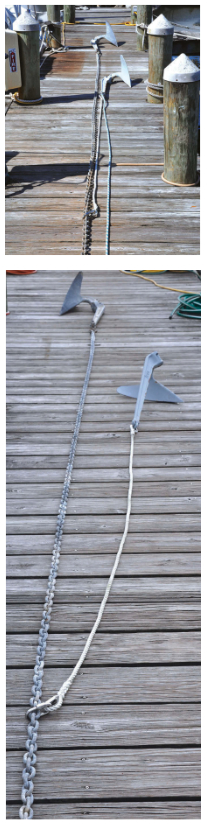
I have two CQRs on twin rollers on either side of my bowsprit. One is a 65-pounder; the other weighs in at a mere 35 pounds. I wish I had two 65-pounders, this being the heaviest I can manage. The 65-pound bower is on 325 feet of 3⁄8-inch chain. The “little anchor” has no chain or rope rode attached to it at all.
I made up a strong rope bridle with stainless-steel thimbles spliced and whipped at each end and keep it permanently in place ready for use. One end of the bridle is permanently shackled to the shank of the 35-pound CQR even when it rests in its roller. The other end then passes around the end of the bowsprit and up the roller of the main anchor and is shackled to an eye on the bowsprit.
On my boat the bridle is 5 feet long, but the idea is to make it as short as possible, so the length will vary according to different bow arrangements. On a boat with only one bow roller, a second anchor can be shackled directly to the chain with a very short bridle.
Anchoring the boat
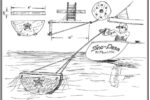
After letting go the main anchor and paying out scope, usually about three times the depth, I let the boat fall back with the wind, or drive it backward, until the chain comes up and it feels as though the anchor has snubbed in. I then shackle the rope bridle through a link in the chain, the other end already being attached to the shank of the 35-pound anchor. At the same time, I bend a good length of strong line to this second anchor. This needs to be at least as long as the length of chain I intend to let out.
I push this second anchor overboard, where it hangs by the bridle on the chain. Then I back the boat while letting out more chain, along with the line attached to the second anchor. I usually let out two or three times the depth, then snub in the second anchor using the line. I now have the main anchor dug into the bottom, a good length of chain, and the second anchor attached to it (a total of 100 pounds of anchors), followed by the same length of chain and a line up to the boat.
All this might sound like a bit of a rigamarole, but it really isn’t if you organize it properly. I can anchor with this method almost as quickly as any boat with a single anchor, but I have a lot more peace of mind when the wind pipes up. My boat weighs more than 20 tons and has above-average windage, what with three roller-furled sails, a square sail yard, and a large cockpit enclosure.
The system can be adapted to any boat with two anchors — and who does not have two anchors? If you use a chain and rope rode, the bridle should be shackled to the last few links of the chain.
The benefits
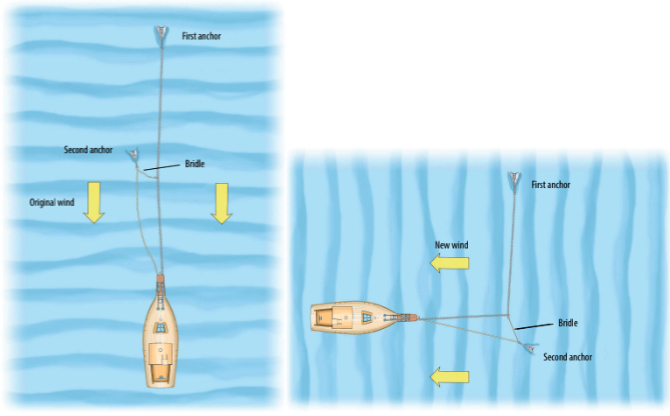
If for any reason — whether wind or tide — the load on the boat becomes strong enough (always at around 3 a.m., of course), the rode will straighten out until the bridle becomes taut and tries to lift the second anchor. If this anchor is well bedded, it will resist the pull of the chain that’s trying to lift it off the bottom. It acts instead as a spring, dampening the effect of the tightening rode and ensuring that the chain to the first anchor will remain lying flat on the bottom.
If the wind shifts or the tide turns, the boat will initially swing to the second anchor. If the pull of the wind or sea is sufficient, it will drag the chain around and the second anchor with it. When that happens, the second anchor will bed in once again. If the second anchor should fail to grip, the whole rode will straighten out in the new direction. This has never happened to us because the second anchor always beds in long before the chain straightens out.
Weighing anchor is only a bit more trouble than you would normally have with or without a windlass. To retrieve the anchors, I wind in the rode — along with the line on the second anchor — until I can haul the second anchor through its bow roller with its rope rode. (Absent a second bow roller, this anchor would be brought on deck by hand.) I then unshackle the bridle from the main chain. At this point, the boat is still anchored by the first anchor and I can take a breather if I like. I then bring up the main anchor in the normal way.
For me, the main point of doing all this is that the anchor has never dragged on any boat I have anchored using this system. I wonder how many people can say that? I have adopted a policy of always — and I mean always — anchoring with this method overnight.
In rough conditions it’s very comforting to know we are lying to two anchors on two separate rodes. Who has not worried just a little, on a wild night, if the chain will break or the single anchor let go? I would much sooner have the trouble of laying and recovering this lot when I am ready than the worry of dragging and all the associated problems and dangers.
This system is easier and quicker than trying to lay two separate anchors, say at 90 degrees to each other. There is no need for maneuvering, as in laying two anchors in different positions, and no chance of the rodes tangling if the boat swings.
The proof is in the holding
We were anchored by this method in Cala Portinatx, a beautiful cove in northern Ibiza, Balearic Islands, in the Mediterranean. A mistral had been forecast, but it came in the night much stronger than anticipated and the bay was soon awash with boats dragging their anchors and heading for the rocky shore. It was mayhem — but not for us. My only concern was keeping watch in case other boats crashed into us.
One boat did come toward us, the terrified occupants unable to reset their anchor or motor against the wind. I heaved them a line and attached it to our aft cleats and they drifted astern. Then a second boat scudded by and we did the same. All three of us remained like this through a very blustery night during which a substantial motor cruiser was driven up a sandy beach by the frantic occupants. Two boats were completely wrecked on the rocks and one person lost his life.
It is certainly worth anchoring well, even in a flat calm and a good forecast, because you never know when old Neptune might change his mind.
Roger Hughes has been sailing for nearly half a century as a professional skipper, charterer, restorer, and occasional imbiber aboard lots of boats, including square-riggers. His latest project is refurbishing Britannia, a once rundown Down East 45, and re-rigging her as a brigantine schooner with a unique roller-furling square sail (November 2015) on the foremast and a few other “inventions,” like his over-the-top blocks (January 2015) and a hot tub in the owner’s head. Roger’s website is www.schooner-britannia.com.
Thank you to Sailrite Enterprises, Inc., for providing free access to back issues of Good Old Boat through intellectual property rights. Sailrite.com