He was “through with boats” until . . .
Issue 106 : Jan/Feb 2016
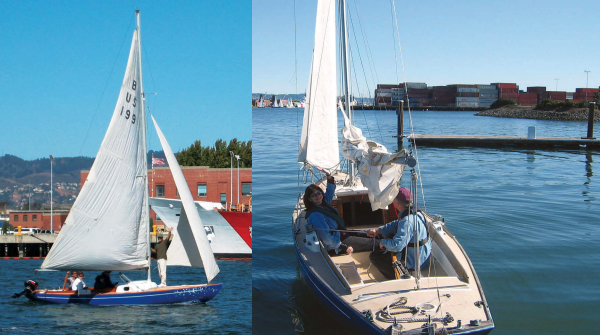
In 2003, I sold my Catfisher 28, Bullfrog, and moved ashore with my soon-to-be wife, Sue. After 15 years as a liveaboard, living ashore was all very nice, but I soon found myself missing the sound of waves lapping against a hull, the prismatic sunlight off the water, and the gentle rocking of a keelboat. I’m a serial boat fixer and, though I’d told Sue I was through with boats, soon found myself absently trolling the classifieds for something cheap, yet interesting. California’s regional sailing magazine, Latitude 38, had an ad stating that the Encinal Yacht Club in Alameda was selling donated boats to raise money for their junior sailing program. I scurried right over, eager to snag a great deal on a dog-eared J/24 or weathered Merit 25. I never dreamed I’d find a rare Bluenose 23 tied to their dock.
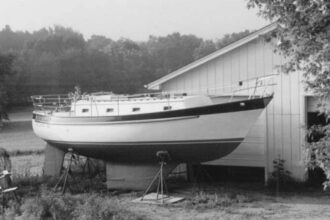
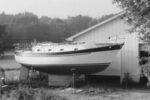
I’d seen the sleek little blue boat plying the waters of the Oakland Estuary for many years. I was told it was probably the only one in the bay area. I had always been enthralled by its beautifully classic lines. At the yacht club, this Bluenose had been like a barn swallow among common starlings. Now, her once magnificent blue paint was faded, bearing decades of little gouges. Her sailcover was weathered and threadbare, the varnish was peeling, and the teak trim was splintered and sprung. Even though she looked a bit forlorn, $1,500 seemed like a steal for a Bluenose, and a few days later Sue and I sailed her the few hundred yards to a new slip at Alameda Marina.
A Canadian classic
The Bluenose 23 was designed in 1946 by William Roué, the naval architect responsible for Canada’s famous big schooner, Bluenose. The original Bluenose 23 was a wooden design, an open, long, low, and narrow racer with a cutaway keel and attached rudder. In the mid-’60s George McVay of Nova Scotia took a mold from a wooden Bluenose 23 hull and made a fiberglass version fitted with a small cuddy cabin. She measured 23 feet 6 inches long with a beam of 6 feet and drew 3 feet 8 inches. The fiberglass Bluenose has a total displacement of 2,000 pounds with 800 to 900 pounds of it ballast.
In its home waters, the Bluenose is a popular class racer. Knockaboutsloops, a website for lovers of small boats, lists it among the most beautiful fiberglass boats ever built. One was even on display at Casino Nova Scotia in Halifax. My Bluenose is hull number 199.
Ask any of my friends: I go through old cars faster than shoes, usually turning interesting mechanic’s specials into dependable classics. I do the same with boats. I thought my new Bluenose deserved a first-class restoration.
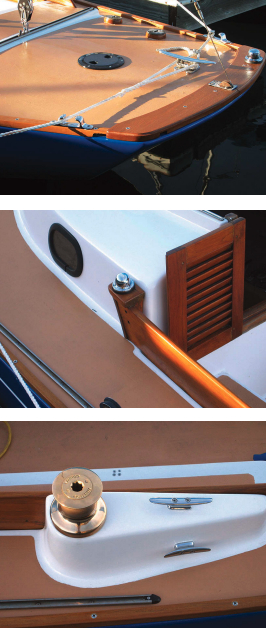
I began by removing all the woodwork so I could refinish it at home in the garage. This included the louvered companionway doors and teak cockpit coamings that were secured by dozens of large stubborn bronze screws. I also unscrewed the teak toerails that were sprung and badly cracked. I had the boat hauled at Svendsen’s Boat Works in Alameda, a yard famous for being the U.S. home of the Folkboat revival. There are usually a few gorgeous Knarrs around for added inspiration. These are, in my opinion, the most beautiful boats ever made.
The dirty work
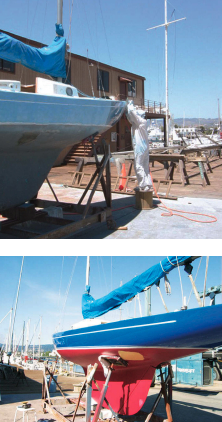
Bundled up in our Tyvek bunny suits, goggles, and respirators, Sue and I power sanded (in the wet) the boat down to the bare fiberglass. This took a few days and included the arduous task of sanding off the many different-colored layers of old bottom paint. The kindly folks of the Island Yacht Club in the building just behind our work site took pity on us and invited us in for a couple of steaks and beer. We appreciated their kindness and joined the club for a short time. I can’t stress how hard Sue, who was a neophyte to the boating world, worked to remove the old paint. Is it any wonder that I married her?
After filling and fairing countless scratches and gouges, I hand-rolled the primer. The folks at the chandlery suggested adding a light blue pigment to indicate coverage of the second coat. Next, I rolled on an epoxy barrier bottom coat. Finally, we masked everything in preparation for the finishing paint.
I’ve tried my hand at painting before: dinghies, houses, bicycles, chairs, and fine art. I’ve even sprayed a couple of cars, so painting a boat hull didn’t seem like too daunting a task. The problem was that Newt was to be dark blue and I hadn’t tried rolling and/or brushing a dark color before. After a few attempts at hand-rolling the Awlgrip navy blue, it became obvious that this was an art requiring a skill I didn’t have time to develop. Every brushstroke and change in paint viscosity was immediately apparent. I eventually came to my senses and asked Svendsen’s to spray it. The resulting mirror finish was worth every penny. I could have literally shaved in the resulting reflection. I can take some comfort that I did at least manage to get the boot stripe right.
At this point, it was time to cut off the compounding yard bill and get the boat back in the water. I motored Newt back to her slip where I would paint the deck. This I successfully rolled and brushed in Interlux Brightside white. Next, I taped out sections of the deck and cockpit for the non-skid, which was Interlux Brightside Bristol Beige with Intergrip Non Skid Paint Additive mixed in. The non-skid had to be effective, remember, because Bluenose 23s don’t have lifelines.
The shiny bits
With all the glossy new paint, it was time to reattach the freshly sanded and varnished wood. MacBeath Hardwood in Berkeley supplied the teak for the toerails and Svendsen’s supplied the countless bronze and stainless-steel screws. After all the hard work and new paint, I just had to replace all the shiny bits too. This included finding a magnificent pair of bronze Barlow #16 winches and, while I knew I would have to continually polish them till the end of time, they are spectacular to look at.
The area belowdecks on a Bluenose 23 is torturously tight and only fit for sails and children. Newt’s is now clean and reasonably bright with a little new fuse panel and the smallest 12-volt battery I could find.
Slender, tender, and swift
I was warned by a club sailor that the Bluenose (Newt was a regular fixture of their Friday night beer can races) is a very tender boat with minimal self-draining capabilities. I can second that. It takes forever to empty the cockpit after a washdown and four adults will cause it to backfill. I was advised not to take her out “the gate,” except in very light conditions.
Newt tends to sail on her ear in our windy San Francisco conditions, so the Oakland Estuary seemed to suit her better. Still, when conditions are right she’s as nimble as a cat with just fingertips on the tiller.
Auxiliary power is always an issue with long overhanging sterns like that on the Bluenose. Newt came with deck fittings for a bronze outboard motor bracket that hung off the stern. But when it’s mounted there, you simply can’t reach the motor controls from the cockpit. I came across a picture of another Bluenose in Nova Scotia with the bracket mounted on the side and, after a little surgery, this pretty much solved the problem. I’ve since seen the same thing on an Ericson 32 Scorpion, and the beautiful Rustler 24s utilize expensive-looking side-mounted motor brackets too.
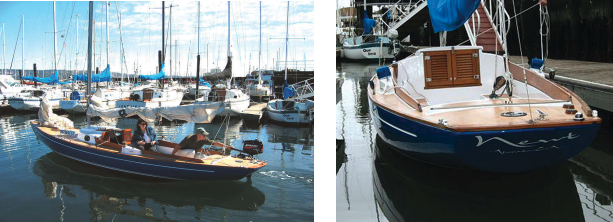
I tried a Nissan 5-horsepower outboard on Newt but it proved to be too heavy, putting her down at the stern while under power. Besides, it just looked too big. After a furious bidding war on eBay, I managed to win a British Seagull that turned out to be the perfect size and looked period perfect too.
When I was finally finished (is a boat ever finished?), we invited a few friends over for a christening party. I loaded up the boat and took everyone for a spin around the estuary . . . but a Bluenose seems really crowded with more than two aboard.
Sue has a boat lettering side business — AlphaBoatGraphics — and did an absolutely exquisite job stylizing the name and applying it to Newt’s tiny transom. The harbormasters at Alameda Marina said Newt was the most beautiful boat in the estuary and that she elicited questions and comments daily.
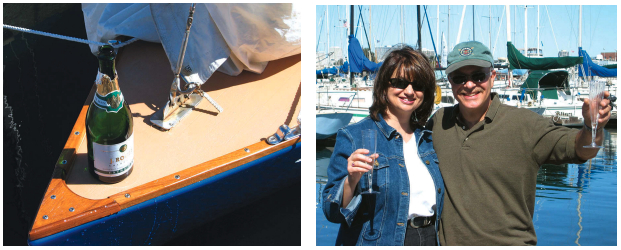
Back to the future
As much of an honor as it was owning Newt, I ended up selling her in 2005 to help purchase a floating home. I couldn’t afford both.
I ran an ad in Latitude 38 and got a call from Southern California. The original owner had seen the ad and wanted to buy her back. He had another Bluenose 23 (in black), but wanted one for his lady friend as well. They showed up with the same trailer that had carried Newt up the coast 25 years earlier. They were extremely happy with the restoration. Sad as I was to sell her, I knew Newt was going to a happy home and to conditions more suitable to her sensitive sensibilities.
Peter Thelin was raised in the Northeast before moving to San Francisco to work for the federal government. A master optician, he runs the Lawrence Livermore National Laboratory Optical Shop. He has owned, restored, and lived on a number of boats before settling into a floating home.
Thank you to Sailrite Enterprises, Inc., for providing free access to back issues of Good Old Boat through intellectual property rights. Sailrite.com