. . . is Katnip to a family of lake sailors
Issue 107 : Mar/Apr 2016
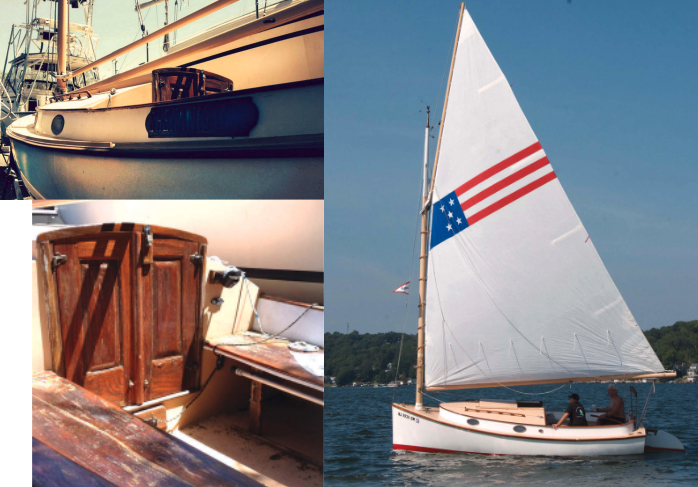
In April 2015, we purchased a 1974 Herreshoff America catboat. She was cute, interesting, and in need of significant TLC. She took the place of a lovingly owned Catalina 25 that had been a wonderful source of fun and adventure for our family and friends for 27 years. I’m in my early 70s, and advancing years brought the realization that we needed to downsize (simplify) to be able to continue sailing for a long time into the future. I discussed this with my wonderful wife and sailing partner, Kathy, and we agreed to look for a smaller boat. No more spinnakers, jibsheets, genoas, heavy mast raisings, and such.
I learned to sail on a Herreshoff S Boat as a kid and have had an infatuation with Herreshoff designs for more than 55 years. Our sailing library is full of books on the Herreshoff family and their wonderful history of designing and building the finest yachts for more than a century. Our boat-search criteria included inshore seaworthiness, dry shelter with a head, nice appearance, room for friends and family, ease of use and trailerability and, we hoped, a Herreshoff design. As we always maintain our own boats, we preferred fiberglass construction.
We sail on northern New Jersey’s Lake Hopatcong, the largest lake in the state, but we have towed boats to many locations on the East Coast and wanted to be able to continue those adventures while expending less effort. With its single sail, shallow draft, and large cockpit, a small catboat seemed to fit these needs. Our search focused on that type.
To my delight, I discovered that Halsey Herreshoff had, in the early 1970s, modified a 1904 catboat hull design of his grandfather’s (Nathanael) to be built in glass. The resulting boat was called a Herreshoff America. Pictures on the Internet showed it to be a cute boat with the conveniences we need. A review in Good Old Boat spoke well of it (January 2008) and I also found a Facebook site with lots of information. I was intrigued and started searching for one.
The Herreshoff America catboat is 18 feet long with an 8-foot beam and has a large cockpit (bigger than that on our Catalina 25) and a two-berth cabin with a Porta Potti — a big small boat with lots of room. She’s a centerboard boat with minimal draft and has 500 pounds of inboard lead ballast. As a catboat, her mast is located in the bow of the boat and she has only one sail. She has easily accessed outboard power mounted in a well in the cockpit.
A brief search
A few Americas were listed for sale at widely differing prices and in locations from Massachusetts to the Chesapeake. Boat conditions varied from “needs work” to “professionally restored.” We wanted something in between at a price that approximated the resale value of our prior boat. Luck was with us.
An Internet search found a 1974 Herreshoff America for sale at a boat-yard on the Jersey Shore about a 2-hour drive from home. Kathy and I headed south the next weekend and found the boat nestled in the back of the yard, uncovered, on a trailer with the mast raised and surrounded by larger boats. She had obviously been there awhile and was in the “needs work” category. She was in basically good condition but in need of considerable cosmetic work. The hull looked good, the deck sound, and the cabin acceptable. She came with an almost new 4-horsepower Yamaha outboard, old sails, and a fair supply of accessories, such as fenders. The asking price was close to our budgeted figure.
Our offer was accepted, and we were suddenly the proud and very happy owners of a Herreshoff America catboat with the underlying awareness that we had a lot of work ahead of us. I took a lot of pictures.
The following weekend, my good friend and sailing buddy Tom and I went back to the yard to figure out what had to be done to bring her home. We checked out the trailer (better than expected) and asked the yard to prepare the boat to be moved. This included lowering the mast and moving her to an accessible location. We picked up the motor at the home of the very hospitable and helpful seller and returned home. Concurrently, we sold our Catalina to a friend who had lusted after her for years.
Two weeks later, the yard had the boat ready and Kathy and I towed her home without incident. We live in a townhouse community and are unable to keep or work on a boat at our place. Fortunately, we have good friends who own a lovely home close to us with a separate drive and storage area for their boats. Bob and Carol have previously let us keep our old boat there when doing spring cleanup and were kind enough to allow us to bring the catboat there for her makeover. On top of offering us this great area to work, Bob is a highly skilled craftsman and has every tool he needs to support his many interests, one of which is woodworking. I benefited tremendously from his generosity, advice, and help throughout the restoration.
Two-stage refit
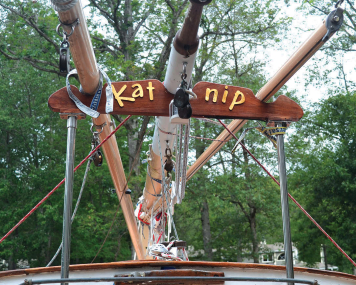
We named her Katnip. Although she was usable from the start, we didn’t want to launch her without improving her appearance and ease of use. We made a list of tasks to do for her first season and another of items to be completed the following year.
First-year tasks
- Paint the cockpit coaming and cabin sides.
- Varnish all brightwork.
- Make new cockpit and cabin cushions.
- Repair damage to rudder bottom (temporary fix).
- Paint bottom.
- Paint new boot stripe.
- Sand, repair, and coat cockpit seats.
- Build tabernacle.
- Build boom gallows.
- Fit new rollers on trailer.
Following-year tasks
- Replace rubrails.
- Redo and paint cockpit sole.
- Sand and paint cabin top and deck.
- Paint mast.
- Clean and polish portholes.
- Complete rudder fix with new fiberglass.
Sometime
- Coat centerboard with epoxy
Katnip arrived at Bob and Carol’s and we set forth to fix her up. We ordered materials from many sources and we sought helpers among family and friends. We searched the Internet and found a lot of good information on how to accomplish our restoration objectives.
The work begins
Kathy, together with our daughter Amy, Bob, and Joe (another good friend and sailing buddy) provided many hours of support. Many others also helped (thanks to Tom and Marty, among others), but this was the core group. Amy is very creative and a talented artist, so the boot stripe fell to her. Kathy, Joe, and I are willing and active, but are average in the skill arena. Bob was the leader who guided our progress while accomplishing many of the more complex tasks himself.
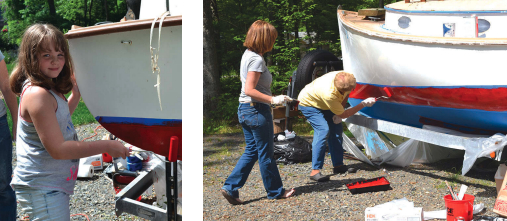
The Herreshoff America has a distinctive American flag on the sail, so we decided to paint the bottom blue with a contrasting red boot stripe on the white topsides in keeping with the American theme. We sanded and painted the bottom and Amy went to work measuring and painting the boot stripe, ably helped by Kathy and our granddaughter Maggie.
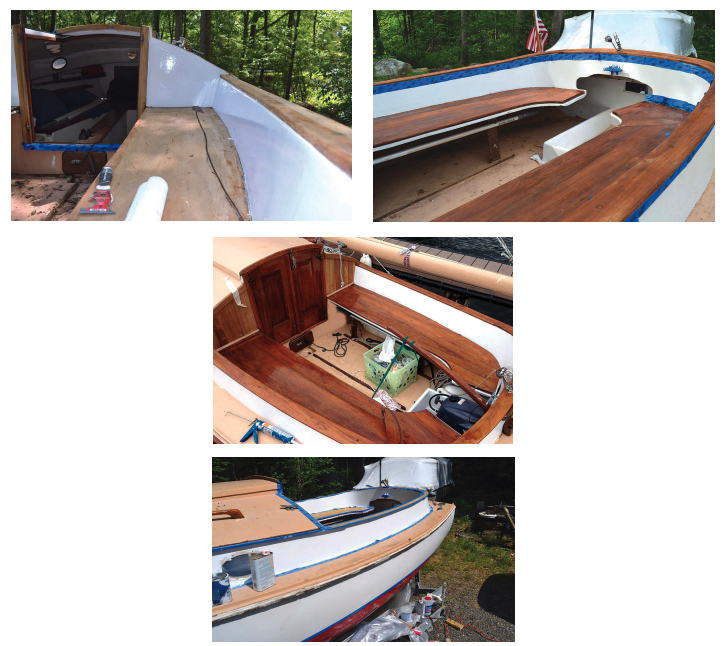
Joe and I went to work on the exterior woodwork. The large teak cockpit seats, teak cockpit coaming cap, hatch doors, and trim were peeling, discolored, and worn. The seats had several large cracks with some running from end to end. We used countless sanding discs on the coaming and seats before they were ready for varnishing.
I filled the cracks in the cockpit seats with polyester mixed with teak dust. Mistake! The polyester did not adhere well and this work had to be redone later with epoxy. The right epoxy mix worked well. We finished by coating everything with several coats of Cetol and were pleased with the result. The teak refinishing took about three days of concentrated work.
We then removed the port-holes and sanded the sides of the cabin and cockpit. Over a couple of days, Joe and I applied several coats of a marine two-part polyurethane white paint using the roll-and-tip method. The result, despite this being the first time either of us had tried the technique, looked OK, but we added a light sanding and better final coat to the next year’s task list.
Lake Hopatcong has a low bridge that prevents sailboats from using about a quarter of the lake. This unavailable section is very attractive and has several waterside restaurants that we enjoy but couldn’t reach on our previous boat. To resolve this issue, I decided to modify the mast to include a tabernacle. This is basically a hinge in the mast that allows us to easily lower and raise it. Tabernacles have been common on catboats for generations, and the Herreshoff America Facebook page contained several homemade designs. I modified one of those designs for Katnip.
I purchased the aluminum tube and other fittings on the Internet. After fabricating the tabernacle components in our garage using a saber saw with a metal blade, I took them to a local Heliarc shop for welding. Bob and I then very, very carefully cut and drilled the mast to fit the tabernacle. Fortunately, (mostly due to Bob’s expertise) all went well and, after painting the tabernacle, we were able to install the mast and tabernacle in the boat.
I then looked at the large fiberglass “barn door” rudder. The bottom had split and the rudder was saturated with moisture. After letting it dry, I roughly patched the bottom with filler to last until we could make a proper repair the following year.
So far, so good. These tasks had taken three to four people about a week of 12-hour days. The bottom and boot stripes were done, the cockpit and cabin sides were painted, the tabernacle was installed, and the cabin cleaned (my wife’s nickname is the “queen of clean”).
Kathy and Carol also made nice new cockpit cushions and we measured and installed new cabin rugs. Bob surprised me with beautifully polished portholes that I then coated and installed. We buffed and polished the white topsides to a high sheen.
Just one more thing . . .
At that point, we had completed the tasks we had decided to take on in 2015. With the boat really looking good, the beat-up and unattractive vinyl rubrails became an eyesore. After a lengthy discussion, Bob, Joe, and I decided we needed to replace them with rails made of mahogany. Although Bob is a highly skilled woodworker, none of us had any experience bending mahogany. We read the books, searched the Internet for advice, and proceeded.
We removed the existing rails and filled the screw holes with epoxy. I bought new mahogany strips cut to 1 inch x 1 inch by a local lumberyard, set up a jig in our garage, and pre-drilled hundreds of mounting holes. We then bundled the strips and put them in a nearby stream to absorb water (instructions straight from the Internet). The stream was on the grounds of a golf course, and the mahogany bundles resting in the shallow stream must have aroused some curiosity among the golfers.
The rubrail covers the boat’s sheerline, which follows a compound curve that sweeps upward from the middle of the boat to both the bow and the stern and laterally from the bow to the transom. This curve is very pronounced in a catboat and required the mahogany to take a significant bend. Even after soaking in the stream for a couple of days, the mahogany rails were very rigid and would have broken if we had attempted to bend them around the sheerline. The only way we were going to be able to fit the rails was to steam them just before installing them.
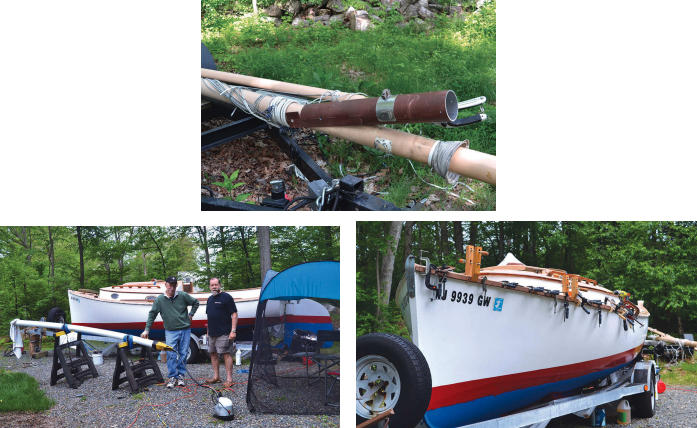
Steaming wood for bending was standard practice in the days of wooden boats and is still common in boatyards. To us novices, however, this process seemed very exotic. In Rube Goldberg fashion, we fitted Bob’s
clothes steamer to one end of a length of high-temperature PVC pipe from Home Depot. Joe, Bob, and I fired up the steamer, placed the 6-foot-long strips in the pipe, and sealed the other end with rags. Our information sources on the Internet advised us to steam the wood for one hour per 1-inch thickness, but warned us against steaming too long. So, after a little over an hour, we pulled out the first piece and bent and fastened it to the boat. It wasn’t easy, but with the use of many clamps and lots of sweat, we succeeded.
One day later, we finished installing the rest of the rails without breaking one. Experience helped, and the job became much easier as we went along. The next day, we filled the screw holes with mahogany bungs Bob had made and sanded and coated the rails. Fitting the rails gave us a great feeling of satisfaction and we were (and still are) patting ourselves on the back and comparing ourselves to the people who built “Old Ironsides.”
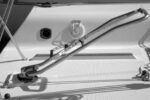
The last task was to build the boom gallows. This was pretty straight-forward using stainless-steel pipe, purchased end fittings, and mahogany I cut to shape. We did this job in our garage. Joe and I installed the gallows after the boat was launched.
To the lake!
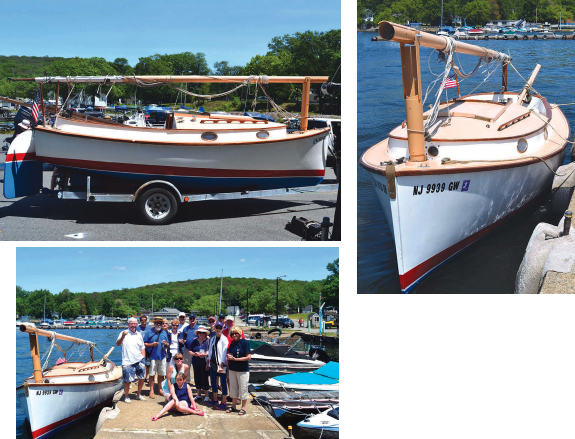
We were very proud of the result of lots of work. Tony, our son-in-law, replaced the trailer rollers, installed new trailer lights, and made sure the trailer was in good shape. We moved Katnip to our house so we could load miscellaneous equipment, then towed her to the lake. We launched her at a local county park. Many of her helpers and other friends were there, champagne flowed, and our newly restored pretty catboat was the hit of the launching site.
It took about three weeks of fairly intense work to complete all that we did. Shortly after we put Katnip in the water, I cut and installed vertical teak woodwork to cover the fiberglass either side of the companionway in the cockpit. This was strictly cosmetic but looks good. After sailing for a couple of weeks and tearing and patching the old mainsail a couple of times, we bought an almost-new sail and sailcover. We also purchased new cabin cushions and cockpit flooring. We made and installed new tabernacle bolts with smooth heads and replaced the mast hoops with parrels I made to allow the sail to hoist more easily.
Katnip looks great and gets a lot of compliments on the lake. She sails very well and is as easy to manage as we had hoped. Katz Marina, where we keep her, is well known for restoring classic wooden powerboats. Katnip seems to be in her element and era among those impeccable old beauties.
I can’t thank my wife, family, and friends enough for all their support, comradeship, good nature, and the amazing effort they contributed.
George Damerel,a retired corporate business manager, sails with his wife, Kathy, on New Jersey’s Lake Hopatcong. He has more than 50 years’ experience sailing a wide variety of boats with family and friends in many locations worldwide. His hobbies have included designing and building sailing dinghies and iceboats and collecting a large sailing library with books, models, and photos focusing on boat design in the 1890 to 1940 era.
Thank you to Sailrite Enterprises, Inc., for providing free access to back issues of Good Old Boat through intellectual property rights. Sailrite.com