A classic-looking cruiser with an unorthodox interior
Issue 111: Nov/Dec 2016
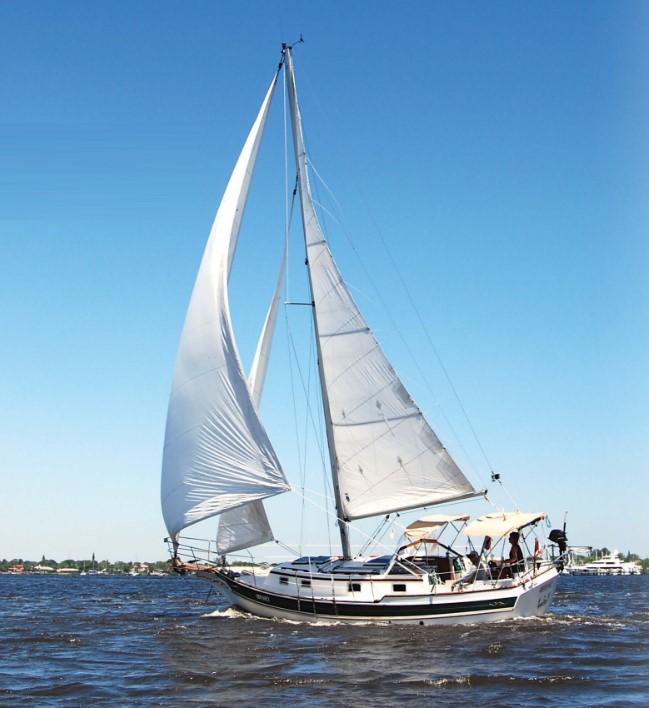
Viewed alongside the sleek cookie-cutter yachts of today, a Gozzard sailboat may look like a throwback to a past era, but the clipper bow, graceful sheer, and cutter rig have never lost their appeal for sailors who favor boats with a traditional appearance. The Gozzard lineup of a half-dozen models from 31 to 50 feet shares the same lines, and the boats are known for the quality and detail built into them. These seakindly yachts were designed for those looking for something more than the standard production boat.
It is for these very reasons that Jamie and Miriam Garnier were attracted to the Gozzard 31. Like many sailors, they started out sailing smaller boats before settling into a larger cruising sailboat. Jamie learned to sail on a Hobie 14 at the family cottage on Lake Erie. He moved on to a Sea Fury 20 and eventually commissioned a Bayfield 25, Hobbit, after meeting its designer and builder, Ted Gozzard, at a boat show.
In the early 1980s Jamie met Miriam, who had been taking sailing lessons on a Tanzer 22. They married, raised a family, and spent summers co-captaining Hobbit on the Great Lakes. When the kids were grown and retirement was on the horizon, they decided it was time for a bigger sailboat that could take them to distant ports. They had always been impressed with the Bayfield, so looking at a Gozzard was a natural choice for them, and they soon purchased the 1990 Gozzard 31 Odyssey.
History
The first boat Ted Gozzard designed was a trimaran, so one has to wonder how he went on to build monohulls of such traditional appearance. But building that boat got Ted thinking about what makes a good liveaboard cruising boat and led him into the boat-building business. He founded Bayfield Boat Yard in the early 1970s to build the Bayfield 23 pocket cruiser and designed the B25, B29, and B32 in the years that followed. The yard delivered cost-effective yachts, but the production line didn’t lend itself to customization.
By the end of the decade, Ted was ready to move into the semi-custom side of the business and sold his interest in Bayfield. In 1982 he formed Gozzard Yachts so he could design boats and build them for individual customers, rather than on a production line. The first sailboat he designed under the Gozzard Yachts name was the Gozzard 36. The G41, G31, G44, and G37 followed over the next two decades. The common lineage of the Bayfield and Gozzard yachts is very apparent. Although Ted passed away in 2014, the family-run yard is still active updating and repairing Gozzard yachts.
Construction
One of Ted’s goals at Gozzard Yachts was to build a “bulletproof” structure. The hull and deck of the Gozzard 31 are of vacuum-bagged sandwich construction consisting of knitted double-bias E-glass skins each side of a foam core. Critical and high-stress areas are reinforced with additional layers of fabric. Full-length rubrails protect the hull during docking maneuvers. The molded deck non-skid has the texture of sand. The hull joins the deck at a 4-inch-high bulwark. The joint is sealed with 3M 5200 and fastened with 5⁄16-inch stainless-steel bolts on 6-inch centers.
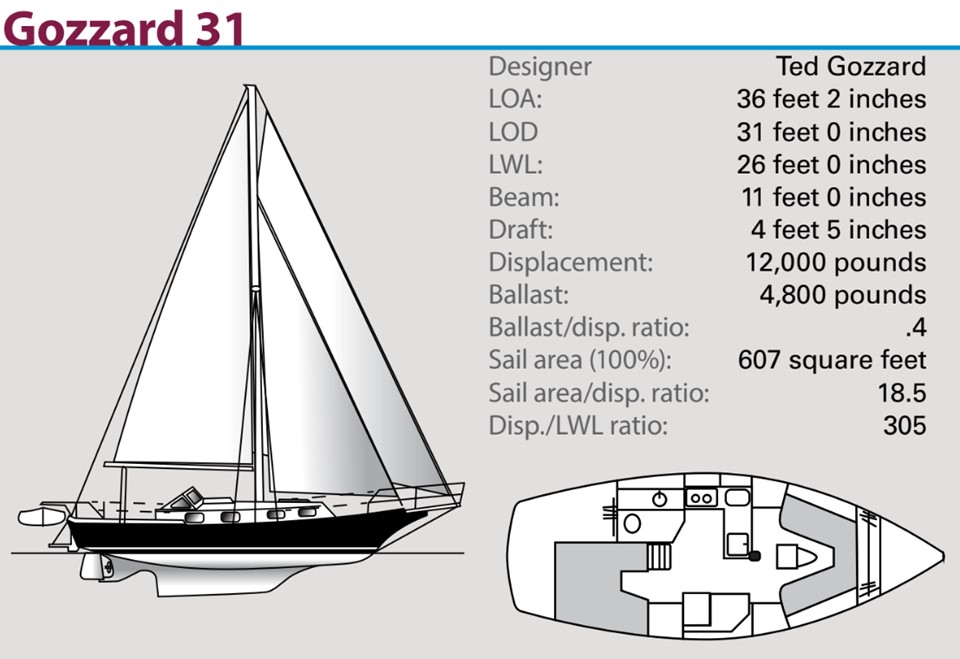
Gozzard Yachts settled on a modified full keel with a skeg-mounted rudder as the best solution for a cruising sailboat. The 4,800-pound external lead ballast takes the impact in the inevitable grounding while the large cutaway section at the trailing edge reduces wetted surface. The skeg supports the bottom of the rudder and also protects the propeller.
On deck
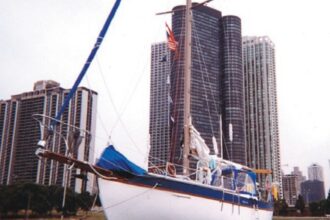
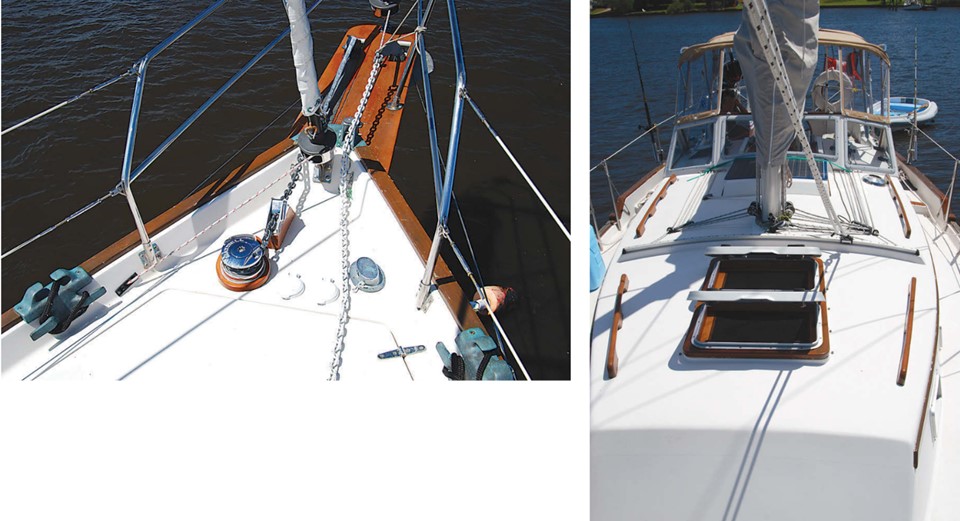
The G31 feels like a larger boat. This is partially due to the teak platform bowsprit that extends its overall length to 36 feet. Odyssey’s 35-pound CQR primary anchor and Delta 22-pound plow secondary fit side-by-side on the platform, and the two rodes stow in a large locker under the foredeck, along with a spare anchor, fenders, and other deck gear. Jamie installed a Maxwell RC8-8 windlass for the heavy lifting (the main rode is 90 feet of chain and 150 feet of nylon). Custom beefy bronze combination chock-cleats are located forward, amidships, and at the stern. Pairs of teak handholds on each side of the cabintop, along with the bulwarks and outboard standing rigging, make for secure passage along the sidedecks.
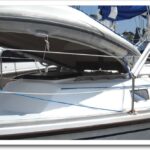
Aft, just forward of the cockpit, the sheerline and sidedecks take a little step up, a classic touch that allows more headroom in the aft cabin A fixed windshield was a standard feature and blends nicely with the lines of the boat. The companionway doors open neatly inside the recessed entryway. A pair of screen doors and a screened sliding hatch allow fresh air into the interior but not bugs.
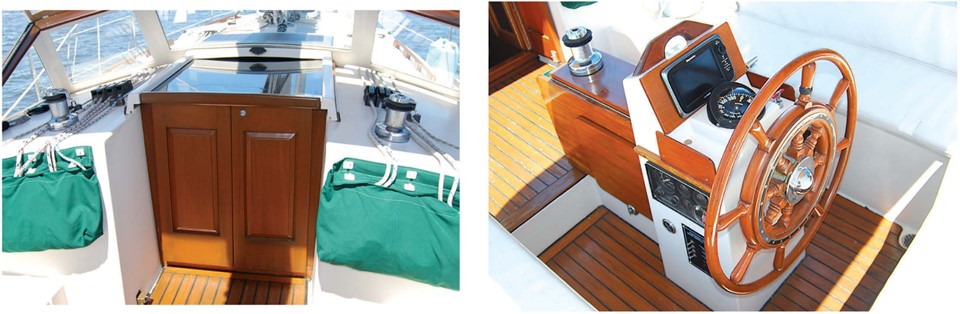
Moving around in the comfortable cockpit is easy, even with the large pedestal that carries the instruments and the 28-inch spoked teak wheel. To avoid the problems inherent with fasteners, the teak cockpit sole is secured with adhesive and a minimum of screws.
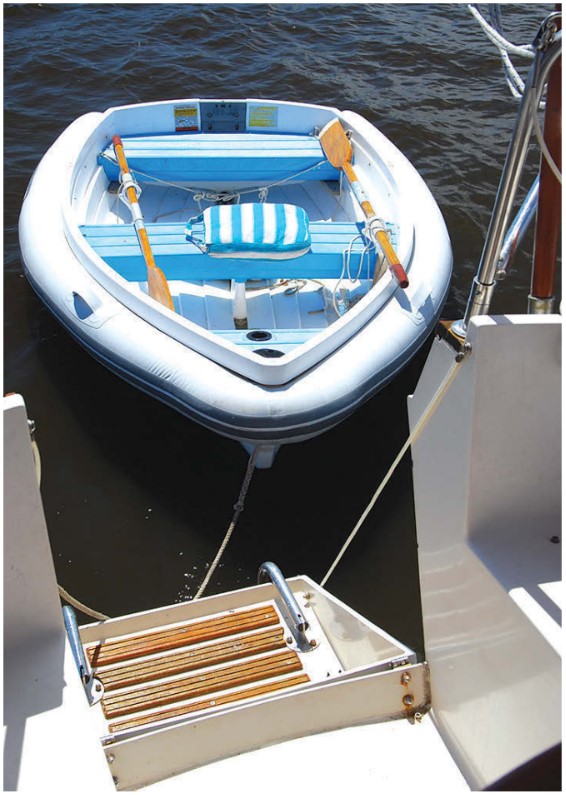
A vented propane locker is built into the aft end of the starboard bench. An interesting cockpit feature is the helm seat that flips outboard to make a small boarding platform. Odyssey carries her dinghy on factory-installed davits.
The rig
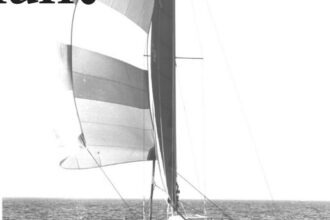
Between the mainsail, headsail (which Gozzard Yachts calls a topsail), and staysail, the G31 carries a total of 782 square feet of sail on its 46-foot-tall aluminum deck-stepped single-spreader mast. The cutter rig offers choices in sail combinations for varying wind conditions. Forward and aft lower shrouds and the upper shrouds terminate at large stainless-steel chainplates bolted on the outside of the hull, where they can be easily inspected. All the running rigging is led aft along the cabintop to Spinlock stoppers and Lewmar 16 self-tailing winches.
Odyssey has a soft boom vang that can be disconnected from the mast base and moved to a pad-eye on the sidedeck for use as a preventer when sailing downwind. The topsail sheets lead back to Lewmar 40 two-speed self-tailing primary winches. The self-tacking staysail sheets to a traveler just forward of the mast. Both headsails are on Schaefer roller furlers.
In the standard configuration, the mainsheet leads from the end of the boom via a block mounted on the cockpit pedestal to a Lewmar 16 self-tailing winch for trimming. This precludes fitting a continuous bimini and enclosure over the cockpit. When Odyssey went back to the Gozzard yard for some upgrades, she was fitted with a stainless-steel cockpit arch for the mainsheet, which now leads from the arch, forward to the mast, and back to a winch on the cabintop.
Belowdecks
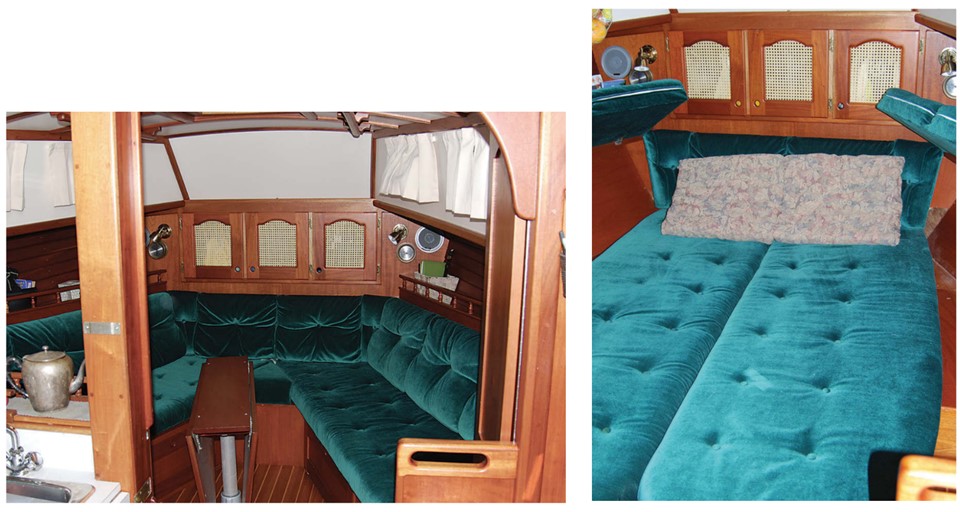
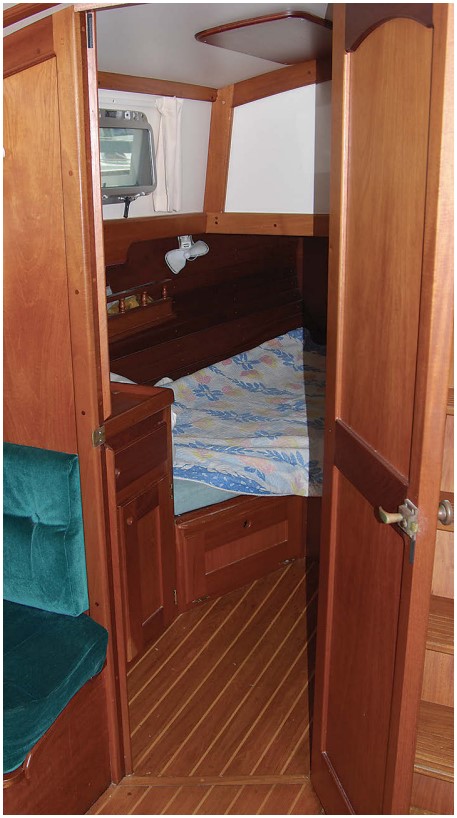
Gozzard Yachts favors an interior design that puts the saloon forward and eliminates the usual V-berth. When the table is lowered and the settee benches pushed together, they form a large double berth, and the saloon becomes a stateroom. With its varnished American cherry interior, nicely contrasted by white laminate on the overhead and cabin sides, the cabin feels warm and cozy. The joinery is top-notch and the craftsmen at the yard have made the most of the space with numerous built-in storage cabinets and drawers.
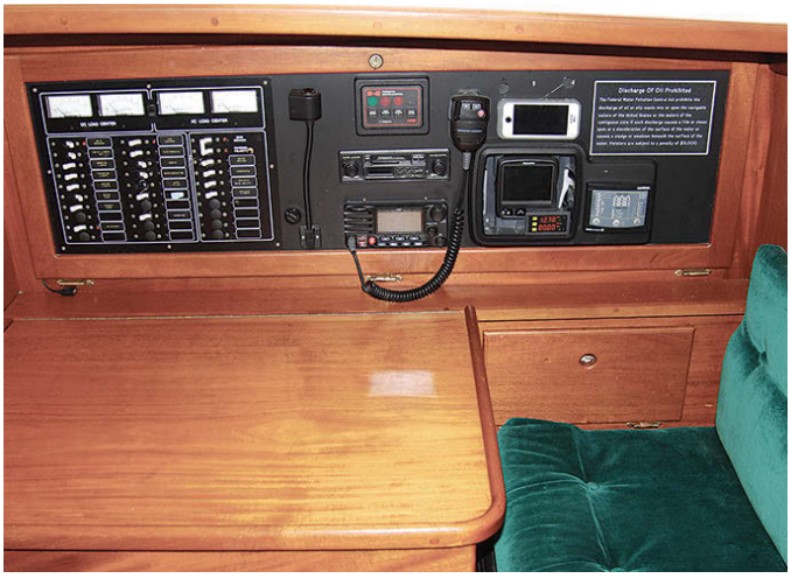
The nav station has a seat and chart drawer. A panel outboard houses the AC/DC electrical panels and several electronic instruments The stateroom in the starboard quarter has standing headroom inside the door, a set of cabinets, and a double berth.
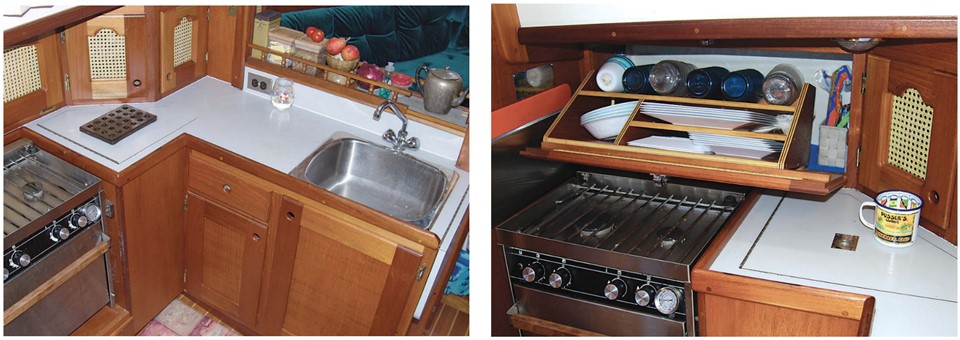
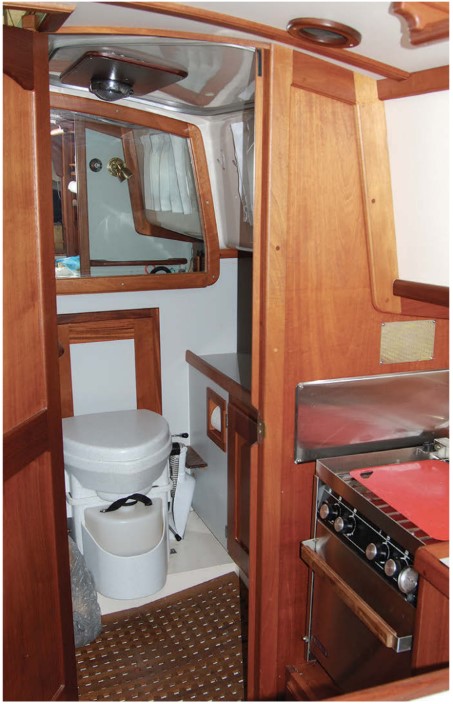
Countertop space in the L-shaped galley is expandable with a flip-up extension inboard of the large centerline sink. The top-loading refrigerator and the two-burner Force 10 propane stove/oven are located outboard. Due to clever use of the available space, storage volume is good.
The head, located aft of the galley, has plenty of elbow room. Because longer term cruising was in their future, the Garniers replaced the marine head with a Nature’s Head composting toilet, and they gained storage space by removing the holding tank. Jamie says it was one of the most worthwhile improvements they have made.
Two 24-x 18-inch screened deck hatches provide volumes of air to the main cabin. Nine opening portlights, all screened, ventilate the remaining compartments, and a solar vent circulates air in the galley 24/7. A 51-gallon stainless-steel water tank mounted in the bilge, along with a 6-gallon Force 10 water heater, feeds a pressurized water system throughout the boat.
Power
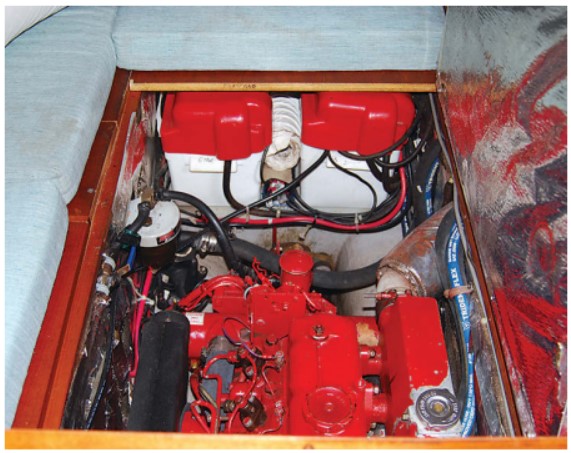
Odyssey came with the optional 37-horsepower Westerbeke 38B4 diesel engine turning a 16- x 14-inch three-blade bronze propellor, giving her plenty of power for motoring through a heavy chop. Jamie upgraded the alternator to a 140-amp model. Removing the companionway stairs and opening hinged panels in the quarter berth allows access to the engine. An electric pump delivers fuel to the engine from the 55-gallon aluminum tank located in the bow.
Under way
I had a chance to sail Odyssey on a cool Florida day in December with clear blue skies, temperatures in the mid-60s, and a 15-knot north wind with gusts into the low 20s. Although we were seven aboard and filled the cockpit, everyone felt comfortable, including the non-sailors. As we motored from the dock on the Banana River, around Dragon Point, and into the Indian River Lagoon, that extra horsepower and the three-blade prop paid off; we didn’t need to push the throttle far past idle to hold the bow into the gusty wind to raise sail. With the mainsail hoisted and the staysail rolled out, Jamie asked if I would like to take the wheel, which I promptly did, and I didn’t relinquish it for the rest of the sail.
The smooth motion through the heavy chop gave the feeling of being on a larger boat. The G31 didn’t hobbyhorse and the bow didn’t slam into the waves. I attributed this to the boat’s moderate displacement and stiff design plus the sail plan keeping it powered up. With the wind in the 15-to-20-knot range, the G31 felt very comfortable with the full mainsail providing the power and the staysail balancing the helm. I expected the helm to feel a bit heavy due to the smaller wheel and rudder, but the boat was easy to steer and I noticed only a slight amount of normal weather helm.
Once on course and up to speed, the G31 tracked very well and made little leeway. But with that longer keel, the boat was a little slow coming about and fell off some before picking up speed on the new tack. Sailing downwind, the G31 was rock steady and didn’t exhibit the uncomfortable corkscrew motion sometimes felt when the wind and waves are on the quarter. On a day when the conditions were less than ideal for a casual sail, the Gozzard 31 was in its element.
Conclusion
While the Gozzard 31’s traditional styling may not appeal to everyone, this well-designed, well-built, and handsome yacht will take a cruising couple just about anywhere in comfort and safety. Jamie and Miriam sailed Odyssey from the Great Lakes, to the Exumas in the Bahamas, and back to Florida and have nothing but praise for her. The boat is as comfortable to live aboard as it is to sail. The G31 is well-thought-out and the builder’s attention to detail goes far beyond that seen in most production sailboats. Reading the spec sheet for the G31 could be a lesson in “How to build the proper sailboat.”
Gozzard Yachts built only 20 G31s but would be happy to build number 21 for a customer. An internet search came up with only one listing, a 1992 model for $89,000. Prices in older ads ranged from $90,000 to $110,000 depending on condition and outfit. The high resale value of the G31 is a testament to Gozzard’s commitment to building a high-quality yacht that has timeless appeal.
Joe Cloidt is a sailor, writer, film maker, tinkerer, and electrical engineer by trade. His current boat is Desire, a 1988 Pearson 31-2 that he sails on the Indian River Lagoon on the central east coast of Florida. Joe also enjoys charters in far-off locations and the occasional cruise to the Bahamas when he’s between jobs. Although mostly a cruiser, Joe crews on a J/30 at the local yacht club for the Friday night Rhum Races.
Thank you to Sailrite Enterprises, Inc., for providing free access to back issues of Good Old Boat through intellectual property rights. Sailrite.com