A well-crafted cruising boat with character
Issue 111: Nov/Dec 2016
John and Nancy Butte began their sailing adventures in a West Wight Potter 19 on blustery San Francisco Bay. Although Nancy, a retired teacher, enjoyed sailing, she was less fond of heeling, so the first step in their boat selection process was always from dock to gunwale, to test a candidate’s initial stability. They trailered their stiff little Potter to their waterfront retirement home on Lopez Island, in Washington’s San Juan Islands, in 1999, and soon realized that the rich cruising grounds of the Pacific Northwest could be better explored in a larger boat.
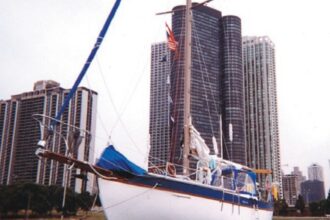
In 2002, they discovered Kabloona, a 1979 Bayfield 29, in North Vancouver, British Columbia. John, a builder, describes her as a project boat, although she was structurally solid and had no blisters. He feels fortunate to have “touched” every inch of her during her restoration, and even contacted Ted Gozzard for advice. He knows his boat.
One thing John and Nancy didn’t change was her name, as they discovered kabloona is an Inuit word with a meaning similar to gringo in Mexico or haoli in Hawaii. John’s father had been a Hudson Bay fur trader at one time, and was doubtless referred to as a kabloona by the native population, so the name stuck.
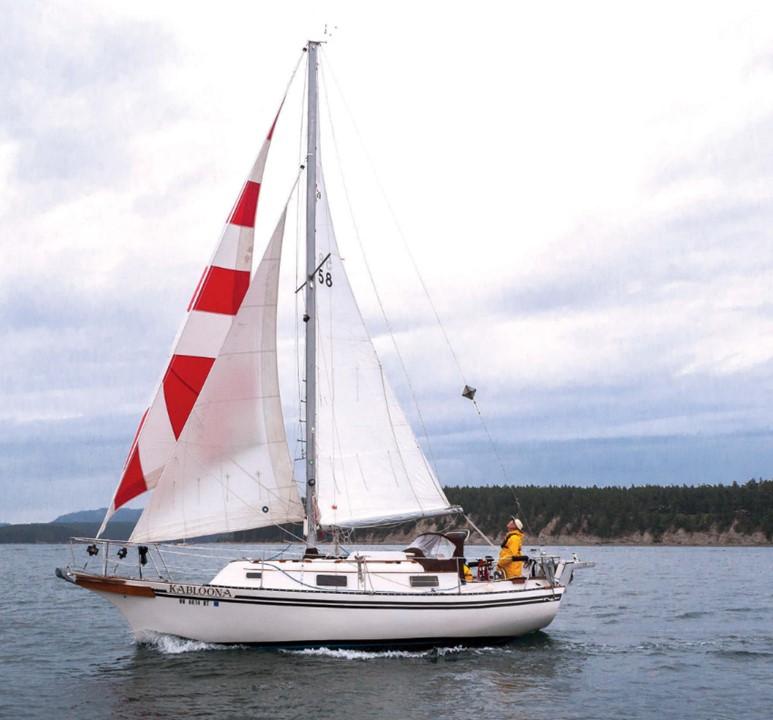
John and Nancy have put many miles under Kabloona’s keel since the restoration, crossing the Strait of Georgia four times and venturing northward to Princess Louisa Inlet and Desolation Sound. Her broad beam and heavy construction give her the stability Nancy sought, and the cutter rig allows the flexible and easily managed sail plan that John wanted. They feel her accommodations and handling characteristics are perfect for a couple, and enjoy her shallow draft and the fact that she can be easily singlehanded, while admitting that she does not go to weather particularly well.
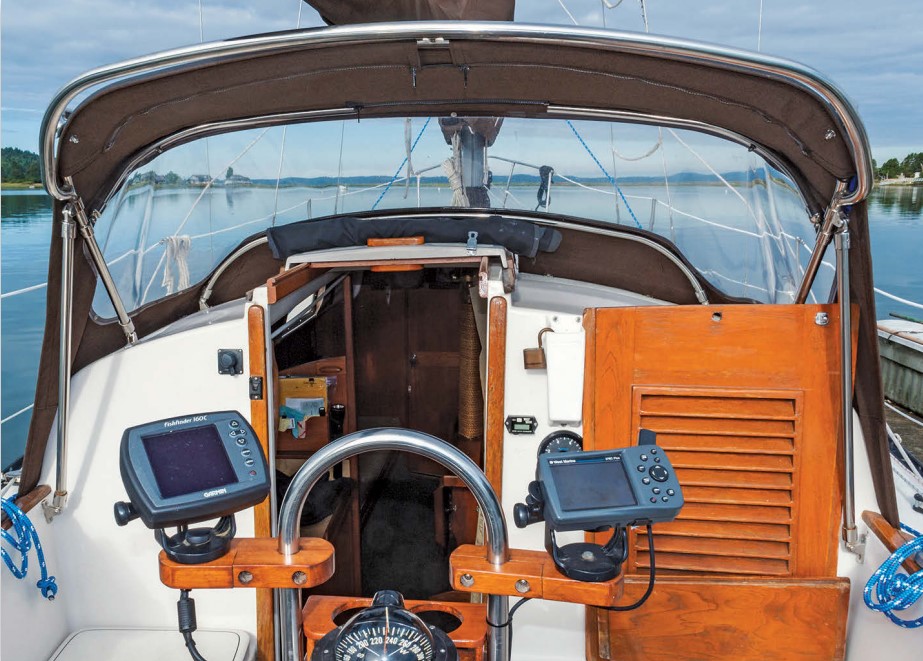
Neither of them likes complex systems, so they replaced the original pressurized-alcohol stove with an Origo (but would have preferred a gimballed stove with an oven), and use a simple Force 10 propane heater to warm the cabin. A handheld VHF suffices for communication, and for navigation they use a Garmin 160C depth finder and a West Marine 276C chart plotter.
Bayfield Boat Yard
Ted Gozzard earned his journeyman’s license in carpentry, masonry, and boat-building in England. After moving to Canada in 1959, he built houses during the week and spent weekends building and then sailing a Thunderbird sloop. After a few years, he sold the boat and the home he built for his family and they moved to the Bahamas, where they stayed for two years. While there, Ted was introduced to multihulls, and after they returned to Ontario he designed and built a 40-foot trimaran in his spare time. His craftsmanship and boat-building skill led to commissions for the construction and repair of wooden and steel boats, and he founded Bayfield Boat Yard in 1970.
Ted designed using half models. A design study for a diminutive traditional-style sloop caught the eye of Gary Ferguson, who promptly sold 10 Bayfield 23/25s at the 1972 Annapolis boat show.
With Ted at the helm, Bayfield created a line of solidly built, well-crafted fiberglass boats that included the 23/25, 30/32, 29, and 40. (The successor company designed and built the Bayfield 36). Ted sold his interest in Bayfield in 1981, but was soon busy again in partnership with his sons, Mike and Ted, designing and building the Pilgrim 40 trawler and the entire line of Gozzard Yachts. (See “Gozzard Magic Lives On,” November 1999, for an interview with Ted Gozzard.)
Design and construction
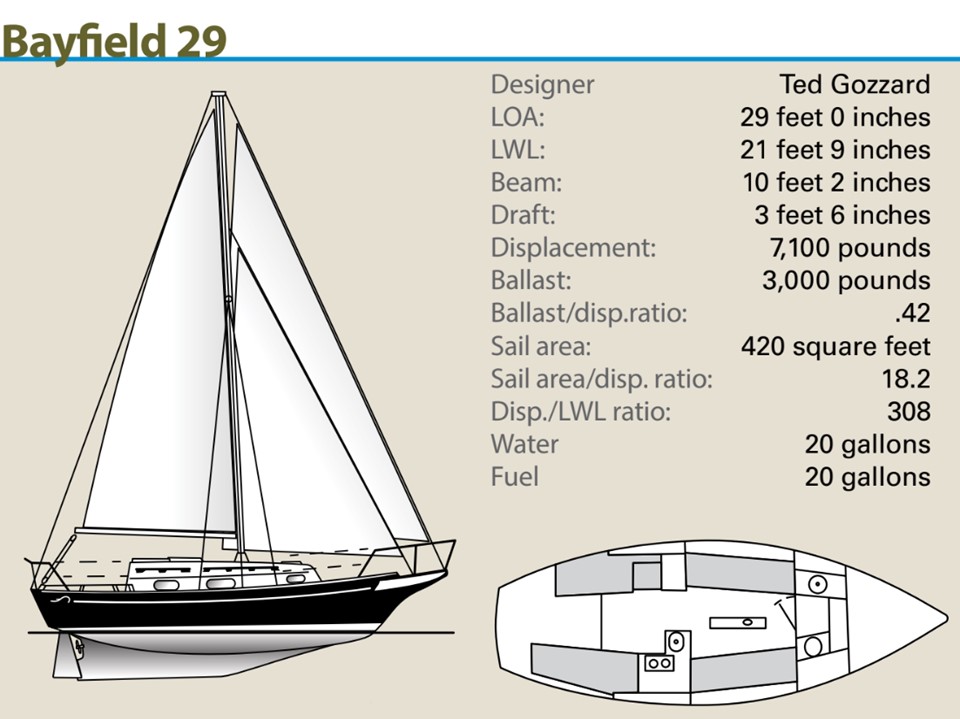
The B29, like all Bayfields, is a beamy shoal-draft full-keel design with a pronounced clipper bow. It has 3,000 pounds of ballast encapsulated in the keel. A displacement/LWL ratio of 308 puts the boat in the moderately heavy category but the sail area/displacement ratio of 18 supports owners’ reports of decent sailing performance. Many owners, including John, refer to the B29 as a comfortable passagemaker that’s capable of good daily runs.
The hull is a solid laminate built up with alternating layers of hand-laid fiberglass mat and woven roving, while the headliner, hull liner, and deck are cored with 3⁄8-inch end-grain balsa. The cockpit hatches, companionway slide, sea hood, and anchor locker have marine plywood cores. Several owners of early models, including John, note that the forward bulkhead is not securely attached to the coachroof and squeaks badly in a seaway.
The aluminum fuel tanks are located in the deep bilge, which has led to many owners having to replace or repair them. John says that is not a particularly difficult job as the tanks are readily accessible. The holding tank in earlier models is a different matter. John had to do extensive fiberglass surgery and repair to replace and replumb the tank in Kabloona.
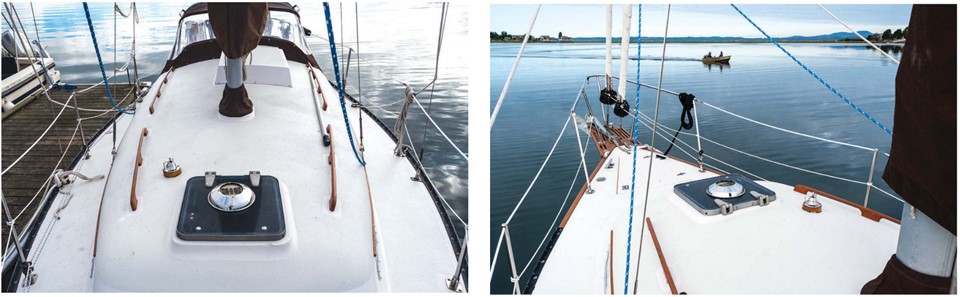
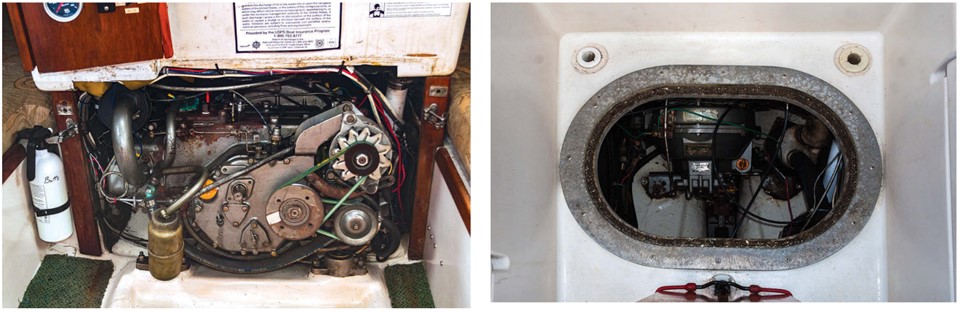
Some later boats were fitted with two-cylinder diesels and convenient engine access hatches in the cockpit sole, but Kabloona is definitely under-powered with her 1-cylinder Yanmar 10. John added a cockpit hatch, and considered repowering, but found the space for the engine so limited that he just rebuilt the original diesel.
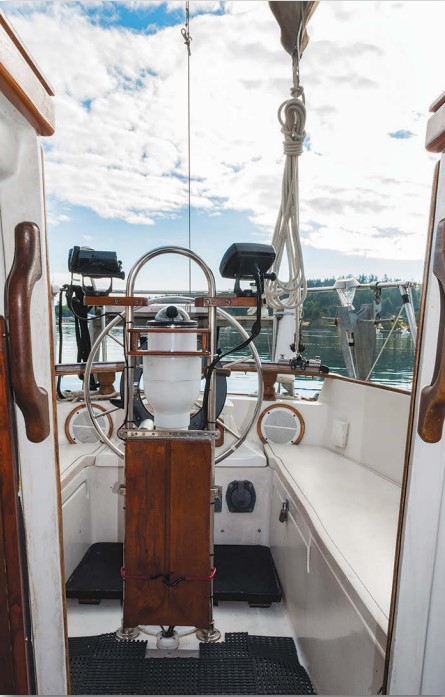
The cockpit is small and is dominated by the standard steering wheel and pedestal. There is a fitting in the cockpit sole for an emergency tiller, although its proximity to the pedestal might make it difficult to use. A raised helm seat and wide sidedecks allow an acceptable view forward past the rather tall cabin trunk. One shallow and one deep cockpit locker are accessible under the comfortable bench seats.
A previous owner installed narrow aluminum davits on Kabloona’s stern. John and Nancy found them useless for a dinghy but perfect for their propane tank and the solar panel that keeps the batteries topped off.
Two winches on each side for handling both Yankee and staysail are conveniently located forward on the cockpit coaming, and a traveler for the mainsheet spans the wooden taffrail aft of the helm seat.
Excellent non-skid creates good footing on the deck and cabintop, while full-length perforated aluminum toerails provide additional security as well as convenient attachment points for everything from flag halyards to fenders.
Rig
The Bayfield 29 was rigged as a cutter, with an inner forestay attached at the stemhead and a headstay attached to the beak of the clipper bow. Some boats also have a bowsprit, which pushes the tack of the Yankee farther forward. This wooden bowsprit is an integral part of the rig but presents an ongoing maintenance problem. Many have rotted out and have been replaced.
Kabloona has the standard sail plan with a Yankee jib set on the headstay and a staysail on the inner forestay. Roller furling on both sails makes the rig easy for an experienced couple to handle, even in the changeable winds of the Northwest. Some owners of boats without the bowsprit comment that the two stays are so close together it is difficult to get the Yankee through the slot when tacking.
The single-spreader keel-stepped mast is very sturdy. It’s supported by a backstay, upper shrouds, forward and aft lower shrouds, and the headstay. There are no running backstays, so the mast’s stiffness alone resists tension in the inner forestay. The chainplates for the upper shrouds are at the gunwale. Those for the lower shrouds are bolted through the cabin trunk, and one owner reported the cabin trunk panting under the loads they imposed.
Accommodations
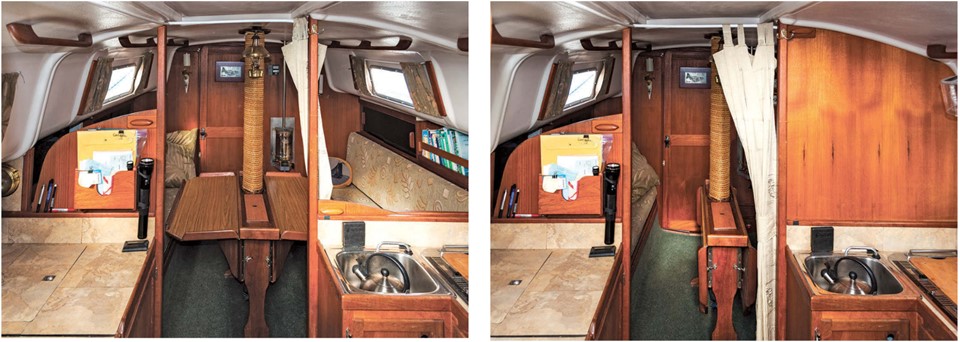
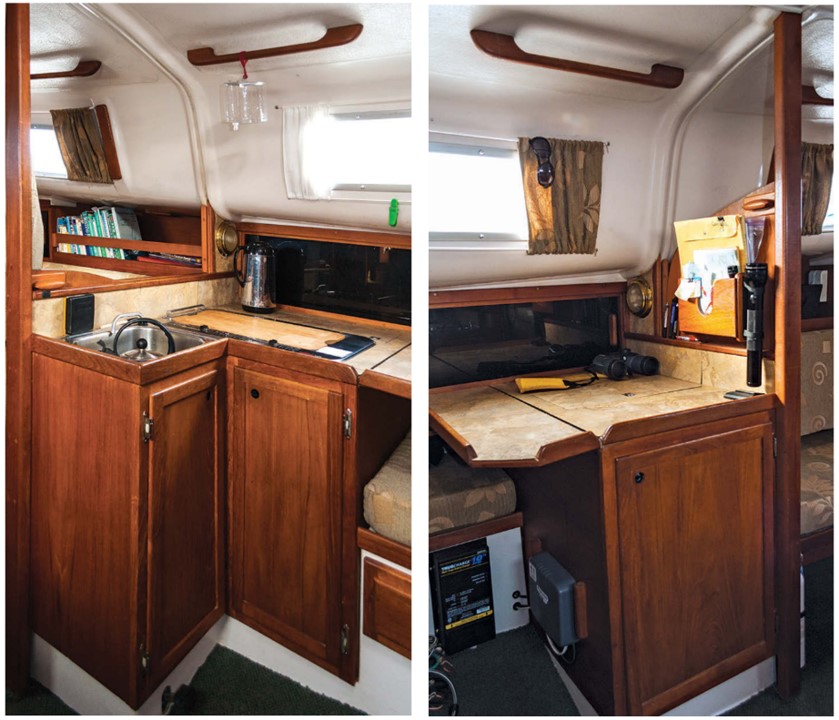
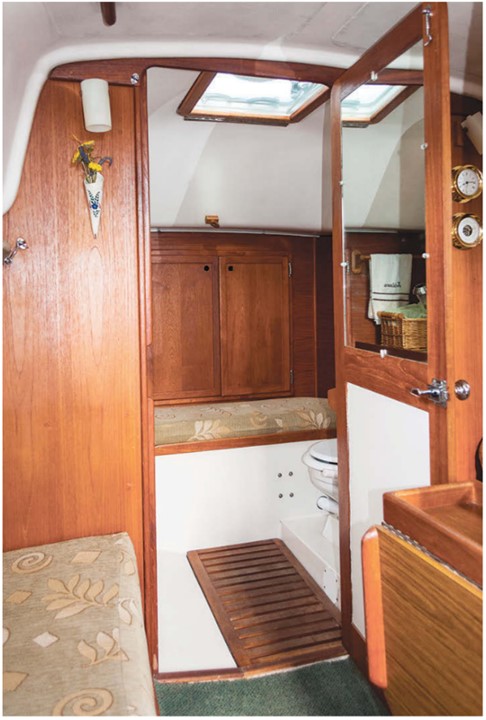
Ted Gozzard’s fondness for clever design touches and beautifully crafted wood is evident in the belowdecks layout and furniture of the Bayfield 29. The companionway leads into an apparently conventional interior with wide quarter berths tucked under the cockpit port and starboard, a small galley to starboard, and a generous navigation station to port. In the saloon, port and starboard settees flank a centerline drop-leaf table. The starboard settee converts to a double berth, and the port-side settee backrest hinges up, turning the seat into a wider berth.
The cabin is spacious and airy, and can be transformed into two private sleeping areas when panels pocketed in the bulkheads forward of the galley and nav area are raised to the overhead. A curtain completes the division.
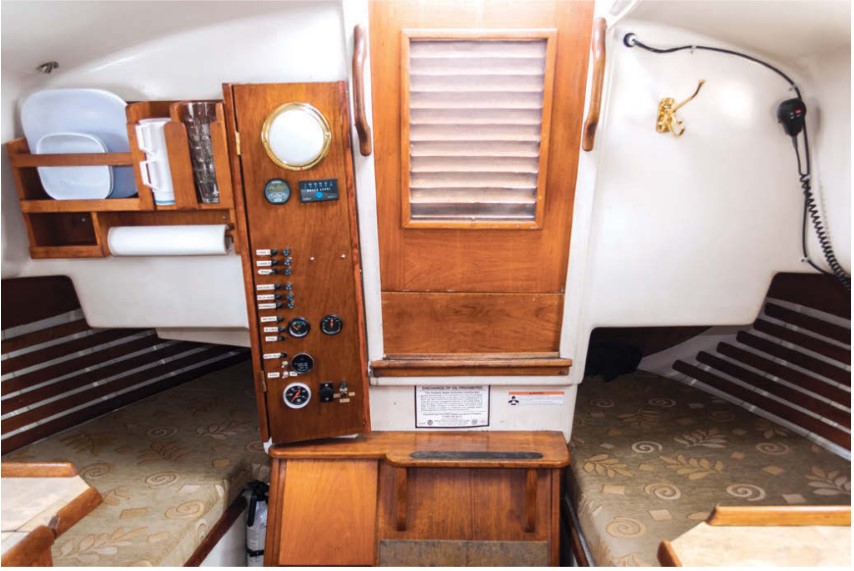
Many owners say the best feature of the interior is forward of the saloon. Instead of a V-berth, Ted Gozzard fitted a huge athwartships head compartment, complete with a large vanity and sink, a toilet, an upholstered seat, and lots of storage. Behind doors in the forward bulkhead are an easily accessible hanging locker and a commodious stowage area in the forepeak.
Every owner we contacted said the Bayfield 29 was a very comfortable cruising boat for a couple or two. While some commented about the size of the galley and lack of a private master stateroom, they all felt the designer had done an excellent job of setting priorities in a 29-foot boat.
Under way
Under a gray Pacific Northwest sky, John and Nancy motored Kabloona out of the narrow, twisting entrance to Fisherman Bay in 10 to12 knots of breeze. They raised full sail and close reached across San Juan Channel toward Griffin Bay as I snapped photos. When John hove to, the boat remained solidly well-mannered and steady while I transferred on board for a sea trial.
After a short stint tending the Yankee and staysail sheets, I realized I don’t have a lot of experience trimming a cutter rig, so I turned Kabloona back over to John and Nancy. They were an absolute pleasure to watch (and listen to) as they worked together to get the most out of their boat. They soon had her speed back above 6 knots.
Although owners agree that the Bayfield 29, like most shallow-draft cutters with relatively high freeboard and windage, is not close-winded, Kabloona showed herself to be a solid and steady performer on a reach and well capable of clicking off the miles.
Once the sails were furled, it was just as evident that the little one-lung diesel, despite the nostalgia its exhaust note might arouse, would not be up to the task of stemming a strong current or of driving the heavy boat into a head sea of any size.
Conclusion
Bayfield 29 owners are consistent in their praise for the solid construction and fine craftsmanship, the arrangement and flexibility belowdecks, the predictable and solid performance under sail, and the aesthetics of the classic design. A few complaints were noted of leaks at fittings and the hull-to-deck joint, as well as plumbing and systems issues, but nothing unexpected for boats now more than 30 years old. There is little on these boats that cannot be brought back to life or upgraded by a persistent owner. The most commonly mentioned model-specific problems were the unsecured forward bulkhead, tank failure, rotting of the wooden bowsprit, and poor windward ability.
Bayfield Boat Yard, under Ted Gozzard and his successors, built more than 350 Bayfield 29s between 1978 and 1988, when the company closed. An online search found several listed at prices between $13,000 and $26,000, depending on year, location, and condition. The combination of traditional aesthetic appeal, quality construction, good cruising accommodations, and adequate performance for coastal passagemaking makes the Bayfield 29 a natural and affordable choice for many cruising sailors.
Ferd Johns and his wife, Beth, live on Whidbey Island, Washington, and cruise the Pacific Northwest, Chesapeake Bay, and Florida Keys. Ferd, an architect, cannot count how many old fiberglass cruising boats he has owned (Beth, also an architect, can!), but the fleet is currently down to two trailerable sailboats and one mini-trawler.
Thank you to Sailrite Enterprises, Inc., for providing free access to back issues of Good Old Boat through intellectual property rights. Sailrite.com