Getting tasty water from your boat’s tap isn’t a pipe dream if you follow some basic steps.
Issue 130: Jan/Feb 2020
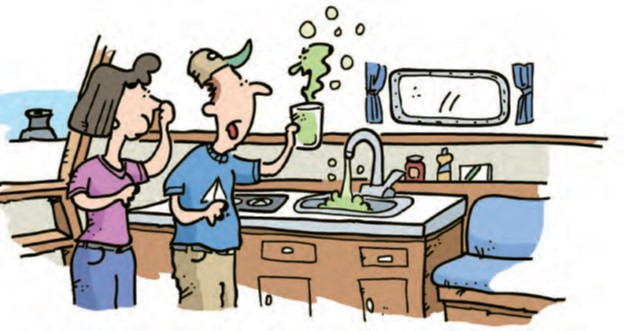
Stagnant, skunky, tank-sourced drinking water is one of the less romantic aspects of sailing. The most common solution is to drink bottled water aboard and to relegate tank water to cleaning. This means hauling and storing additional water in wasteful single-use plastic containers. It doesn’t have to be this way. Imagine drinking safe, pleasant-tasting water from your boat’s tap. It’s doable, and it’s not complicated.
Why So Nasty?
Fresh water can become unpalatable in just a few days. In the absence of oxygen, bacteria convert the sulfate in the water (common in coastal areas) into sulfide, resulting in a familiar rotten-egg odor, which is objectionable at sub-ppm (parts per million) levels. In northern sailing climes, a frequent cause is winterizing with too little glycol. Both alcohol and propylene glycol are antiseptic if maintained at packaged concentrations. But dilute them with just a bit of water (such as residual water in plumbing), and they become bacteria food and will ferment as easily as an open bottle of Boone’s Farm, with a similarly distasteful result.
U.S. tap water is quite safe, but the hose you use to fill your boat’s tank, unless it’s used frequently, is likely contaminated with algae and bacteria that grow inside and shed every time the hose is moved. Giardia and cryptosporidium are occasional concerns.
Biosolids from the hose, combined with rust from city pipes, accumulate to form a layer of sludge in tanks. This sludge, even if it never reaches the tap, will impart an off taste to tank water. Cleaning a tank is the first step to sanitizing it for clean, good-tasting water.
Fortunately, all of these causes are easily addressed, and common chlorine bleach is the answer (along with some diligence and consistency). A water tank will stay clean if water is either pre-filtered or dispensed from a clean tap, and chlorine levels are maintained either by addition or frequent refilling. Of course, chlorine itself is objectionable, but after chlorine has done its job, it is easily removed with activated carbon. Adhere to the following best practices and you’ll willingly drink from your boat’s water tank.
Keep it Clean
Clean the tank at the end of every season or annually. Solids prevent effective sanitizing of the tank because bleach cannot penetrate them.
Sanitize the tank once each year or whenever it gets skunky. The standardized shock and rinse ANSI A119.2 procedure will give you a fresh start.
Keep solids out of the tank. Let the hose run before filling the tank, and move it around a bit to shake off any loose algae inside. Rinse the deck. Finally, pre-filter with a hose-end filter or bag filter at 1-10 microns. Do not use a dock-mounted filter; this will not protect you from algae growing in the hose. Allow the filter to drain and dry between uses.
Secure the vent. Bugs can crawl in; you wouldn’t drink from a cup that had been sitting outside without looking first, would you? The plumbing code typically calls for a 12-20 mesh screen, though most boat builders skip this. Bladders and flexible tanks do not have a vent.
Chlorinate. Bleach oxidizes sulfides so that they revert to tasteless sulfates and the organic fermentation residuals are burned off. Bleach kills bacteria and algae, and even cysts are deactivated through long exposure. Treat with either 3 ppm bleach (about 1 ml per 3 gallons or 1 teaspoon per 10 gallons) or water treatment tablets (17 mg sodium dichloroisocyanurate per gallon. For example, Clean Tabs Midi Tabs treat 6 gallons, and Clean Tabs Mega Tabs treat 60 gallons). Allow 30-minute contact time. If giardia and cryptosporidium are concerns, double the chlorine dosage and time. If rinsed and refilled each time, the residual chlorine in the tap water should be enough for a few days’ protection.
Remove chlorine. This is primarily a taste concern. In-line carbon filters or carbon pitchers are effective. The carbon removes the chlorine by sacrificially being oxidized to CO2, converting the chlorine and hypochlorite to chloride (salt) in the process.
For those who store their boat over the winter, all that will be required each fall is a good blast with a hose followed by pumping it dry, and each spring a simple rinse will do. The first time, however, it may require a good scrubbing. Go light on the soap because it is hard to rinse out; substitute elbow grease. Always suck a tank bone dry with a wet/dry vac and leave the cover off so that it can dry over the off-season (cover it with a screen if bugs are a concern).
If the water system is pressurized, NSF 53-rated carbon block filters, such as the Pentek FloPlus 10, will remove both chlorine and cysts using .5 micron filtration. I used them on my cruising cat with great success. However, the rocker hand pump on my F-24 trimaran doesn’t generate sufficient pressure to work with sub-micron filters. Garden hose-style, carbon pre-filters, however, are easy to replace, have low pressure drop at low flow, and are cheap. Although they are typically rated for only about 30 percent chlorine removal at the rated flow (5-10 gallons per minute), my Whale Flipper is only rated at 1.85 gpm, and I doubt I ever pump more than 16 ounces at a time, which coincidentally is equal to the holdup volume of a typical in-line filter. Put another way, the actual contact time using a hand pump is hours, not sec¬onds, and chlorine removal is actually more like 90 percent. Since the tank is clean, chlorine kills the bugs and destroys the off tastes, and carbon then removes the chlorine, this is all I need to produce fresh-tasting water.
By breaking the water treatment problem down into simple parts, I can ditch bottled water, increase my safety margin, and minimize systems maintenance. That’s a good deal.

ANSI A119.2 Tank Sanitizing
First, inspect and clean, and for that, reasonable tank access is needed. If you don’t have good access, consider installing ports. Look inside with a flashlight and feel the walls; sludge, scum lines, or a slick feel are evidence of bacterial growth. It all must go. Machine dishwasher detergent works well as do long-handled brushes. A power washer can help, but some angle fittings will be needed to get the walls and roof. Or perhaps your tank is only stale; if so, proceed directly to the next step.
The RV code (ANSI A119.2 section 10.8) contains simple procedures that are often quoted and work well. I’ve added a few details, but the bones of it come straight from the code and have been reviewed and accepted by the U.S. Public Health Service.
- Turn off the hot water heater until finished.
- Remove any carbon canisters, micron-rated filters, and faucet aerator screens. Retain wire mesh pump protection strainers. The plumbing will very likely slough off a layer of bacteria during later flushing steps.
- Clean and remove the vent screen and flush the vent hose.
- Use the following methods to determine the amount of common household bleach needed to sanitize the tank: Multiply gallons of tank capacity by 0.13; the result is the ounces of bleach needed to sanitize the tank. This is 1⁄8 cup of plain bleach (no fragrance) per 10 gallons. Or, multiply liters of tank capacity by 1.0; the result is the milliliters of bleach needed to sanitize the tank.
- Mix the proper amount of bleach within a 1-gallon container of water. This will provide better mixing and reduce spot corrosion of aluminum tanks.
- Pour the solution (water/bleach) into the tank and fill the tank with potable water.
- Allow some solution to escape though the vent, if safe and applicable (some boats use the vent as an overflow, while in some cases the vent is in the interior). This will sanitize the vent line.
- Open all faucets (hot and cold), allowing the water to run until all air is purged and the distinct odor of chlorine is detected. Leave the pressure pump on.
- The standard solution must have four hours of contact time to disinfect completely; doubling the solution concentration cuts that to one hour.
- When the contact time is completed, drain the tank. Refill with potable water and purge the plumbing of all sanitizing solution. Repeat until bleach is no longer detectable.
- If the smell of bleach persists after two refill and drain cycles, add a teaspoon of hydrogen peroxide per 20 gallons and mix. The peroxide will oxidize the hypochlorite to chloride (salt) and oxygen, neutral¬izing the bleach. Any excess peroxide will be harmless to drink and will have no taste. Peroxides are common ingredients in commercially available water-freshening preparations. Others suggest vinegar, but vinegar at long dilutions can ferment, undoing all of your hard work.
- Replace all filters and the vent screen.

Tools of the Cleaning Trade
Starbrite, Camco, and others produce water-freshening liquids that are basically pre-diluted bleach, which isn’t a bad idea; it makes measuring easier and reduces the risk of bleaching clothing or upholstery. Household bleach is 3 percent sodium hypochlorite (use the fragrance-free variety). One ml of bleach treats 3-5 gallons of good water to 1-2 ppm chlorine. One teaspoon of bleach treats 10 gallons.
Sodium dichloroisocyanurate (Na DCC) tablets are handier to use (no measuring). Additionally, the chlorine residual is far more stable, lasting weeks instead of a day or two. It is also about 20 times less corrosive to aluminum tanks than bleach, important since there is no other sanitizing alter¬native. (Hydrogen peroxide is sometimes suggested as a bleach alternative, but if used at sufficient dose to be effective, it is unhealthy. There is no EPA, World Health Organization, or national standard approving hydrogen peroxide for drinking water.)
Aqua Tabs, 8.5 mg NaDCC, treats two quarts of good water. Aqua Mega Tabs can be snapped in half for smaller tanks, and they keep quite well in a glass vial.
Hose-end filters were first marketed to the RV sector, and that is where you still find the best values. The Camco RV Water Filter is filled with a carbon/KDF blend and will remove the chlorine from 6,000 gallons of water at its rated flow of 10 gpm, and probably about 2,000 gallons at our higher removal efficiency. It is cheap ($20.76 per two-pack through Walmart). They also make a more expensive “marine” version that is white but not noticeably different. Shurflo makes the Water Guard and Culligan makes the RV-800, which are slightly higher-performance, NSF-rated units for about twice the price. I’ve tested and used them; they have finer filters and last a little longer, but they will all last the season, after which they are discarded.
Drew Frye draws on his training as a chemical engineer and pastimes of climbing and sailing to solve boat problems. He cruises Chesapeake Bay and the mid-Atlantic coast in his Corsair F-24 trimaran, Fast and Furry-ous, using its shoal draft to venture into less-explored waters. He is most recently author of Rigging Modern Anchors (2018, Seaworthy Publications).
Thank you to Sailrite Enterprises, Inc., for providing free access to back issues of Good Old Boat through intellectual property rights. Sailrite.com