Rethinking a battery lifting strap results in a longer-lived piece of essential boat gear.
Issue 130: Jan/Feb 2020
Batteries are heavy. In a sailboat they are best positioned low, near the centerline, and in a battery box. In other words, in a space not easily accessible. This is probably why most marine batteries have handles or straps on them, so they can be easily (sort of) removed and replaced. Choose a battery not targeted for the marine market, though, and it’s a different story.
Aboard Second Star, our 1993 Sabre 362, the house battery bank is comprised of 6-volt golf cart batteries. Golf cart batteries are great for deep-cycle use and offer a lot of bang for the buck, but they don’t come with straps or handles. Rather, the case has two ears to which a generic battery lifting strap is attached. These straps, made of thick rubber with steel hooks on each end, are easy to use, inexpensive, and readily available. Unfortunately, they don’t last.
As the rubber deteriorates, they become softer, more elastic, and weaker. At what point do I not trust my lifting strap to hoist 65-pound batteries from deep within the boat?

Tossing an aging strap in the trash and buying a new one every couple of years is an easy solution, but one that adds to a growing trash problem and is antithetical to this frugal sailor’s mindset. I sought to modify the strap to extend its life.
Design requirements for the strap are simple: The hooks must not deform under the battery’s weight, and the handle must be strong enough to lift the weight and fat enough to be comfortable to hold. (A thin piece of Dyneema line would be more than strong enough, but you’d need welding gloves to preserve your hands while lifting a 65-pound battery.)
The best solution would be inexpensive, functional, and re-use as much of an existing strap as possible. After considering several possibilities, tubular nylon webbing emerged as a great option.
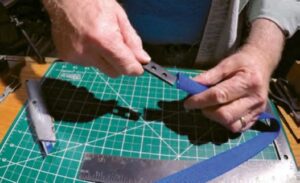
I began by deconstructing a lifting strap. The hooks were attached to the strap with two rivets. I ground the heads off using a bench grinder and punched out the rivets. Then I separated the hooks from the strap.
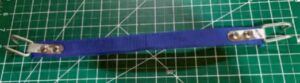
Next, I trimmed the rubber strap to fit inside the tubular nylon webbing. (One-inch webbing was a little too small for the rubber strap; wider webbing would have eliminated this step.) After inserting the rubber strap into the webbing, I located the rivet holes in the strap, marked them with a Sharpie, and used an awl to pierce the webbing. I slid the brackets with hooks back onto the handle.
Then I put a large nail into a vice, pointed end up, and heated it red-hot with a propane torch. By pushing the holes in the brackets down over the nail, I was able to enlarge and seal the holes. Finally, I attached the hooks using ¾-inch 10-24 stainless steel machine screws and nyloc nuts.
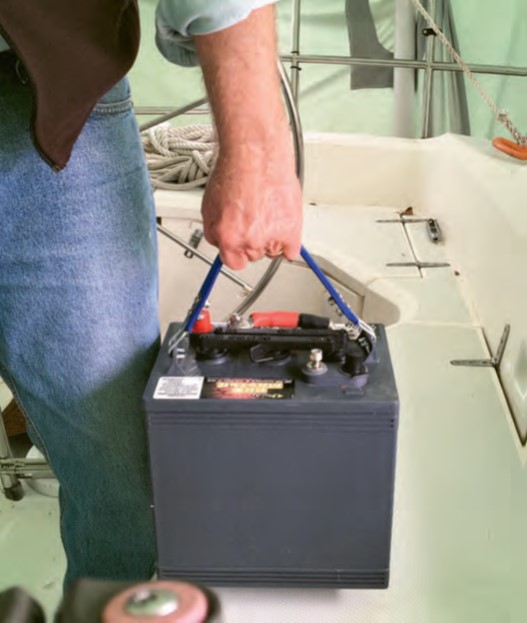
Putting my lifting strap (with its stylish blue nylon cover) to the test was a success. Reaching down into the battery box, the hooks engaged the lifting ears, the strap felt secure and comfortable, and up rose the battery from the depths.
Dave Lochner and his wife, Susan, currently sail Second Star, a 1993 Sabre 362, on Lake Ontario. With the refit of Second Star near completion, they plan to set sail down the St. Lawrence River and turn right at Newfoundland in June 2020. Their adventures can be followed at SV-SecondStar.net.
Thank you to Sailrite Enterprises, Inc., for providing free access to back issues of Good Old Boat through intellectual property rights. Sailrite.com