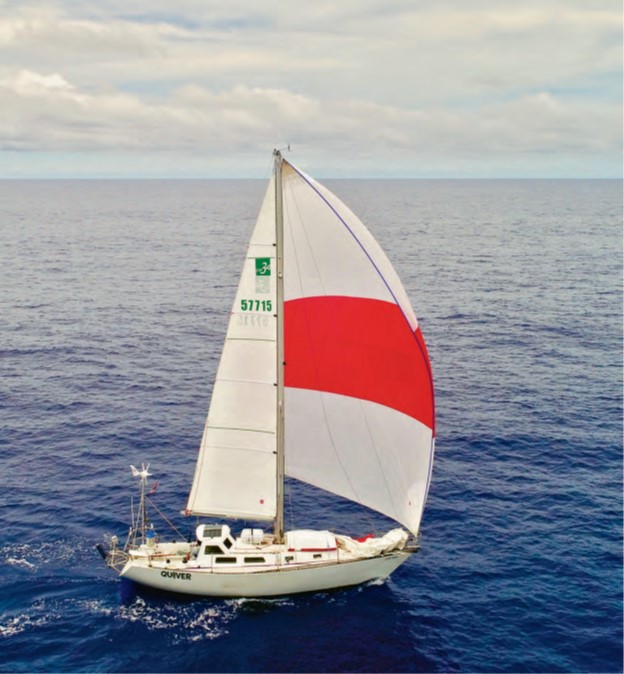
This refit of a proven, 1970s-era racer maximized performance for speed, safety, and fun.
Issue 136: Jan/Feb 2021
Three months after selling my Cal 2-29, Loophole, I found myself pining for another boat. I thought I’d be satisfied racing or sailing other people’s boats, but without a boat of my own, life just seemed a bit less…interesting. Owning my own boat offers essential therapeutic benefits; at the end of a long day, nothing beats the feeling of clutching the tiller and steering my boat wherever I want to go, powered purely by the wind.
Once I accepted that owning a boat was necessary, I realized I had an opportunity to replace Loophole with something even better aligned with my sailing self. Before starting my search for the next boat, I considered carefully what I wanted.
I firmly believe that fast is fun. My next boat would go upwind with ease and respond to zephyrs on the quiet days. She would be a performance boat I could cruise, not a cruising boat that struggled to perform. Clearly, her underbody would feature a fin keel and a spade rudder. She would be on the lighter side of the displacement curve. Her sail plan would be generous.
Looking at my future, I knew my next boat needed to be capable of sailing around the world. She would even be willing and able to play a starring role in a poor man’s Sydney-to-Hobart campaign. And she still had to be fun to sail. I knew she had to be pleasing to look at.
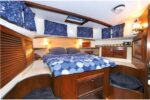
It wasn’t long before I found a Peterson 34 lying alongside a dock in Honolulu. She was a bit rough around the edges, the proverbial dime-a-dozen plastic classic in need of a little love. But I knew she had an impressive racing and performance pedigree. I knew she was strong, and her build quality was good. Her lines were pleasing. Below, I found an interior that would satisfy my liveaboard needs. I knew that with some refit effort and minor modifications, Quiver was a boat that could eventually tick every box on my requirements list. I offered the owner just enough money to not offend and was quickly on my way.
The Big Three
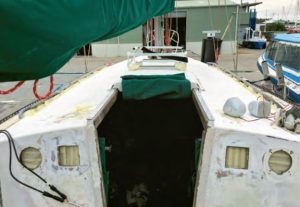
Now I could begin the project to refit Quiver to optimize her already considerable sailing chops for cruising speed and shorthanded efficiency. I started by focusing on what I see as the three key points of durability: the rig, the keel, and the rudder. It’s critical that the first stay upright and the other two stay attached. In the course of sailing more than 100,000 miles—split between racing boats and cruising boats—I’ve lost all three; this is personal.
I was confident enough in the mast itself to wait until later—as I prepped to go far offshore—to pull it and conduct a full inspection. The standing rigging, though, had to go immediately, since I had no way to know its age. I replaced it piece by piece with the mast in place.
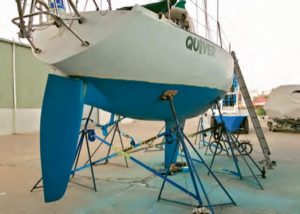
Next, I turned my attention to the rudder. A 40-year-old fiberglass hull is one thing, but a 40-year-old fiberglass foil that endures the strains and stresses of steering a lively boat—that’s another thing entirely. With offshore plans for Quiver, I opted to replace the rudder, as I have done on my last several boats.
Some will argue that a full replacement wasn’t necessary, and that draining the water from what could be a soggy rudder, then sealing it back up, would suffice. But under this scenario, it’s extremely difficult to qualify the integrity of the rudder stock and aperture, both critical elements of the system. I believe any boat of this vintage intended for offshore sailing needs a new rudder, regardless of how the rudder appears. The value of peace of mind increases with every mile I sail away from land. And, my racing experience supports my opinion; of all the offshore races I’ve sailed or written about, rudder failure while reaching is the most common cause of retirement or major problem.
I couldn’t buy a new rudder off the shelf at my local chandler. For my third boat in a row, I enlisted the services of Foss Foam of Newport Beach, California. Foss has molds to build many different rudders but none for a Peterson 34— and that suited me just fine. When buying a new rudder for a 40-year-old boat, it costs nothing to go with a newer foil shape; it’s a good performance upgrade.
I asked the folks at Foss for the coolest, most efficient rudder shape that matched as closely as possible the surface area of the boat’s original rudder, built around a rudder stock with dimensions identical to those of the boat’s original. Foss suggested using a mold for a Carl Schumacher-designed Express 37. They also recommended adding a bit of foil surface area forward of the post to preserve the stock rudder’s semi-balanced nature.
A few weeks later, I unpacked a sexy new blade that looked decidedly less 1978 and more 2018, and it fit Quiver like a glove. It was a fun, interesting, and ultimately rewarding journey from initial conception to on-the-water gains.
For the keel, I relied on a thorough visual inspection, in and out of the water, and a lot of shakedown sailing. The keel bolts are easily visible and accessible, relatively massive, and spaced closely. I have not tried backing the nuts off, but whether in the water or on the hard, there are no cracks in the bottom paint to indicate movement of any kind. I will remove the keel at some point, but for now, and maybe due to my observation of the boat’s overall robust construction, I have no shortage of confidence in the keel.
The Powerhouse
Having addressed the three critical points of durability, I was eager to refine Quiver’s performance as a sailboat. I started with sails. First, I ditched the roller furler for a full inventory of hank-on sails. I know it’s contrary to what most people would do, but I am a firm advocate of hank-on sails, especially for shorthanded ocean sailing. Why? Because I prefer reliability to convenience.
On my first sail across the Pacific, from California to New Zealand in 2014, I recorded statistics on the fate of that year’s cruising fleet. By far, the most common major failure experienced by other boats was related to roller-furling headsail equipment. Rigs and sails are easily damaged (sometimes catastrophically) when a furler fails to furl in a blow, and less common but more insidious is the damage or corrosion furling gear can hide that can threaten the mast itself. It’s a wake-up call to watch a vessel arrive in a distant port with ribbons of shredded, semi-furled Dacron flying from the headstay.
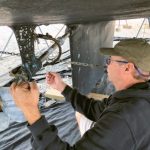
As if to confirm my instincts, on a sail during the first week I owned Quiver, the lower toggle on the headstay failed. The Schaefer furling drum had been trapping saltwater (not draining, a common issue in some older Schaefer furlers), promoting corrosion of the toggle. To add insult to injury, installation of the furling equipment made it difficult to inspect this toggle. It was a major scare and reinforced my decision to re-rig and my preference for hank-on sails.
Once I went with a simple wire headstay, I purchased a couple of new hank-on sails and modified the older-but-serviceable 110 percent and 135 percent genoas. With a full hank-on inventory that now effectively included a #1 genoa, #3, #4 blades, and storm jib, I had a headsail to suit any condition.
It’s hard to overstate the efficiency gains (read: speed gains) offered by flying the sail best matched to the conditions, versus sailing around with the wrong headsail most of the time while carrying the additional windage and weight aloft of a partially furled sail and its heavy aluminum foil. And, changing a hank-on jib or reducing sail is easy; nothing slides up and down like a metal hank on a wire forestay. A lowered sail (or one that’s ready to raise) is easy to manage as it stays on deck and is firmly attached to the boat at its luff.
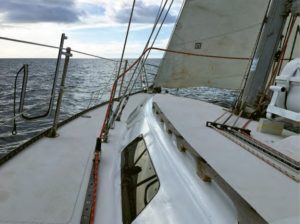
Next, I addressed the Peterson 34’s long genoa tracks. To sail more efficiently, I cut out a middle section of the stock track and moved it inboard and far forward to give my #4 jib and storm jib a tighter sheeting angle, letting me lead the sheets inside the forward-lower shrouds. When I relocated the cut portion, I also removed and rebedded the existing sections of track.
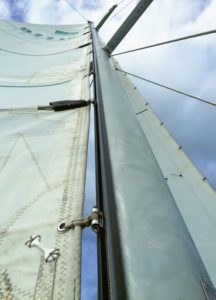
With the headsail situation sorted out, it was time to move on to the mainsail. Quiver came with a groove in the mast and nylon slides on the mainsail. This created enough friction that the mainsail was a bear to hoist—worse, it was reluctant to come down when I wanted it to. This was more than just a bother; the ability to quickly lower and raise a mainsail is really a matter of safety and sailing efficiency. There are times when you need the main to come down immediately, and the ability to easily and quickly put in or shake out a reef in the mainsail maximizes how much I can sail Quiver to her potential.
While many sailors choose to sail under full main and then reef the furling headsail as the wind picks up, I choose a headsail that’s just barely on the side of being really powered up, and then I reef the mainsail as the breeze blows harder. Since it’s harder to change a hank-on headsail than to manage the main, this makes sense, and by moving the center of effort forward, this configuration actually reduces weather helm and self-steering-system loads. It’s a very French way to sail; I often see shorthanders flying a double-reefed main and the biggest headsail possible.
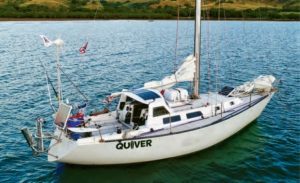
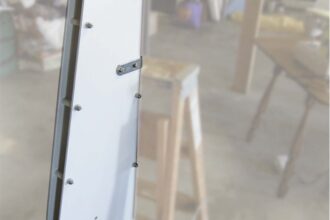
My solution to Quiver’s sticky mainsail slot was to install a Tides Marine Strong Track system, a slippery, plastic track that slides up the existing mast groove. Highly polished, stainless steel slides on the mainsail glide up and down with a minimum of fuss.
Mainsail sorted, it was on to the fun stuff: the spinnaker. Most older boats carried large symmetrical spinnakers that powered them dead downwind quite efficiently, at least with a full crew—still, when it came to some IOR designs of the Peterson’s era, there was a well-known saying: “Upwind, go like hell. Downwind, pray like hell.”
But managing a spinnaker pole, topping lift, foreguy, and sheets and guys is not so practical for daysailers or cruising boats with small crews, especially when the asymmetrical exists. And truthfully, the asymmetric is far more than a compromise; it makes downwind sailing safer and easier. The boat must run downwind at slightly hotter angles than when using a symmetrical kite, and this off-the-wind heading eliminates much of the dreaded “death rolling” that prompted that saying about IOR boats with pinched-in transoms.
I needed an asymmetrical spinnaker for Quiver, and I relied on an old sailmaker’s trick to score a good kite for cheap.
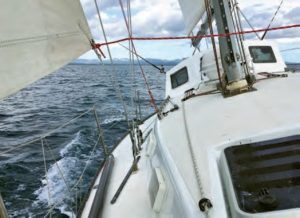
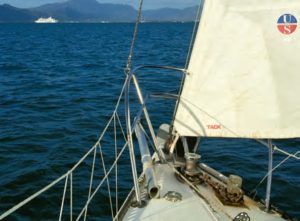
First, using a section of a 3-inch-diameter boom I salvaged from a small boat, I rigged a small bowsprit. I attached it aft using a small bracket and through-bolting it to the deck. Forward, I secured it to the toerail with lashings. In front, I attached a low-friction ring through which a tack line could pass. With the sprit in place, it was time to measure, first from the tack to the max hoist position of a spinnaker halyard. This was the maximum luff dimension of my new sail.
Armed with that number, I headed to the internet to search luff dimensions for popular one-design race boats. Bingo! The J/105 shares the same dimension that my rig was prepared to handle. Now it was a simple matter of shopping for a gently used asymmetrical from a J/105— easy! When the new-to-me kite arrived, it fit like it was cut for my boat.
The Controls
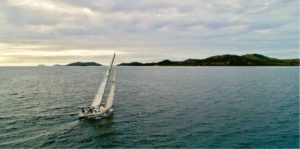
With the sail plan refit complete, I turned my attention to how I could manage the sails most efficiently. When they built the Peterson 34 in 1978, there must have been a sale on winches, because they installed a staggering nine of them; two at the mast, three in the pit, and four in the cockpit. Since I wouldn’t be flying a symmetrical kite, I had no need for the pair of secondary winches mounted to the cockpit coaming. Adding seven rope clutches in the cockpit allowed me to remove two winches by the mast and one of the three winches in the pit.
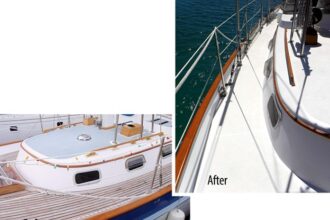
All in all, I went from nine winches to four. As well as easing sailhandling and opening up the cockpit for more comfortable seating, eliminating five winches removed a lot of weight, and reducing weight where possible can return big dividends in terms of efficiency, aka speed.
It’s been four years now since I began living aboard and sailing Quiver, and it’s still a joy. I open her up in the light stuff, and she scoots along nicely, no need to run the motor. I can throttle her back in a breeze, for comfort, and she still puts up good numbers. She sails like an old racing boat, performing reliably well and getting me where I need to go. I started with the fastest and most efficient platform that was available in my size and price range, and by equipping her to my need for speed, I have ended up with a boat that is a joy to sail and so keeps me doing just that—sailing.
Ronnie Simpson is a 35-year-old racing and cruising sailor, as well as sailing journalist, writer, and sailing media professional. He has sailed more than 100,000 miles on his own cruising boats and on racing boats, and has made ocean crossings on everything from a Moore 24 solo to a 100-foot, fully crewed supermaxi. He currently lives in western Fiji on his Peterson 34 Quiver, where he has started a surfing-related company in the Mamanuca Islands.
Thank you to Sailrite Enterprises, Inc., for providing free access to back issues of Good Old Boat through intellectual property rights. Sailrite.com