Applying patches with a sticky sealant is as effective as sewing
Issue 121: July/Aug 2018
Modern cloths make sails infinitely trouble-free when compared with the state of things in the bad old days. But, for all their modernity, sails are still assemblies of fabric that we purposefully put up on a windy day. And no matter how close to or far from shore we sail, we need them. Of course, they chafe, they rip, they split at the seams, and when they do, we need to put them back together, fair and strong, so we can keep catching the wind to get us where we’re going.
Boat owners are a hands-on crowd, but it takes time for a sailor to become self-sufficient in the practical skills needed to keep a boat going. Luckily, in sail repair, a significant shortcut exists for obtaining top-quality results
In a twist to the universe that will appeal to everyone in the duct tape and Bondo crowd, it turns out that simply gluing sails back together, using patches cut from sailcloth and held in place with 3M Fast Cure 5200, produces results stronger than a professionally sewn seam. This claim is backed up in The Complete Guide to Sail Care and Repair (Beowulf, 2002), in which author Dan Neri, now CEO of North Sails Group, reports on loading tests that show repairs using this technique to be stronger than machine stitching. (And, this is a really valuable book for anyone covering miles in a sailboat — it describes a lot of repair techniques that will keep a sailor self-sufficient.)
It seems almost too good to be true, but with 5200 you can make permanent, full-strength repairs quickly at sea. On our Galactic, we always give the sails a careful going-over before setting off on a passage, and we’ve used 5200 patches in a lot of remote anchorages to fix incipient problems. But this technique really comes into its own at sea after a sail abruptly fails.
As our sails have aged, they have started to occasionally tear under normal use, but at least half of the rips we’ve experienced at sea have been the result of operator error, such as a tired or distracted sailor doing something stupid involving a winch and a sail stuck on the rigging. Once the guilty party is done with self-recrimination, we conjure up the magic trick of making a full-strength repair in the middle of nowhere.
Easy application
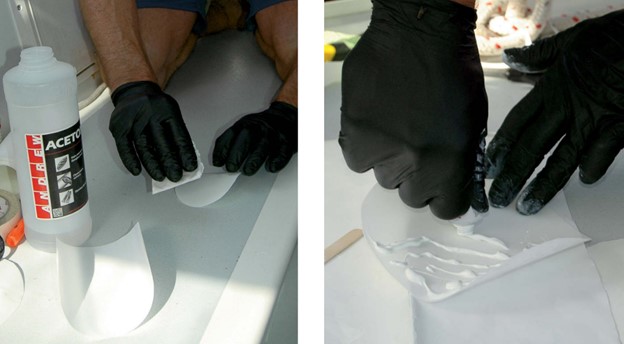
The application is straightforward. We carry 9-oz UV-stabilized Dacron sailcloth to make patches. When a sail rips, we cut a patch to overlap the damaged area by about two inches on all sides — more for a major repair. We clean both patch and sail with acetone to ensure a good bond. To keep the 5200 from leaking through and creating a mess, I fit a piece of stickyback to the back of the damaged area, and remove it after the 5200 is tack-free but before it has set up completely.
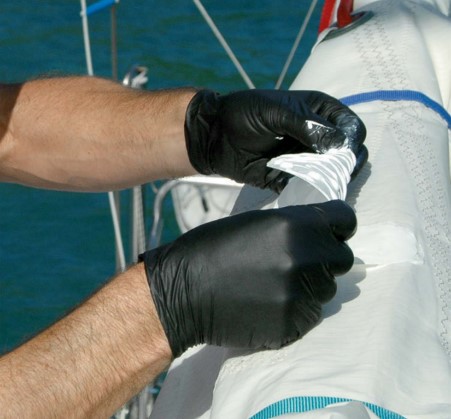
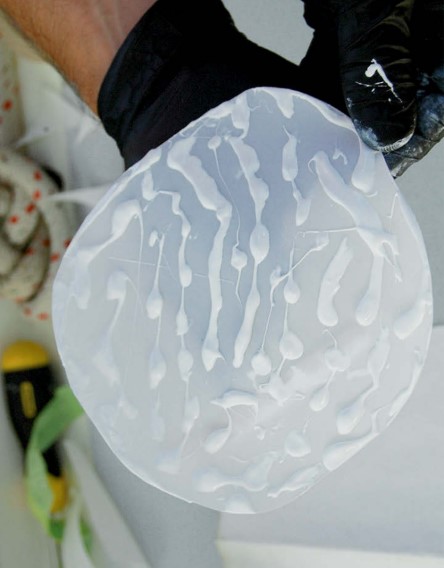
Finding the right amount of 5200 to use takes a bit of experience. Too much and it will squeeze out around the edges, not enough and the edges of the patch won’t be bonded and will threaten to peel off over time. Seamstick can be useful for keeping the 5200 from leaking past the edges of the patch. Applying pressure is important, as pushing the 5200 deep into the sailcloth is key to getting a strong repair. Use a plastic scraper, screwdriver handle, or whatever is convenient to apply firm pressure, working from the center of the repair to the edges. Wear gloves to keep the stuff off you, and take whatever measures you can to protect your work area and, if outdoors, to keep the damaged sail from flapping around in the breeze.
You can do a whole lot more than simple patches. Grommet failures on the luff can be repaired with multiple patches in layers that get progressively smaller to distribute the load. After the 5200 has cured, you can fit a new grommet directly through the patch or replace the grommet with sewn-on webbing. For large structural repairs, when we are at anchor and have the possibility of using our Sailrite sewing machine, we sometimes build composite patches, using a combination of 5200 and sewn seams. A handful of small tubes of 5200, along with West System epoxy, is now on my short list of repair supplies that I feel naked without when setting off on an ocean crossing.

The patches you make with 5200 won’t necessarily be pretty, but no one more than a boat length away will be able to tell the difference from a professional repair. The real value of this technique came to me when we finally got around to taking our mainsail to a sailmaker in Tasmania, 5,000 ocean miles after I’d used 5200 to repair the badly torn head. He looked at the repair and told me that there was no point in his replacing it. His repair would be prettier, but it wouldn’t be any stronger.
Now, if I could only learn to splice double braid.
Mike Litzow cut his teeth club-racing C&C sailboats on Lake Erie. He is the author of South from Alaska: Sailing to Australia with a Baby for Crew. Mike and his family are living on board Galactic, their 1989 45-foot steel cutter, in their home port of Kodiak, Alaska.
Thank you to Sailrite Enterprises, Inc., for providing free access to back issues of Good Old Boat through intellectual property rights. Sailrite.com