During a running refit, a boat imparts life and sailing lessons.
Issue 132: May/June 2020
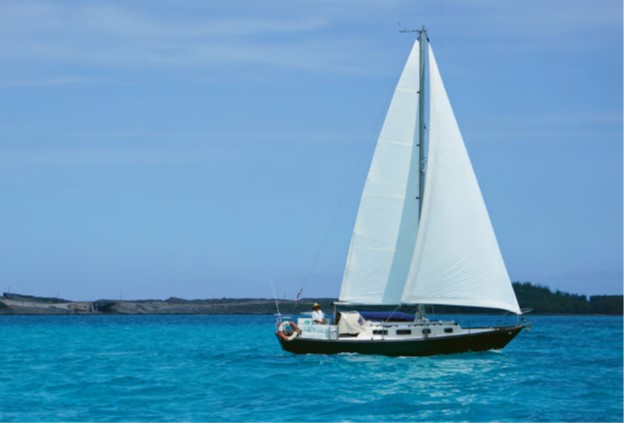
It all started on a freezing winter’s day in a boatyard at the French Canadian-New York border. The decks of the Pearson Ariel 26 I’d just bought were covered in snow. The sails were frozen; the canvas crunched as I shoved it into the lazarette. I hadn’t checked for spongy decks or compromised bulkheads before I bought her. I most certainly hadn’t checked for a running engine. I was in love with her lines and I was blissfully ignorant.
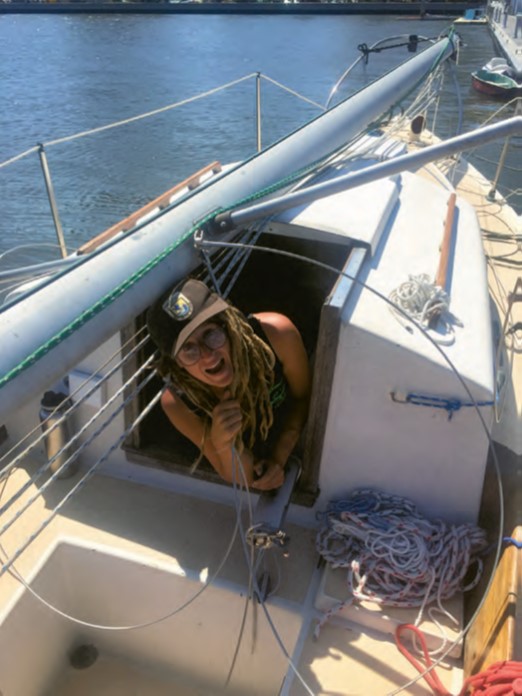
I knew she was a fine sailing vessel by nature, and possibly suited to offshore adventures with a few modifications, or so I’d read in a book.
She was a Carl Alberg design built in 1968, and I figured she was more seaworthy than the Bristol 24 I had just sold. She had one upper and two lower shrouds on each side, and each shroud connected to an individual chainplate. The Bristol had only two shrouds on each side and they shared a chainplate. The Pearson was two feet longer but narrower and with longer overhangs.
She went to weather better and was faster than my Bristol, that I knew, because I’d sailed her that previous summer on Lake Champlain. She was in the same boatyard and marina at which I’d showed up a year earlier armed with a dinghy, a bicycle, a hammer, and a mission to fix up a sorry Bristol and teach myself to sail.
But that was then. The Bristol had been great for a lake adventure, and now I had a boat that could really go somewhere, far beyond Lake Champlain.
The name on the Pearson’s transom was Vanupied, French for barefoot peasant, I learned. I called her Vanu and tasked her with taking me down the Champlain Canal, the Hudson River, along the New Jersey coast, through the Delaware and Chesapeake bays, onto the Atlantic Intracoastal Waterway, and across the rivers, sounds, and bays from Georgia to the Florida Keys.
But not yet. I had to wait for the thaw, move her to my mooring in Vermont, fix what was necessary to get her to Florida, and then I could be underway. With more time to assess Vanu’s condition, I decided that all I had to do to get her ready for our trip was to install an electric bilge pump, shore-up the backstay
to prevent imminent failure, acquire a new-to-me mainsail, find a motor that worked later, (I would have to modify the stern locker to accommodate it), and a few other odds and ends. Completing that work and the voyage afterward would be no small feat for this sailor, so early in her sailing life.
And I wasn’t blind to the fact that for Vanu to really be seaworthy, there was much, much more to be done. “But I’ll deal with that later, in Florida,” I told myself. I had a vague plan: get to my mooring in Vermont, take care of the urgent repairs, get to Florida, find work, work on the boat, and go to sea.
You see, I was the planner, I was in charge, I had a lot to show this boat, what she could be. Little did I realize, I was a student of boat life and Vanu was about to become my teacher.
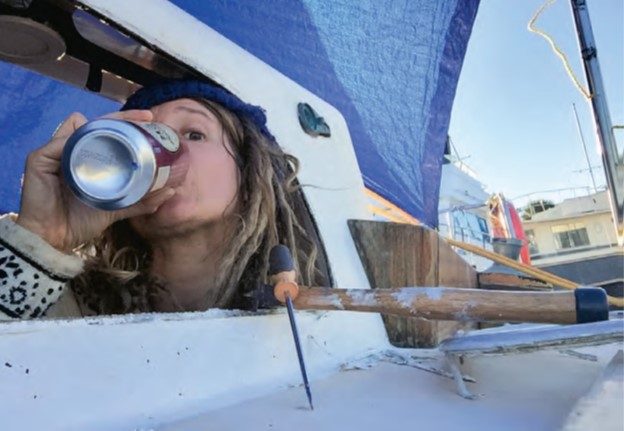
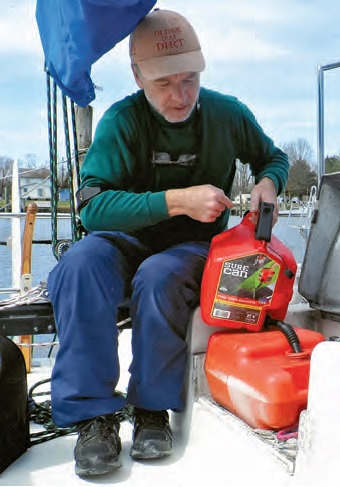
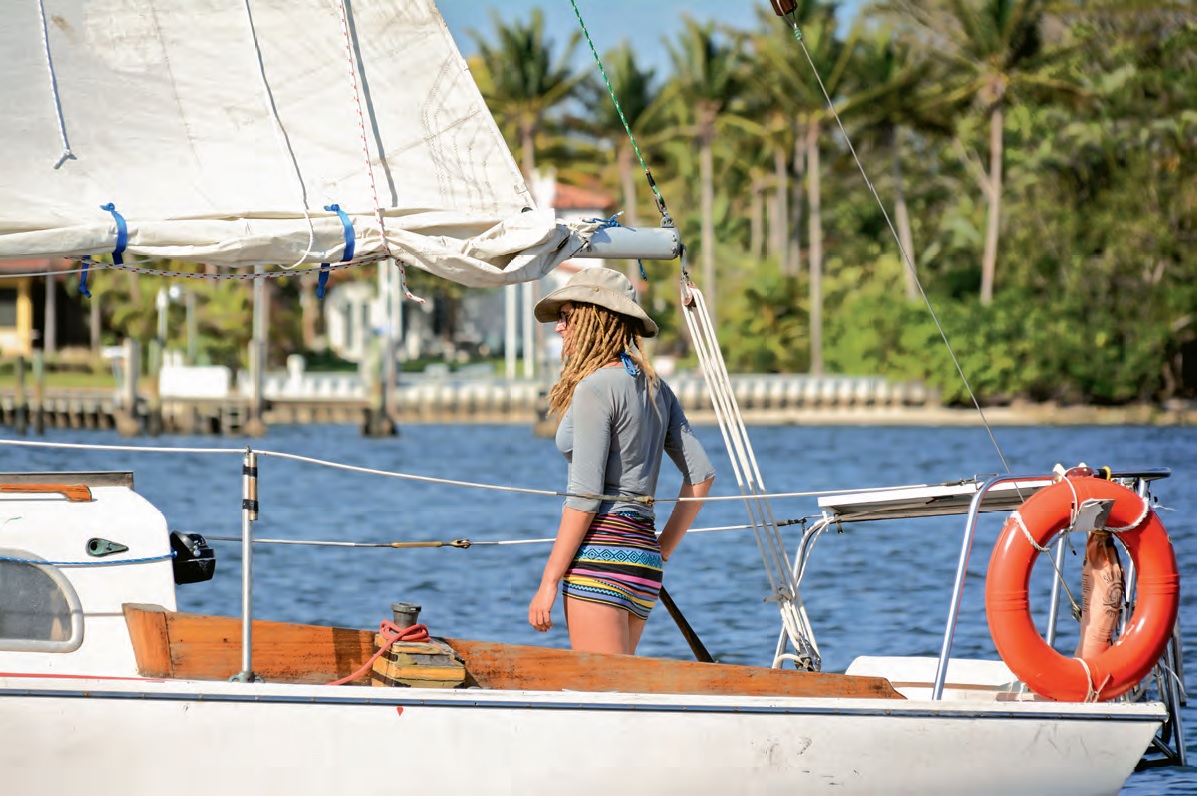
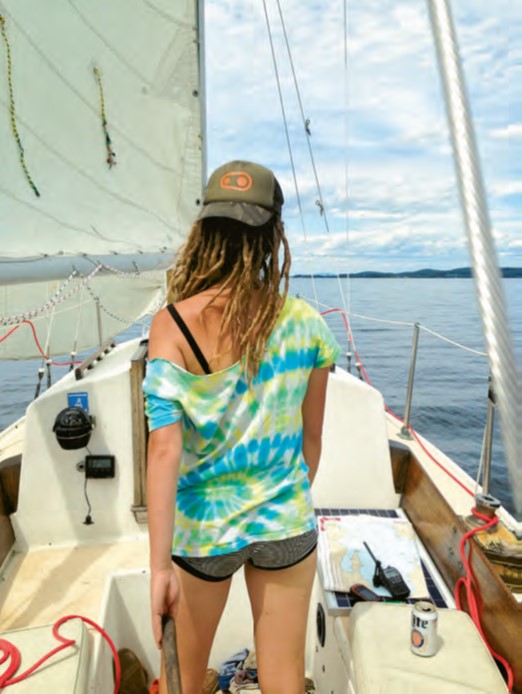
The thaw came and I eagerly launched her in early May. I’d replaced her ancient two-stroke outboard with a modern outboard, but it wouldn’t start. So, I drifted off the dock and raised the main just in time to avoid a collision with a Beneteau. I continued south towards Burlington, Vermont. Along the way, I got the outboard started but had to continuously feed its little fuel tank to keep it humming. Picture a 27-year-old woman holding the tiller with her foot while filling the little tank (again) and dodging traffic.
The motor was also a problem in that it wouldn’t fit in the well. When installed, the hatch wouldn’t close. Once on my Vermont mooring, I bought a 6-horsepower, long-shaft replacement, and a friend helped me modify the engine locker hatch to fit over it. In what was my first foray into boat carpentry, we cut a giant hole that the cowling poked through and then used thin plywood and fiberglass to build an arched cover over it.
The backstay situation was far worse. “Please don’t break, please don’t break,” I remember saying aloud as I tacked in 25 knots on my way to Vermont. When I finally removed the bolts, they crumbled in my hand. There was no backing plate, and the structure of the wooden knee was questionable. I added a thick aluminum backing plate, stainless steel bolts, and fiberglass tabbing to the knee.
“You saved it,” an old salt remarked.
I realized I couldn’t wait to replace the mainsail, as mine ripped anew every time I raised sail. On the Pearson Ariel owner’s forum, I wrote about my planned trip, asking if there was anyone who had recently replaced their main and had an old one in better shape than mine. I’d pay shipping, of course. Within hours, the organizer of the owner’s group had a mainsail in the mail for me. When it arrived, I estimated it had 20 years of life remaining. Mine had about 20 minutes. A friend helped me install second and third reef points.
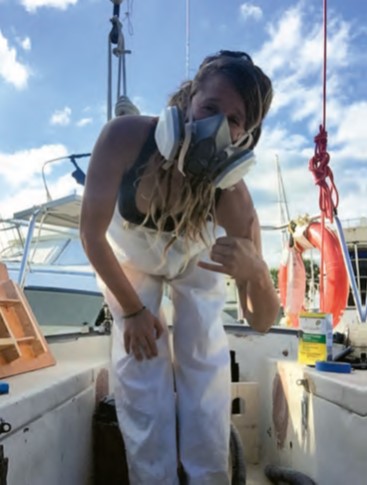
“I’m not coming back!” I called to my neighbors as I left. I’d have cut the proverbial mooring line, but I’d sold my bridle to a friend to pay my debt to the marina. I sailed only five miles that day, but the next day I continued south, tacking through the torrential rain remnants of what had been a major hurricane, frying the electronic components of my depth sounder.
The transducer for the same instrument had been leaking when I launched. But after a few days on the water, I noticed that the wooden spacer on which it was mounted began to swell, seeming to stop the water intrusion. This was a problem that would come back to haunt me, but for now it didn’t matter, I was off.
By the time I reached the mid-Hudson, it was time to make my first repair of the trip. The tiller pilot wouldn’t stay connected to the tiller and had stopped steering. I added wood and epoxy as a backing for the pin socket and I used a sock-and-duct tape at the base as a temporary shim to raise the tiller height by an inch. My fears of having to hand-steer overnight along the New Jersey coast were allayed.
At New York Harbor, Vanu and I were spit out through the Verrazzano Narrows and into the Atlantic Ocean. The boat still had no business being at sea, but I took it easy, still very cautious.
Unfortunately, with just a single 30-watt solar panel, I could barely keep my house battery charged when there was no load. So, from Sandy Hook, New Jersey, to Cape May, I used emergency running lights powered by disposable batteries. Fortunately, the over¬night passage was magical, with light winds and a swell that my boat pranced across like a pony. I dropped the hook just hours ahead of a gale. Stuck at anchor while the wind blew, imagining what it must be like out there, I began to contemplate the limitations of my boat. It didn’t feel good.
On the Chesapeake, I sailed downwind in the cold fronts and upwind in the warm fronts and came to learn that it was time to re-bed my traveler and add new springs to the winch on the mast.
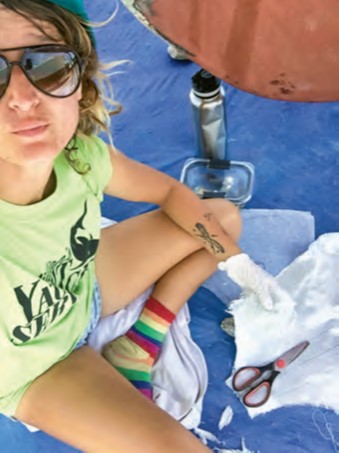
By Oriental, North Carolina, I’d found a cracked swage in my rigging. A rigger told me I was playing Russian roulette. I replaced the damaged stay with a piece of cable from another boat and Sta-Lok terminal fittings.
In Ladies Island, South Carolina, the folks at the canvas shop helped me make a new cushion after they found out I’d been sleeping on the original vinyl cushion from 1968.
In St. Augustine, Florida, another sailor girl let me build a stitch-and-glue dinghy out of a sheet of plywood in her woodshop.
In West Palm Beach, I spent $700 replacing the rest of my standing rigging. With the help of five friends and the rig of an adjacent Ericson 27, we raised and lowered Vanu’s mast.
I called my stop-and-fix approach a running refit, but some things couldn’t be done on the move, like the now-leaking-again transducer for the depth sounder and the seriously corroded bronze seacocks for the non-working head. With each low-pressure system that passed and the more I got to know my boat, the less I trusted her integrity.
I was in Florida now and I needed dry land to think things through. I found a place to live at The Boathouse, owned by a yacht broker and sailing author, and where sailors and writers alike passed through. In between odd jobs such as working on a pirate ship, stocking a chandlery, and doing deliveries, I rode my bike 10 miles under the Florida sun to the yard where I’d hauled Vanu.
I made a lot of progress. I ripped out the head and disgusting old holding tank and replaced them with a DIY composting toilet. I replaced all the old wiring. When I removed the corroded seacocks on the through hulls, pieces broke off in my hand.
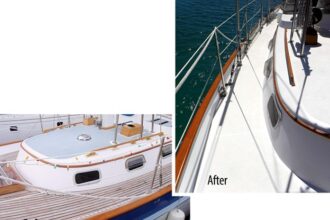
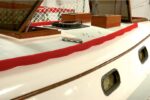
I removed the leaking rubrail and repaired the delamination I found along the hull-to-deck joint. I replaced Vanu’s portlights. In my second stint doing boat carpentry, I modified the bridge deck to make the cockpit better suited for offshore work. I installed bronze cockpit scuppers and tended to the rot in the stern locker as best I could, without recoring the entire thing. I rebuilt and refinished the V-berth, painted the hull, and installed a manual bilge pump.
And much more remained to be done.
It happened that I then headed out on two back-to-back offshore deliveries, one aboard a Parkins 28, the other aboard a Pearson Triton 28. On these trips I started to see what the ocean was really made of. I was at sea in a gale for the first time. I quickly came to appreciate how beam and displacement contribute to seakindliness. When I got back to Vanu, I was changed.
Vanu’s decks were too narrow. Vanu wasn’t heavy enough. Vanu had limited storage capability, not suited to long-term living aboard. And the more I learned, the more I learned how many more repairs she required to be seaworthy. She needed structural work to reinforce her chainplate attachment points. Her sinking mast screamed for a proper compression post. She required deck repairs and an assortment of safety equipment.
And none of those repairs would make her beamier or heavier. It didn’t make sense for me to keep going aboard a boat I’d outgrown.
I painted her cockpit, refinished the galley, and reinforced the knees where the chainplates attach. I painted eyes on her keel and dubbed her All Knowing Vanu, for she had taught me what I needed to know to move on, the confidence to breathe new life into an old vessel with my very own hands.
When I splashed, I knew this would be our final journey, six weeks to get from St. Augustine, Florida, to the York River on the Chesapeake Bay. I had a job on a 100-foot-schooner and planned to sell Vanu to buy another. When I arrived at the York River, a part of me still yearned to keep going, to keep on sailing Vanu, to keep patching her together.
A small part of me.
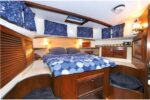
I sold her sight-unseen to a young sailor and I bought another boat the next day, a 1977 Great Dane 28. She has a full keel, transom-hung rudder, beautiful interior carpentry, and an enclosed head. Her ballast, displacement, and beam are all a big step up from my little Ariel.
Of course, she needed work. So far, I’ve glassed in all the defunct through hulls, replaced the standing rigging, made half of the new chainplates, and installed a wood-burning stove. An electric motor and the rest of the chainplates are next. But I’m not daunted. I’m moving forward with the lessons Vanu willingly shared.
Emily Greenberg is a liveaboard sailor and journalist, currently refitting her Great Dane 28 while simultaneously traveling the East Coast. You can follow along on her blog, dinghydreams.com.
Thank you to Sailrite Enterprises, Inc., for providing free access to back issues of Good Old Boat through intellectual property rights. Sailrite.com