Fresh sailing grounds of the Salish Sea offer perspective on Lake Superior.
Issue 132: May/June 2020
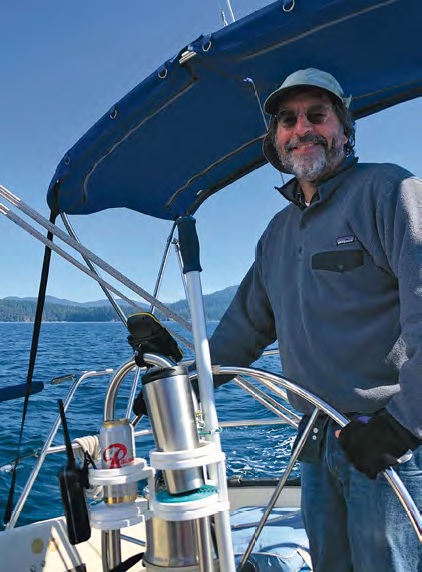 Nothing in four years of summer sailing on Lake Superior has prepared me for this. Adrenaline pulsing, ground speed 8.3 knots, my young son and I hang on as we tack upwind through Cattle Pass. On this December day we can ride tidal currents nearly 50 nautical miles clockwise around San Juan Island and back to our home port on Lopez Island.
Close-hauled against a 20-knot southeast wind, carefully positioned between Goose and Deadman islands, we’re pushed by a 2-knot tidal current into the open waters of the Strait of Juan de Fuca. Across the strait, the Olympic Mountains tower, and their snow caps sparkle. Just beyond the pass we are hit by confused 5-foot rollers, the result of recurrent winter gales that have tossed telephone-pole-sized driftwood onto beaches, wreaked havoc on ferries plying the treacherous entrance to Admiralty Inlet, and kept small boats tied up. Our bow plunges, burying the anchor. Rounding buoy 3’s mournful gong off Salmon Bank, with squat Cattle Point Lighthouse pivoting starboard, we ease sails downwind to the west. The Pacific Ocean beckons.
Before I moved our boat to the Pacific Northwest, I thought year-round saltwater sailing was easier, less complicated, than summer-only freshwater sailing; now I am not so sure.
Summer sailing on Lake Superior was tactical. I judged the day’s winds, hoped for favorable weather, and set a course for a destination. I could usually spot ominous clouds that signaled summer thunderstorms generating 30 or 40 knots of trouble. But where I sailed was largely in my control.
I am learning that sailing on the Salish Sea is more strategic. There are more forces at play, and the key is anticipating them and understanding where they aim to push me. We’re in luck today. The last gasp of an ebb tide flushes us south through Cattle Pass, then a flood tide coming in from the Pacific propels us north up the west side of San Juan Island, past Lime Kiln State Park’s well-known whale-watching grounds. Later, we ride the end of the flood tide through dramatic Spieden Channel and back into protected waters near Friday Harbor.
The Salish Sea was named by marine biologist Bert Webber two decades ago to help make visible the natural connections of Canada’s Georgia Strait, Washington’s Puget Sound, and the Strait of Juan de Fuca. Its complex, intertwined ecosystems encompassing 6,900 square miles and stretching 150 miles north to south vitally depend on both countries collaborating to ensure its future. Native peoples who claim the heritage of the Coast Salish encourage cross-border cultural, judicial, and resource-management ties.
It’s a magnificent expanse of water, but coming here from Lake Superior has provided me with a unique perspective to counter those Pacific Northwest mariners who assume that an inland body of water surely cannot equal it. Stretching 350 miles east to west, Lake Superior is nearly five times larger in area than the Salish Sea. While a sustained 30-knot blow from prevailing winds in the Sea might generate waves to just over 7 feet, the same conditions applied to Superior’s 200-mile fetch can produce waves nearly twice that height. For our Sunyata, an S2 9.2, the Salish Sea at its worst is doable, whereas Lake Superior can be threatening.
If wilderness sailing is about confronting the primal forces of nature, it’s clear that Lake Superior and the Salish Sea each offer plenty of challenge. All open-water crossings on Lake Superior should occasion careful planning, an eye on the clock, and sharp attention to weather. Any passage beyond the Salish Sea’s inner protected waters likewise require caution and care. In each, I find the sailing equal parts therapeutic, cathartic, and just plain fun.
We approach our home port after winter’s immense darkness has descended, and we can see almost nothing of the marina’s rock breakwater and finger piers that we must slide into. We creep through the darkness until spotting the broadside of a large motorboat; our boat’s slip is just to the far side. Home safe, I give a nod of respect for the forces of nature that we collaborated with today on this body of water.
Thomas Misa and his sailing spouse, Ruth Fothergill, moved Sunyata from Lake Superior to the Salish Sea in summer 2018, and thereafter have sailed each month including February’s brisk 38° F. tjmisa.com
Thank you to Sailrite Enterprises, Inc., for providing free access to back issues of Good Old Boat through intellectual property rights. Sailrite.com