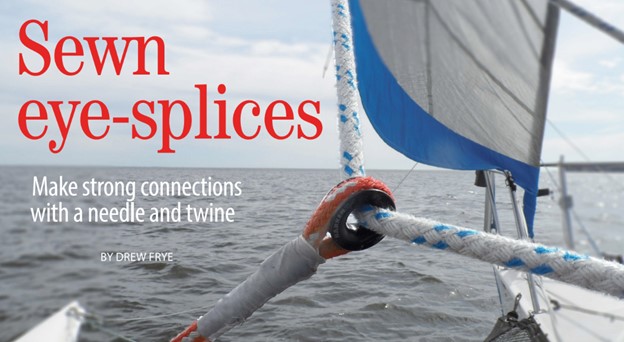
Make strong connections with a needle and twine
Issue 120: May/June 2018
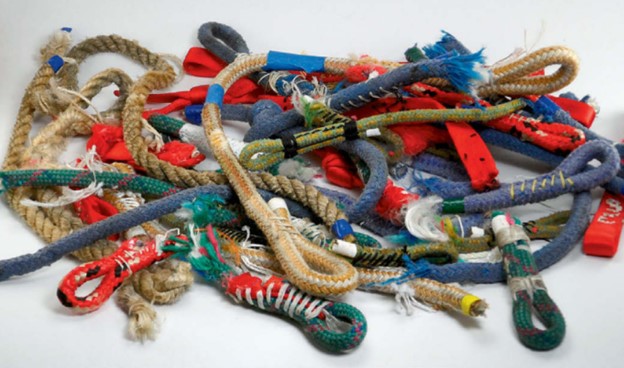
Conventional splices are king for forming eyes in rope. They resist abrasion and snagging and retain nearly the full strength of the rope. But for the double-braided rope commonly used today, traditional splices aren’t always the best approach. They’re vulnerable to abrasion at the throat (on one side the cover bears the full load), require special skills and tools, and they are a nightmare to make with stiff old line. A good alternative is the sewn splice.
I have used hand-sewn splices in high-load applications on my boats for 30 years and have never had one fail (although lines have occasionally parted where they ran through a block or jammer). Sewn splices are traditional in sailmaking and are commonly used on industrial safety lines and tethers. It is easy to make a sewn splice to an exact length in the field or on a sail, but the challenge lies in making them strong enough. Sewn splices are also vulnerable to abrasion and to degradation by ultraviolet light (UV), and the fiber from which the rope is made has a significant effect on how a splice performs. Nylon and polyester are very different animals — one stretches, the other does not — and this dramatically affects how the stitches carry the load.
The information in this article is based on extensive lab and field testing. I have a load-test rig in my workshop. In the process of writing this article, I broke hundreds of hand-sewn sample splices in many patterns in nylon and polyester rope and webbing, using polyester and Dyneema whipping twine. I will skip the reams of data and present only summary conclusions and stitching-schedule tables.
Stitching and rope stretch
Remember playing tug-of-war? So long as the rope remains in a straight line, the team (all of the stitches) shares the load. Now imagine playing tug-of-war with a bungee cord, with the additional rule that, like stitching, your feet cannot move. Now only the first person is doing any work. If the others pull, the line only stretches, and since they cannot move their feet, each successive person (stitch) carries less and less load. So it is with sewn splices in nylon rope; only the stitches within the first inch or two do any real work. The remainder are only there for backup. For that reason, stitching in nylon must be concentrated in a very small area. In non-stretch materials, such as polyester or Spectra, the long sewing pattern distributes the load along all of the stitches.
Hand vs. machine sewing
It’s easy to assume that machine sewing is superior to hand sewing, but the handwork of sailmakers should make it obvious that this is not universally true. Hand stitching made with heavy whipping twine is inherently more resistant to abrasion and UV than machine stitching made with thread, because the twine is wax-coated and many times thicker. Only very specialized machines can sew rope. My emphasis is therefore on handwork.
Twine
The whipping twine should be 1/10 to 1/20 the line diameter and waxed for improved handling and reduced abrasion. In general, the whipping twine number should be 10 times the diameter of the twine in millimeters (#4 twine should be 0.4 mm). Nomenclature varies between manufacturers, but you can measure the size by winding the twine 10 times around a pencil and measuring the length covered. The whipping twine data table at the bottom of this page summarizes the strength of two brands.
Waxed polyester twine produces slightly stronger splices than Spectra because it stretches with the rope, while Spectra will cut right through the rope fibers. On the positive side, Spectra twine resists abrasion better than polyester. Although both resist UV very well in these sizes — at least 5 years at 80 percent strength — I always cover sewn splices.
A stitching palm can be used to push the sailmaker’s needle when making a splice, but it’s far more efficient to use a wooden cutting board placed across your lap to support the eye of the needle while pressing the rope down the needle with your fingers. Use pliers to pull the occasional stuck needle when sewing larger-diameter ropes.

Zippering
A common concern is that if a single thread fails, the stitching will rapidly fail. This is not the case. During testing, I often tensioned samples to within 70 percent of their breaking strength and began cutting threads with a razor knife. In general, I had to cut threads until about 90 percent of the calculated breaking strength (based on stitch count) was reached before the splice would fail. Under tension, the rope fibers are forced so tightly together that the stitching becomes trapped, preventing slippage.
Stitches used in rope
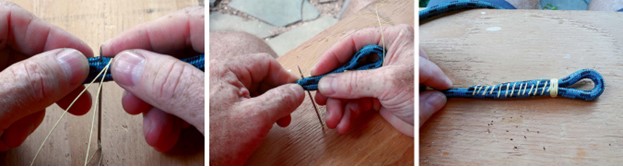
One of three stitching techniques can be used on rope, depending on the application. Doubled waxed polyester whipping twine is used in all cases.
Basting stitch – Pass the needle through the rope, then back through it about 3/16 inch away from where it emerges, and continue back and forth in that manner.
Round stitch – Pass the needle through the rope near the edge, pull it around and over the edge, and reinsert it from the same side, 3/16 inch farther along. The thread takes a spiral path.
Seizing – Wrap the twine around the pair of lines 10 to 30 times and secure it by passing it back through the line several times. The turns can be secured in place with basting stitches. The turns must be very tight, because the line, especially nylon, will become thinner under load.
Splicing methods
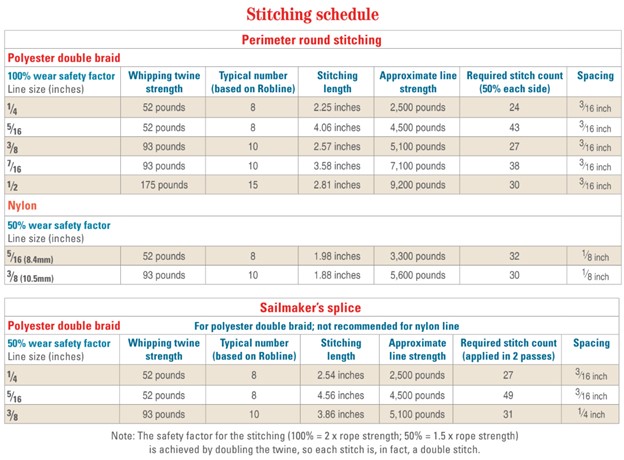
Two splicing methods are commonly used: the round-stitch method and the sailmaker’s method. (See the Stitching Schedule, below, for the required stitching length and stitch count.)
Round-stitch splice
This is the stronger method, easily as strong as the line with polyester rope, and nearly so with nylon. The angled stitches easily adjust and share the load. However, because the stitching lies on the sides of the splice, it is vulnerable to abrasion.
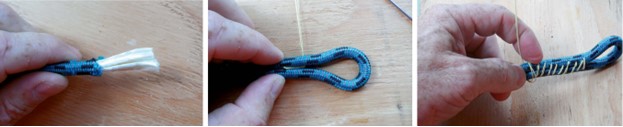
Pull out about 1 inch of core and trim it off. Pull the cover back over the core, melt the end of the cover, and press it flat.
Fold the eye, leaving about eight line diameters (not counting the cover-only portion) for stitching. The throat angle should not exceed 3:1.
Beginning at the throat of the eye, make round stitches on 3/16-inch centers, the needle penetrating the core but staggering the exact location.
Cross the rope at the tail, carefully stitching the tail down. The tail carries no load, but careful work makes for a smoother splice.
Continue stitching up the other side toward the throat. The number of stitches specified in the table includes a factor of 2x the rope strength to allow for chafe.
Seize the throat of the eye with at least 10 tight turns. This is to prevent the spreading force from over-straining the first few stitches.
Sailmaker’s sewn splice
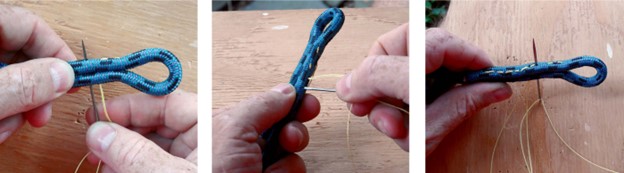
The advantage of this splice, and the reason it is commonly used by sailmakers, is that the stitches can be pulled below the level of the rope and are thus protected from wear. However, two disadvantages make this method unsuitable for line larger than 3/8 inch. First, after the first pass, the rope becomes so compressed that sewing the second pass is a terrible battle. Second, with larger rope diameters, it becomes impossible to squeeze enough stitching into a practical length of rope before the effects of stretch fatally weaken the splice, even in polyester. This splice is not acceptable for nylon rope — the stretch makes it very weak.
Fold the eye, leaving about 10 line diameters for stitching. The throat angle should not exceed 3:1.
Beginning at the throat of the eye, make basting stitches on 3/16-inch centers down the middle of the rope.
About 1/4 inch from the tail, seize the two lines together with 10 tight turns.
Stitch the line back toward the eye, filling in the gaps left by the basting stitches on the first pass. The total number of stitches required is given in the table.
Seize the throat of the eye with 10 tight turns to prevent the spreading force from over-straining the first few stitches.
Thimbles
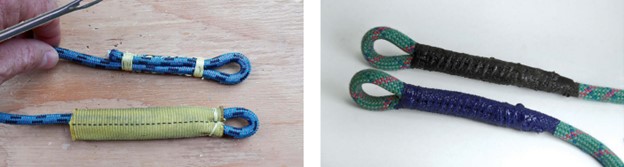
I’m not a big fan of thimbles because, when the rope stretches, they can shift under load and cut the line. A simpler method, which I have used for 30 years, is to thread tubular climbing webbing over the rope before forming the eye. This provides more than adequate chafe protection for most applications, as well as a little padding, and it will never cause collateral damage.
Coating the eye with Yale Maxijacket has also been shown in independent testing to reduce chafe by 5 to 10 times. I use it on splices, furler lines, and mooring lines.
Metal thimbles, though, are still the best protection when connecting to a rusty shackle.
Coverings
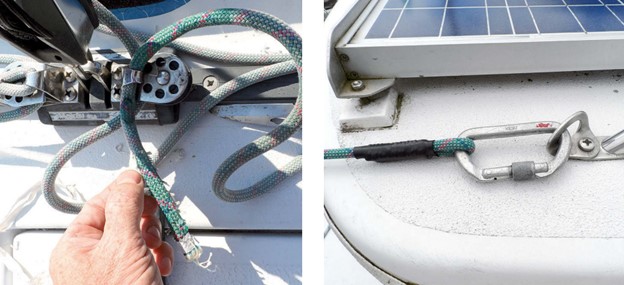
UV and chafe are the enemies. In applications with little exposure to chafe, such as becket splices in tackles and light-air spinnaker sheets, a wrapping of rigging tape is sufficient. Heat-shrink works well, but be very careful with the heat. For tough applications, such as genoa sheets, I like tubular climbing webbing (1-inch webbing fits splices up to 5/16-inch rope and 2-inch fits up to 5/8-inch rope). Although the webbing might not look salty, it has proven bulletproof and is easy to slide up to inspect the splice for wear. I use the same webbing for UV and chafe protection on lifeline lashings. You can sew up a leather cover, if you like the look. For UV protection only, I have used latex paint with success. It is used aboard many tall ships to coat seizings. Sewn connections can be just as strong as splices, though vulnerability to UV and chafe will always be somewhat greater. A combination of conservative stitch counts, heavy whipping twine, and coverings that protect against chafe can make the resulting splice safe and durable.
I do not recommend DIY sewn connections for safety-critical applications, because the required quality-control testing isn’t practical. A good knot is always better than a spliced or sewn connection in which you do not have complete confidence.
Drew Frye cruises Chesapeake Bay and the mid-Atlantic coast, until recently aboard his 34-foot catamaran Shoal Survivor, searching for out-of-the-way corners known only by locals. Last year, he went up a hull, and now sails his Corsair F-24 trimaran. A chemical engineer by training and a 40-year climber and 30-year sailor by inclination, he brings a mix of experiences to solving boating problems and writing about them.
Thank you to Sailrite Enterprises, Inc., for providing free access to back issues of Good Old Boat through intellectual property rights. Sailrite.com