It was not the best place for his rudder to jam hard over
Issue 120: May/June 2018
On the day I purchased my first boat, the 30-foot Shallow Life, my sailing experience amounted to only two days aboard someone else’s boat, tacking back and forth on a tiny mud-brown reservoir in Iowa. After just a few more days of sailing experience under my belt, my buddy Fred and I planned to sail Shallow Life more than 100 miles across the green-blue waters of Lake Michigan from Pentwater to Milwaukee.
“You can’t be captain,” Fred said. “You don’t know anything.” He had a point. I was a little intimidated and a little more scared, but I didn’t let on.
“Only three people have a say in who is captain,” I said. “The bank, because it’s their boat; the insurance company, because they’re going to fix what we mess up; and me — and while I haven’t actually called the bank or the insurance company, I’m pretty sure they don’t want to come along.”
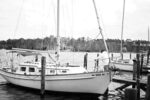
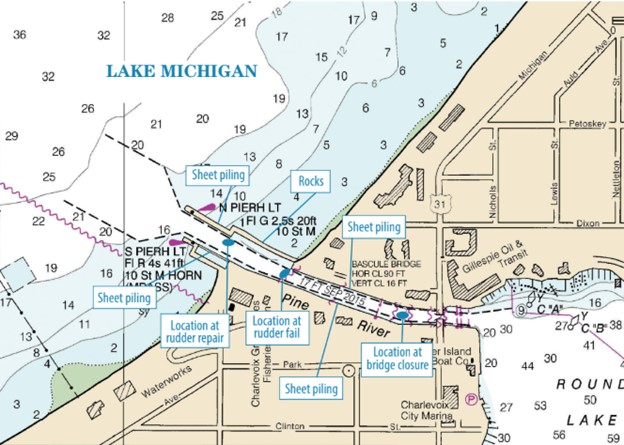
Seven years and 5,000 sea miles after that day, I was aboard my current boat, Indiscretion, a 42-foot Comar Comet 13, staring at the giant boulders that made up the north side of a narrow channel and the steel wall on the south side, feeling almost helpless and certain that both the bank and the insurance company were this time going to get involved.
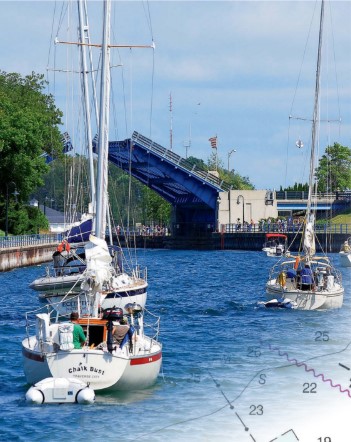
It was a beautiful Fourth of July weekend and I’d singlehanded Indiscretion from Frankfort, Michigan, to Charlevoix. Holiday crowds filled the nearby dunes and boardwalk trail. Boats of all sizes and types buzzed about the entrance to the half-mile-long channel leading to the marina on Round Lake. Having been there only once before, I couldn’t remember at what times the drawbridge opened, but a cluster of sailboats was circling the harbor entrance and so I figured it wouldn’t be long. When the first sailboat started in, so did the rest, trunk-to-tail like so many circus elephants. I was bringing up the rear and a light runabout stayed in my way, creating a roughly 50-foot gap between me and the sailboat ahead.
That was when the bridge tender decided road traffic was backed up enough and there was not time enough to let me through as well. The bridge came down, leaving Indiscretion trapped in a congested channel about 150 feet wide. A 2-foot swell rolled off the lake and down the channel, trying to board my swim platform.
No room to turn
It was time to turn around, but the volume of small-boat traffic was high and the courtesy level of holiday-weekend small-boat drivers so low that it made turning the boat around a bit problematic. Instead, I put her in reverse. The boat was backing well at idle speed, but waves were breaking on the stern. I’d made considerable progress along the channel, but when I reached out to put the transmission in neutral to slow us down, a wave grabbed the rudder and spun the wheel out of my hands. The rudder swung hard to port. When I attempted to turn the wheel back, it wouldn’t budge. It was jammed tight.
My 42-foot boat was now turned sideways in the channel with lots of traffic buzzing all around us, the wind and waves pushing us, and I’d lost steerage.
My first reaction was shock. Wide-eyed, I yelled, “Help!” to no one in particular as the powerboats continued to weave around me, music playing and smiles wide. I finally took stock of my situation and noted that neither the boulders on the north side of the channel nor the steel wall on the south provided anything safe to tie the boat to. And even if they did, the swells would surely tear the heck out of something important. My anchor wasn’t ready for me to drop it in a hurry, and I wasn’t convinced doing so wouldn’t make things worse.
I tried to clear my mind, but all I could do was visualize Indiscretion rising and falling onto the boulders until they punched a hole in her and she sank in front of the strolling tourists.
I picked up the VHF mic and spoke as calmly as I could. “Mayday. Mayday. Mayday. This is the sailing vessel Indiscretion on channel one-six.” The Coast Guard answered quickly and I answered their questions: nature of emergency, souls on board, the whole litany. They promised to send someone out to assist me.
I tugged hard on the wheel and then remembered the emergency tiller. I pulled it out and tried it, but it also wouldn’t budge. Keeping an eye on the sides of the channel, I thought to try and somehow use the engine to keep us clear. I put the transmission in forward for a few seconds to get away from the south shore. After a time, I put it in reverse to get off the north shore. When I shifted into forward, the boat turned to port. In reverse it also turned to port, just stern-first. It was wiggling its way out of the channel even though the wind and waves were trying to push it back toward the bridge. Great. If I could get out to Lake Michigan, I’d have enough room to go in circles until I found a solution. But there was a problem. Between me and Lake Michigan, the channel narrowed by about 30 feet. I was not sure my technique was going to work in there, and I was not looking forward to trying it.
In between each shift in gear, I had about a minute while the boat coasted. I used this time to run below to grab tools I needed to begin searching for the problem. In a short while, I’d removed about half of the panels and pieces necessary to access the various parts of the steering mechanism. I didn’t see anything amiss.
Then the promised help showed up and my heart sank.
Mixed feelings
It was the Coast Guard Auxiliary in a 24-foot day boat. Indiscretion is 42 feet long, weighs 24,000 pounds, and her rudder, almost as tall as I am, was locked full to port. I didn’t know if this boat could provide the power necessary. On top of that, the rescue captain’s crew was two teenagers in training, one of whom tried to tie a line to a bow light. The rescue captain straightened them out.
When the Auxiliary captain tried to tow Indiscretion from a midships cleat, both boats pulled toward the rocks. I watched the rescue captain’s eyes widen before they jettisoned the line. Then he radioed for assistance. Both of us were confident the Coast Guard’s 45-foot response boat would do the trick. In the meantime, I felt I had to do something to save my boat.
I asked the Auxiliary captain to tie his boat alongside mine, and to then try doing what I had been doing, just toggling between forward and reverse to keep our boats in the middle of the channel. I hoped this would give me time to work on finding and fixing the problem with my rudder.
As the two boats bounced up and down in the swells against each other, other boaters weaved around the two of us without a thought or a word. On the boardwalk, small groups strolled by only feet away from me. After a bit I realized the scraping and crunching I was hearing was Indiscretion’s hull abrading on the rescue boat. I shoved some fenders in between us and tried to encourage the teenage rescue crew. “Just stay with me here.”
Uncovering the problem
While the Auxiliary boat held us steady, I returned to looking for the problem. It was only when I removed the compass that everything became clear. Looking down inside the binnacle, I could see where the chain goes around a sprocket on the wheel’s axle and is connected to a cable. The connector was wedged between the inner wall of the binnacle and the sprocket. When the rudder was pushed fast to port, it hyper-extended the cable and caused the jam. I grabbed a hammer and a punch and gave the connector a tap.
“Fixed!” I yelled to my new heroes on the other boat, casually turning the wheel back and forth. I asked the rescue-boat captain to remain tied to Indiscretion.
“I’ll tow us up to the drawbridge,” I said. “It will appear to the bridge tender that you’re towing me and he’ll open the bridge right away.”
Once through the bridge and into the dead-calm waters of Round Lake, we separated. I took a slip in the marina and cracked a beer. Then the Coast Guard vessel arrived. They boarded for a courtesy inspection, asked that I sign some forms, and issued me a citation for not having a required ship’s bell aboard. Fortunately, there was no fine or fee for the call.
Before heading into town for some supper, I grabbed a small board out of my spare-parts bin and used it to make stops that will prevent the connector from ever wedging in place again.
I emerged relatively unscathed from this adventure, but perhaps a little wiser, and with a bunch of scratches on my boat’s starboard side and a ship’s bell (still in the box). I guess I also have a new perspective. If every day of sailing was a perfect one, I’d be bored and quit. If every day of sailing was like this one, I’d have the presence of mind to still quit. It’s the variety that fills the void in between delight and terror that’s kept me at it.
The takeaway
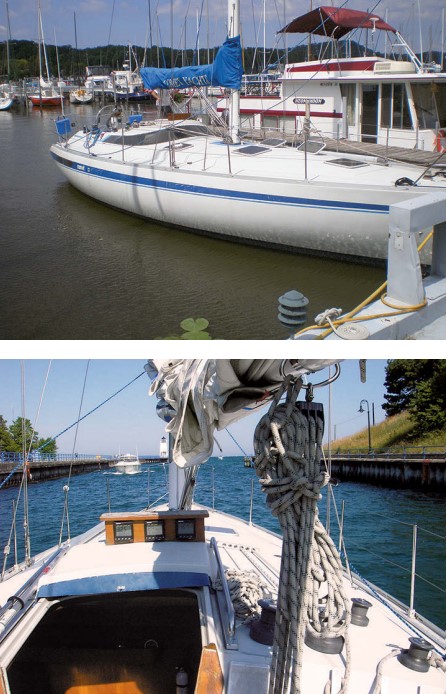
Despite the drama, everything ended well without my boat touching anything but the rescue boat. I carried tools aboard and had the knowledge I needed to find and fix the problem, even under stressful conditions. In retrospect, anchoring would likely have made addressing the problem less stressful and less risky. Regardless, an anchor should always be ready to be deployed, especially when maneuvering in tight quarters. Shifting into reverse in following seas was risky; I’m lucky the damage to the steering wasn’t greater. Calling Mayday should be reserved for more dire emergencies. I’m now more knowledgeable about when to use Sécurité, Pan-Pan, and Mayday.
As a lesson, rather than follow the crowd, I should have checked the opening sequence by referring to my charts or Coast Pilot 6 (or by asking on VHF) while in the relative safety of open water. If I had known the opening times, I would have chosen my time to enter the channel and wouldn’t have been last in line.
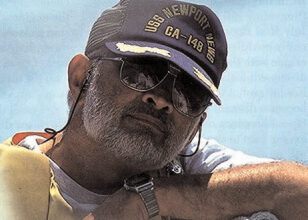
John Gaich sails Indiscretion, a Comar Comet 13, out of Sturgeon Bay, Wisconsin.
Thank you to Sailrite Enterprises, Inc., for providing free access to back issues of Good Old Boat through intellectual property rights. Sailrite.com