An update of a longtime favorite
Issue 120: May/June 2018
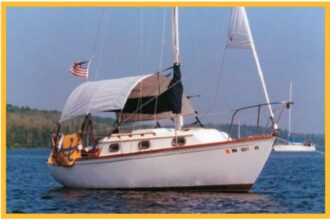
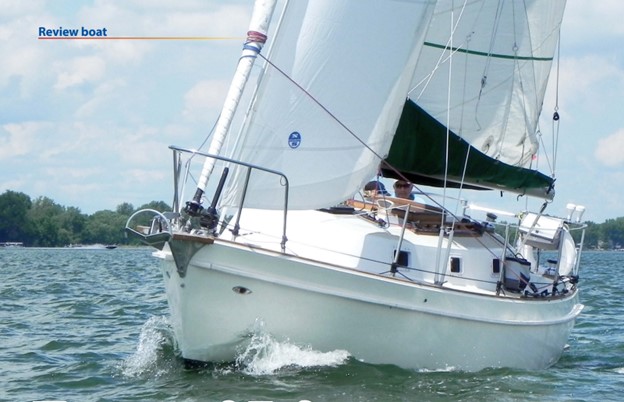
I came upon this classic good old boat at Mazanet Marina, up the Yahara River in Madison, Wisconsin, but I was puzzled as to what it was. Andy Jackson solved the mystery when he responded to the note I left in the cockpit: she’s a 1978 Tartan 27-2 named NorthStar. Andy is a retired mechanical engineer (he worked with cheese-making equipment), and this shows in the modifications he’s made to NorthStar. His wife, Barbie, is a retired IT project manager. Andy learned to sail from his father, starting with a sailing canoe about 50 years ago, and came to this cruiser from the world of racing A- and E-class scows on Lake Mendota. Barbie learned to sail on an I-20 scow. Before NorthStar, which they’ve owned for 10 years, they owned a Beachcomber 25 cat ketch.
After acquiring NorthStar, Andy spent three years making upgrades to her before trailering her to the North Channel of Lake Huron, where she remained for four seasons. After those wonderful summers, NorthStar returned to Madison. Andy and Barbie brilliantly fashioned all sorts of mechanical things, and even made a cuddy under the starboard settee for their pet cat.
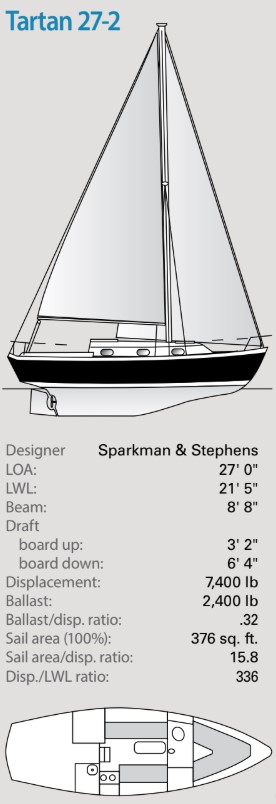
The Tartan 27-2 was a major refinement of the earlier Tartan 27, which is much more commonly found. While it’s not quite the same boat, I’ll report on the earlier boat for much of the design description and details, and where appropriate I’ll point out the differences on the 27-2. Seen side by side, they do not look like siblings.
History
In the era of molded-plywood boats, Douglass and McLeod built the Thistle, International 14, Great Lakes 21 (now known as the International 21), Flying Scot, and Highlander. Being Scotsmen, when they partnered with Charlie Britton in 1960 to build a new fiberglass 27-foot auxiliary cruising sailboat, they naturally gave it, too, a Scottish handle — Tartan. Designed by Sparkman & Stephens and built by Douglass & McLeod Plastics in Grand River, Ohio, the small yacht made its debut in 1961. Following a fire in January 1971 that destroyed the production facilities, Douglass & McLeod Plastics sold its interest in the Tartan 27 to Britton, who then formed Tartan Marine. Later, as the company grew through an expanding line of ever-larger boats, it opened another production facility in Hamlet, North Carolina. Tartan consolidated its operations back in Ohio during the 1980s downturn in yacht sales.
As its line of performance cruisers expanded, the company moved to Fairport Harbor, Ohio, in 1996 and has remained there. Despite several changes in ownership through the years, the Tartan line never lost its loyal customer base. In 1997, Tartan acquired the C&C brand, but 10 years later sold it to another company. Tartan Marine is still building boats using the latest in composites technology, but it all started with the pioneering Tartan 27 design 57 years ago.
Design
The Tartan 27 (T27) is typical of boats built in the early 1960s to conform to the CCA (Cruising Club of America) rule, with long overhangs and a short waterline, moderate displacement, long keel, centerboard, shallow draft, aperture propeller, keel-hung rudder, and slack bilges. CCA boats, like the Tartan 27, Pearson Triton, and Hinckley Bermuda 40, are the definition of “classic plastic.” They have a seakindly motion but are quick to put the rail in the water if not reefed early. They are designed to sail at 20 to 25 degrees of heel, which lengthens the waterline and increases speed, but some sailors may find this uncomfortable. Heeling can also induce weather helm. A few Tartan 27s were built with the yawl rig, which received a favorable rating under the CCA rule.
The T27’s production run of 712 boats ended in 1980 (with a one-year time-out for the 1971 fire). The first of the major changes came in 1966, when the ballast was increased by 350 pounds and encapsulated. In 1973, the deck was redesigned with a longer cockpit and a bridge deck. The T27-2 appeared in 1977 with the sheerline raised by 4 inches, a less boxy-appearing cabin trunk all on one level, and a more traditional interior layout. The review boat, hull number 652, is this version, of which 63 were built. However, the upgrade eliminated the attractive teak coamings, prompting some owners to install a teak cap.
At first, the auxiliary was the famous Atomic 4 gasoline engine. Beginning in 1975, the Farymann 12-horsepower single-cylinder diesel was made available. Owners seem to feel the Atomic 4 is fine but find the T27 underpowered with the Farymann.
All Tartans are well-built boats. The hull of the T27 is a very solid laminate of 5/16- to 3/4-inch-thick woven roving and mat. The deck is balsa-cored with plywood substituted at hard points. The hull-to-deck joint is an outward-turning flange fastened with screws that also secure a teak rubrail in place. While this joint might be difficult to repair if damaged, it does not have a reputation for leaking. However, some owners report the teak rubrail on the earlier 27 is prone to breakage. The T27-2 has a vinyl rubrail, which is less susceptible to damage but much less attractive. The mast is stepped on the keel, but the step is prone to deterioration. During the production run, the fuel and holding tankage varied. Andy replaced a “three-day” holding tank with a “two-week” tank. The centerboard on all but the earliest boats was a fiberglass-encapsulated steel plate, which had plenty of issues. The T27-2 cabin has a fiberglass furniture pan and is trimmed throughout with solid teak and teak-veneered panels.
Deck
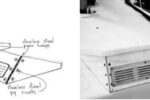
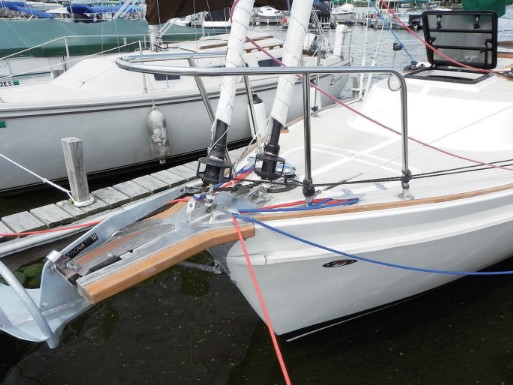
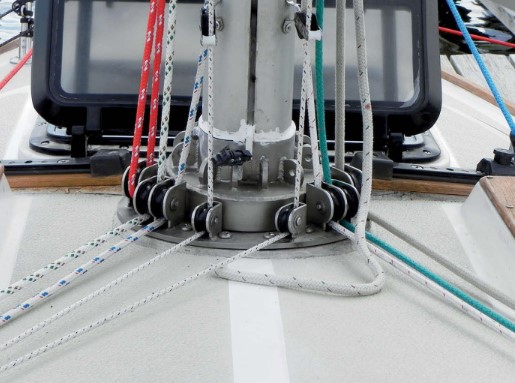
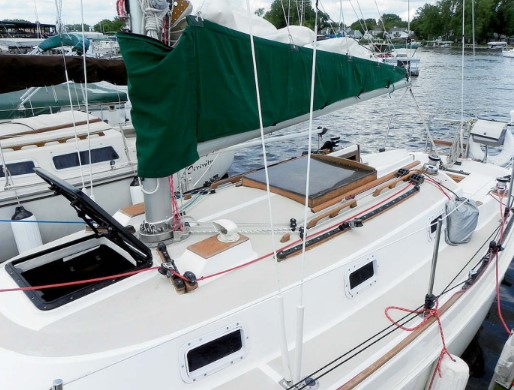
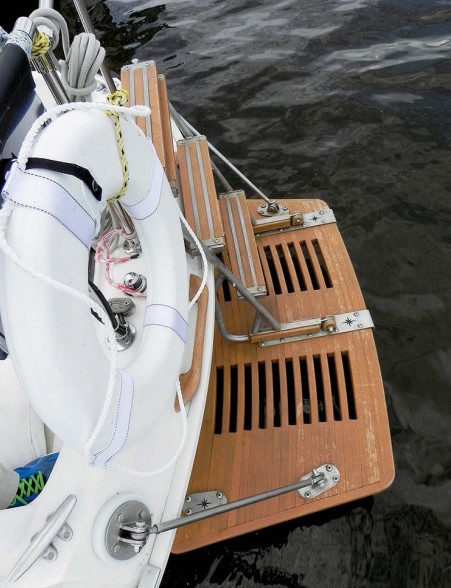
Because Andy has made many modifications, NorthStar’s deck layout is far from original. The custom-fabricated anchor platform looks like it belongs here and could fool one into thinking all Tartan 27-2s have them. Aft of that is a windlass Andy has added and a shallow anchor locker with a washdown hose. Single lifelines run between stainless steel bow and stern pulpits and are supported by substantial stanchions bolted to the deck inboard of a teak-capped toerail. Long teak handholds on the cabintop aid crew negotiating the adequate sidedecks. Overall, the non-skid on deck is quite good, but Andy added a massive eight-block-plus turning plate and 10 line stoppers which, while moving line-handling to the cockpit, have put a lot of lines on the cabintop. A large opening hatch forward, complemented by six opening portlights, ensures ventilation and light are plentiful belowdecks.
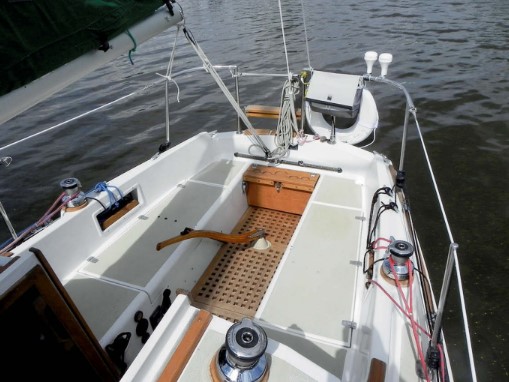
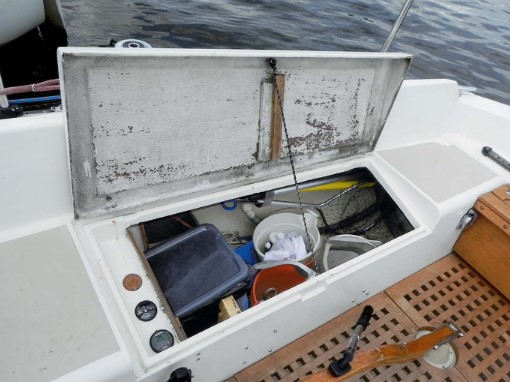
Teak dropboards close off the companionway, but none of the T27s has a sea hood over the hatch slide. The cockpit is large with wide and long seats without a lazarette aft (older 27s do have a lazarette). The tiller rises from the cockpit sole about two-thirds of the way aft and takes up considerable space. Engine controls are to starboard and there is a manual bilge pump to port above a teak grating. Under the seats are two large lockers (that may leak a bit); between them, at the aft end of the cockpit, Andy built a wooden locker to hold three small propane tanks.
The centerboard pendant is just aft of the companionway. I did not inspect the cockpit drains (they are under the grating) but Andy says the T27-2 has two full-size scuppers. Some reports indicate earlier boats have two on the small side that join into one outlet. One can make a case that smaller yachts should have larger scuppers because a cockpit full of water is a more serious matter in a smaller boat.
Rig
The T27 has a single-spreader masthead sloop rig, to which an inner forestay has been added on some boats. Upper shrouds and single lower shrouds attach to chainplates mounted just inboard of the toerail. NorthStar has a genoa and a jib, each on its own roller furler, and is rigged for an inner staysail, although the Jacksons consider this for emergency use only. Andy has added long tracks for the sheet leads for both the headsails and upgraded the winches to self-tailing Lewmar models.
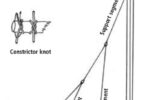
The mainsail is fitted with the Harken Battcar System, a downhaul, jiffy reefing, and lazy-jacks with a sail-pack cover, and sheets to the boom end with a short traveler. To maximize performance with the large mainsail and small foretriangle of the standard T27, genoas of up to 176 percent are recommended for racing.
Accommodations
Earlier T27s had a layout that some owners did not consider very comfortable. The redesigned cabin, deck, and hull of the 27-2 resolved several issues.
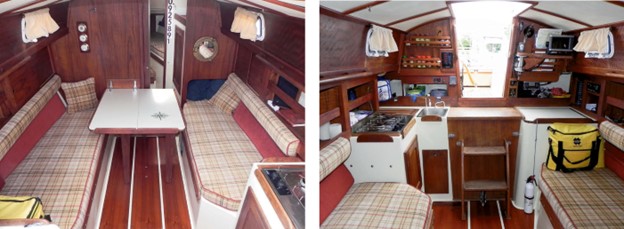
The cabin is attractive but tight. A well-appointed standard-size V-berth forward and a just-big-enough head to port with a hanging locker facing it are all closed off by a somewhat balky sliding door.
The saloon has a traditional layout with long settees on either side, storage behind and below them, and a nice bulkhead-mounted folding dining table. Bulkheads are teak-veneered plywood and should be inspected for water damage at their bases. The starboard settee slides out and, supported on legs, offers a larger berth space. The port settee is adequate as a berth or for lounging, where the starboard settee is a bit shorter. There is no quarter berth, but there is a navigation station aft to port with an icebox beneath it.
Headroom is 5 feet 10 inches, measured by my standing just clear of the overhead. The overhead is a hard board with teak strips and no handholds; however, there are two stout handholds on the carlings between the portlights on both sides of the saloon.
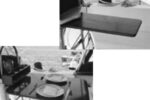
Andy has installed new portlights, as well as shorepower and a GPS on a swing-out mount. He has also fabricated boards that span between the settees, making for a very large berth with the help of some additional cushions.
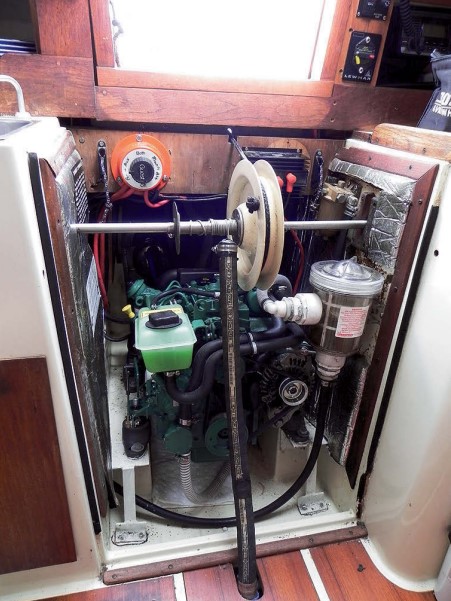
Access to the engine, bilge, and the centerboard pivot and pendant is quite good.
Under way
After taking photos of NorthStar under sail from the beautiful powerboat of Captain Don Sanford, I left him to climb aboard our review boat for a test sail — from the rough ride of the skiff to the smooth, sublime ride in NorthStar in one big step.
Although it was the first of July, it was Andy and Barbie’s first sail of the season. They set the mainsail with a reef and rolled out the working jib. With the mainsail eased a bit and the jib sheeted tight, the boat tracked well with a neutral helm. In puffs there was some weather helm. Due to NorthStar’s shoal keel, they’ve found they must reef in winds above 10 knots. We had that and then some, with 17 knots showing on the anemometer/direction indicator, which I referred to often, as I could not reliably feel where she was pointed.
With a trailing-edge rudder on a long keel and a worn tiller-head fitting (a common problem on T27s), there was a certain vagueness to the handling at times. This was not a design problem so much as an old-age problem. I did not expect crisp handling, but she did not demand much effort either, never requiring me to use two arms on the tiller. Off the wind with the genoa rolled out, she tracked well and could probably be set to sail on her own without much tiller input.
While Andy steered, I stretched out on a cockpit seat. Wide and long, it earned a Penticoff Napability Index (PNI) rating of 5 (on a scale of 1 to 5) for great napping potential. The seats are so wide that, when the boat is heeled, the water rushes by very near at hand, almost disconcertingly so. Barbie, on the high side, braced herself easily between the seats, but only the tallest will have a backrest to lean against while braced due to the width of the seats. Such is often the downside of a PNI 5.
Barbie’s favorite black “Canada” hat blew off her head. We immediately went into a man-overboard drill. Andy was at the helm, while I acted as spotter and fishnet operator. It took us two passes to snag the hat, with NorthStar performing well during the exercise. We then motorsailed up the channel to their marina.
Motoring was straightforward. Although I did not get the chance to put NorthStar through her paces under power, I would expect that going ahead is a breeze, but backing a difficult guessing game typical of this type of hull. I did note turbulence against the rudder from the stopped prop while under sail. That slight vibration felt at the tiller could be eliminated with a feathering prop, or by marking the shaft so the prop blades can be aligned with the keel. There is plenty of room to install a wheel, and some T27s have been so fitted. If you were to sit to leeward of the wheel, you would be quite intimate with the water flowing by.
Things to look for
The tiller-head fitting may be the most common and annoying problem with the T27. More than likely, any deteriorating mast step has been fixed by now, as it can cause leaks and rigging problems. Through-hull fittings are another potentially serious problem. They are brass nipples glassed to the inside of the hull with gate valves screwed on to them. Give them the heave-ho. Delamination of the balsa-core deck is a frequently cited problem, particularly with leaks around the chainplates. Also check for proper backing plates under hardware. Gelcoat fading and cracking will likely call for a complete paint job.
Because there are no bearings in the rudder tube, the rudder stock feels sloppy. External bearings may solve this problem.
The centerboard pivot can wear, possibly to the point that it breaks, leaving the board dangling by its pendant and possibly being lost. The pendant, too, is prone to wear in its guide tube. This calls for a pre-purchase inspection, best done on the hard.
Conclusion
The Tartan 27-2’s inherent strengths, style, and modest performance make it a good candidate for a fixer-upper. Properly upgraded, it is capable of offshore passages. The Tartan 27-2 offers the best of both worlds — modernized, but with plenty of classic charm, although some owners are of the opinion that the better working deck of the early boats was sacrificed to gain more cabin space.
You won’t be sailing an orphan if you join the Tartan world. There is strong regional support for racing and cruising as well as good technical resources, and the Tartan 27 Handbook, compiled by four members of the Chesapeake Bay Tartan Sailing Club, is renowned for its completeness in covering all aspects of ownership and is considered a must-have for anyone buying a T27.
Prices vary considerably. T27s were expensive boats new; most are still afloat and prized by their owners. Boats with the Atomic 4 sell for less than those with diesels. What you pay probably will depend on how much work you are willing to put into the boat. Fixer-upper boats can fetch less than $6,000, while reconditioned, modernized, and ready-to-go boats like NorthStar can be more than $14,000. Newer boats don’t necessarily bring a higher price. The $14,000 listing was for a 1969 T27, while two 1979 T27-2s were listed at $6,800 and $9,000.
Allen Penticoff, a Good Old Boat contributing editor, is a freelance writer, sailor, and longtime aviator. He has trailer-sailed on every Great Lake and on many inland waters and has had keelboat adventures on fresh and salt water. He owns an American 14.5, a MacGregor 26D, and a 1955 Beister 42-foot steel cutter that he stores as a “someday project.”
Thank you to Sailrite Enterprises, Inc., for providing free access to back issues of Good Old Boat through intellectual property rights. Sailrite.com