From Carbon Wings to Polytarp Lugs and Beyond: The Complete Guide to What’s Flying in 2025
The wind hasn’t changed, but the cloth catching it has never been more diverse. On one marina dock you’ll find an IMOCA 60 with a molded 3Di square-top mainsail that cost more than a Porsche; two slips over, a teenager is raising a $120 flat Utility Dacron balance lug on a plywood Goat Island Skiff that will outsail half the fleet. This is the beautiful contradiction of modern sailing. Here, in one place, are all the sails you’ll see on the water right now—explained, photographed in the mind’s eye, and priced like contraband.
PART I – THE CARBON & KEVLAR CIRCUS
The Grand-Prix & Superyacht Wardrobe
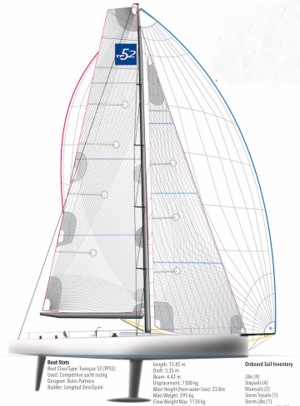
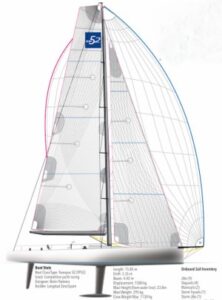
Walk any TP52 or Maxi pontoon and you’ll hear the whisper of names that sound like fighter jets: 3Di RAW 860, Helix Structured Luff, and Cableless Code 65. These aren’t sails; they’re aerospace components that happen to catch wind.
- Square-top mainsails – Once exotic, now mandatory. Pin-heads are for classics and cheap charter boats.
- Structural furlers – North Helix, Doyle Cableless, Quantum iQ. The luff rope is gone; torque is carried by the fabric itself.
- Code Zero / Code 55 – The reacher that broke racing. Flat as a board, twice the size of a genoa, flown from a 3-meter carbon sprit.
- Wing sails – AC75 foiling monohulls and SailGP F50 cats use double-skinned rigid wings taller than a six-story building. Adjust camber with a fingertip; accelerate like a Tesla Plaid on water.
Typical TP52 inventory cost (2025): $380,000. Yes, the sails alone.
PART II – THE CRUISING IDEAL
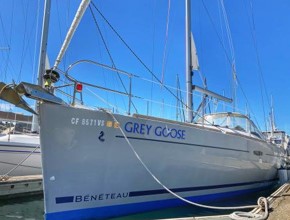
Open a Beneteau Oceanis brochure: in-mast furling main + 108 % furling genoa. Done. But the smart money buys performance cruisers (J/45, ClubSwan 50, X-Yachts) with:
- Full-batten square-top mains (extra 8 % area up high, no backstay flicker).
- Self-tacking blade jibs on curved tracks.
- Top-down furling A2 asymmetrics (furl round a torsion cable, or a “structural membrane”, from the top down) that a couple can launch in 45 seconds.
Average 42 ft. cruiser sail package: $22,000–$28,000 (available from sailmakers like Doyle Stratis, North Xi, or Quantum Fusion).
PART III – SAILS FOR “THE REST OF US”
What 99% of the World Actually Sails —Bermuda Triangle Made with Carefully Engineered Dacron Fabric – often sewn at home from a kit
Sewn, computer shaped Dacron panels with taped edges are the norm. They are relatively inexpensive and still highly efficient. Indeed, these sails are often required by one design fleet associations for the sake of keeping costs down and for the sake of fair, competitive, sailing. Foresails are hanked to their stays or fitted with “continuous support tape” at the luff and run up a groove in a furler. Mainsails are on mast tracks or bolt roped luffs are slipped up slots on the aft side of masts. This is still the dominate segment of the sail market.
Price: $500 to $1,000 or so each.
Orange Fabrics That Save Lives – also often kit based
Every blue-water boat still carries two neon relics made one panel at a time just like the sails above:
- Storm jib (13 % LP, 6 to 8 oz. Dacron, hanked in place on a forestay).
- Storm trysail (separate track, triple-reefed profile).
Price: under $1,100 each. Worth every cent when the fetch turns black.
PART IV – THE BACKYARD REVOLUTION
Where $500 Beats $50,000
While the carbon crowd obsesses over 0.2-knot gains, an army of plywood philosophers is quietly winning the joy-per-dollar war. The variety of sailing rigs espoused in recent years is really astounding. Phil Bolger’s books, 100 Small Boat Rigs and 103 Sailing Rigs “Straight Talk” are two examples – note that all this variety is mostly minor variations on the primary themes described below. The overriding goal is always the same: simplicity and economy. To ignore this crowd would be a grave disservice to the sport we all enjoy. These rigs distribute stress so evenly in the sail that many jumped to the conclusion that tarps from the local hardware store could now be used for sails. Michael Storer still has instructions for tarp sails in his plan books. I know because I have just started work on his Oz Goose. I intend to give the MC Scows on Lake Maxinkukee here in Indiana a run for their money. But I will not be using a tarp for my sail. Almost anyone with experience has concluded that the savings obtained with tarp sails do not make up for the short useful life. The current vogue is utility Dacron sailcloth, often intended as sailcloth for cruisers because it is soft, not engineered, and, thus, relatively inexpensive. I will be using 4 oz. Supercruise from Sailrite. It is 58 inches wide and costs just $14.95 a running yard.
The Lug Family – Still Unbeatable After 2,000 Years
| Sail | Best For | Legendary Boats* | 2025 Price (new) |
| Balance Lug | One-person efficiency | Goat Island Skiff, Welsford Pathfinder, Oz Goose | $650–$950 |
| Standing Lug | Lazy coastal cruising | Drascombe Lugger, Oughtred Acorn | $800 |
| Dipping Lug | Windward grit (if you like exercise) | Traditional Cornish crabbers | $1,200 |
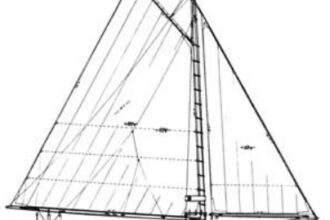
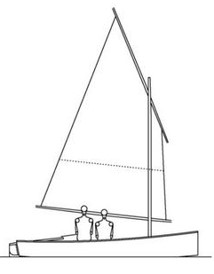
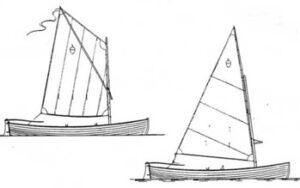
*These boats often offer two or three rig choices of distinctly different types. Representative types are pictured below.
Sprit, Leg o’ Mutton & Gunter – The Minimalist Trinity
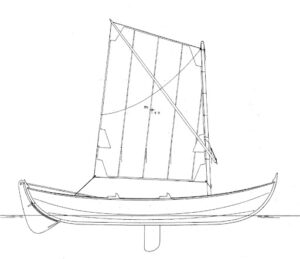
- Boomless sprit – The Acorn above, Oughtred Elf, Bolger Gypsy. Spars store in hull.
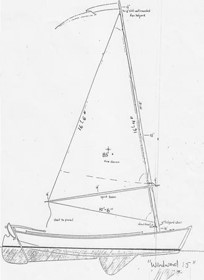
- Leg o’ Mutton – Melonseed skiffs, Stambaugh 15’ Skiff, one halyard, one sheet, zero stays. Sets in 8 seconds.
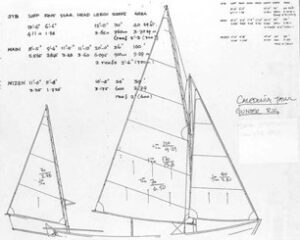
- Sliding Gunter – Caledonia Yawl, Core Sound 17. Looks Bermuda, trailers like a dinghy.
Junk Rig – The Cult That Refuses to Die
Annie Hill sailed around the world twice under a flat-panel Chinese junk rig that reefs by dropping a grocery bag. Modern junk sails use cambered panels sewn on a $179 Singer from Walmart. Zero flogging, instant reefs, and you can read a book while gybing.
Light Weight Utility Dacron – The Anarchist’s Edge
Yes, Virginia, flat sheets of inexpensive Dacron still win races with $300 Utility Dacron lug sails (home sewn and rigged with hardware from the local hardware store). Such sails are so durable that they can be used to cross the Atlantic in a large boat with sufficient preparation.
There follows an AI generated chart listing MC Scow sails from major lofts:
| Loft | Mainsail Model/Design | Price (USD) | Fabric Details | Key Notes |
| North Sails | Rocket (flatter AP for lighter crews/heavy air) | $1,564 | 3.8 oz NPC Cross-Cut Dacron | Radial head/clew; includes battens, numbers, visibility window; class leader for pro racing. |
| UK Sailmakers | PS1 (all-purpose) | $1,555 | Dimension-Polyant Dacron | Radial head/clew; versatile for varied conditions and sailor weights. |
| Mad Sails | AP (all-purpose) | $1,420 | Dimension-Polyant Dacron (likely 3.8-3.9 oz ripstop) | Hand-sewn; designed for average-weight sailors in mixed winds. |
| Schurr Sails | Racing (AF4 crosscut) | $1,295 | 3.8 oz super-hard Dacron | Fuller cut option available; budget-friendly entry for racing. |
| Quantum Sails | Standard Racing | ~$1,500 (quote-based) |
Dacron (3.8 oz equivalent) | Focus on easy mode changes for unstable breezes; exact price requires loft quote. |
Admittedly, these are finished sails. But the price of an Oz Goose Balance Lugsail kit from Sailrite (about 2/3rds the size) is still pleasantly low: $281.74*. Add another $100 if tooling to set #4 and #0 spur grommets is required. A finished Oz Goose sail by “Really Simple Sails” from Duckworks.com would be $561 plus shipping.
*Sailrite uses a “current cost basis” to set prices – that is one reason why the yearly Sailrite Catalog is no longer published. As a result this price may move up or down slightly over time.
THE 2025 INVENTORY CHEAT SHEET
| Boat Type | Sail Package (real-world 2025 examples) | Total Cost (USD) |
| IMOCA 60 | 3Di square-top + J0–J3 cableless + 4 kites | $1.2 million |
| TP52 | 3Di RAW square-top + Helix J1–J4 + Code 55 | $380,000 |
| J/111 club racer | Carbon/PX square-top + blade jib + A2 | $48,000 |
| Beneteau Oceanis 46 | In-mast Dacron + furling 110 % genoa + gennaker | $19,000 |
| Goat Island Skiff | Balance lug (polytarp or Dacron) | $120–$950 |
| Oughtred Ness Yawl | Standing lug + mizzen lug (cream Clipper canvas) | $1,600 |
| Junk-rigged Coromandel | 3-panel cambered junk (DIY or Slack Sails UK) | $1,400 |
| Melonseed skiff | Leg o’ Mutton sprit (Egyptian cotton or PX) | $550 |
THE FUTURE IS ALREADY HERE
While we were busy watching foiling catamarans hit 54 knots, a 19-year-old in Tasmania just launched a 14 ft. balance-lug raid boat that cost $2,300 total and will sail to New Zealand next summer. The wind doesn’t care if your sail was molded in Minden, Nevada, or sewn on your grandmother’s kitchen table. It only cares about shape, angle, and the grin on your face.
So raise whatever you’ve got—carbon wing, orange storm scrap, or a blue tarp that still smells like the hardware store. The water is wide, the breeze is free, and every single one of these sails will get you home.
Fair winds and full sails—see you out there.
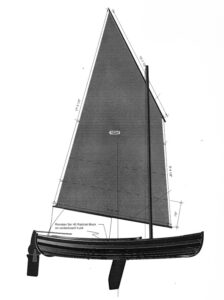
A balanced lug rig is a versatile and simple traditional sail configuration commonly used on small boats like dinghies, skiffs, and canoes, characterized by a quadrilateral mainsail attached along its upper (head) edge to a diagonal yard (a spar angled upward from the mast) and along its lower (foot) edge to a horizontal boom that extends forward of the mast, with the tack (lower forward corner) positioned well ahead of the mast to create a “balanced” center of effort that pulls the boat forward rather than twisting it around the mast. The spars lengths are generally about 37% forward of the mast although this is flexible and often fine-tuned for circumstances. This setup allows for easy single-handed handling, as the sail can be quickly raised, lowered, or reefed without complex fittings—typically using just a halyard, downhaul at the tack (which tensions both luff and leech for better twist control), and sheets at the clew—while the forward boom section provides self-tending qualities during tacks without needing to dip the yard around the mast, unlike a dipping lug rig. (More examples of the balanced lug in the Good Old Boat sail plan data base: Argie 15, Arctic Tern Lug Yawl, Bolger Chebacco, Caledonia Yawl, Goat Island Skiff, Herreshoff 11’6” Dinghy, Nss Boat, Ness Yawl, and Welsford Pathfinder.)
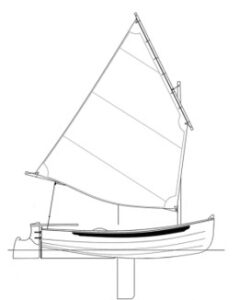
A standing lug rig is a traditional, low-tech sail configuration widely used on small boats such as dinghies, skiffs, and fishing vessels since the early 19th century, featuring a quadrilateral mainsail (lug sail) attached along its upper (head) edge to a diagonal yard (a spar secured about 35% aft of its forward point (to be adjusted as desired) and angled upward from near the masthead) and along its lower (foot) edge to an optional horizontal boom, with the tack (lower forward corner) fastened at or very close to the mast—allowing the yard to remain “standing” in position during tacks without needing to be dipped or swung around the mast, unlike a dipping lug rig. This setup typically employs a simple downhaul line from the tack to tension the luff directly against the mast, a halyard to hoist the yard, and sheets at the clew (lower aft corner) for control, often with a sprit boom or vanging lines to extend and flatten the foot for better shape; the rig is unstayed (no shrouds or forestay), making it lightweight and easy to step or unstep single-handedly. Compared to a balanced lug (where the tack is positioned forward of the mast for neutral helm and self-tending qualities), the standing lug can induce more weather helm (tendency to turn into the wind) due to the sail’s center of effort being farther aft, but it offers superior upwind efficiency through tighter luff tension and less twist, plus versatility off the wind with the yard’s overlap providing power without excessive heeling—ideal for short-handed coastal or inland sailing in moderate winds. Its enduring appeal lies in the rig’s forgiving nature, minimal hardware requirements (often just rope and wooden spars), and quick reefing via the downhaul, though it may require more frequent trimming when tacking to maintain speed. Note that the sail may be designed with the yard to be hoisted nearly vertical making the sail “look” triangular. (More examples of the standing lug in the Good Old Boat sail plan data base: Deer Isle Koster, Navigator, Scamp, Sea Hen, and Whilly Tern.)
A dipping lug rig is a traditional, low-tech sail configuration historically favored on small working boats like fishing vessels, skiffs, and yawls since the 18th century, featuring a quadrilateral mainsail (lug sail) attached along its top (head) edge to a long diagonal yard (a spar angled upward and extending significantly forward of the mast) and along its lower (foot) edge to a horizontal boom, with the tack (lower forward corner) positioned well ahead of the mast base to maximize power from the sail’s large forward projection. The rig is typically unstayed (no shrouds or forestay), using simple ropework: a halyard to hoist the yard, a downhaul or throat hauling line at the tack for luff tension, and sheets at the clew (lower aft corner) for control, often with a peak halyard for fine-tuning the yard’s angle and optional reef points for quick reduction in sail area. Its defining characteristic is the “dipping” maneuver during tacks or gybes: as the boat comes through the wind, the sail must be fully lowered (dipped) to swing the yard and sail around the forward side of the mast to the new leeward position, then re-hoisted— a process that requires coordinated crew effort but keeps the rig clear of the cockpit when dropped. This contrasts with the standing lug (tack at the mast, no dipping needed but more weather helm) or balanced lug (tack forward with self-tending boom, easier handling but less power), offering the dipping lug superior upwind efficiency and the highest drive for its sail area due to the extended yard overlap, though at the cost of high sheet loads akin to a genoa and labor-intensive maneuvers that demand a skilled, multi-person crew. Ideal for coastal or inshore work in moderate winds, its enduring appeal lies in the rig’s affordability, minimal hardware, and raw power for small boats, though modern adaptations may include roller reefing to mitigate the tacking hassle. There is not one example of the dipping lug rig in the Good Old Boat sail plan database although Ian Oughtred drew one for the Tammi Norrie but it is paywall protected – plans must be purchased to see it.
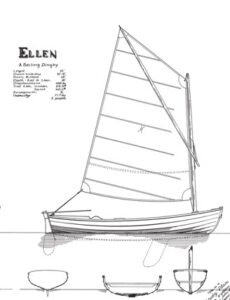
A sprit rig is a traditional, minimalist fore-and-aft sail configuration dating back to at least the 2nd century BC in the Aegean Sea, commonly used on small working boats, dinghies, skiffs, and traditional craft like Thames sailing barges, featuring a four-sided mainsail (spritsail) supported vertically by a short mast along its forward luff and diagonally by a spar called the sprit (a lightweight pole angled from the mast to the sail’s upper aft corner, or peak) to extend and tension the leech without needing a gaff or upper boom. The sail’s four corners—throat (upper forward), peak (upper aft), clew (lower aft), and tack (lower forward)—are typically secured with simple ropework: a halyard or throat halyard hoists the sail and sprit from the mast, a downhaul tensions the tack at the mast base, and sheets control the clew, while the foot may be attached to a boom for flattening or left loose-footed for easier reefing and flexibility. The rig is unstayed (no shrouds or forestay), allowing quick stepping/unstepping of the mast and sprit, often bundled together with the sail via a brail line for storage and deployment in under a minute—ideal for single-handed sailors. Compared to lug rigs (which use a yard roughly parallel to the boom), the sprit rig offers a flatter sail shape for better upwind performance with less twist, while resembling a simplified gaff rig (its evolutionary descendant) but with fewer spars and easier tacking—no dipping or swinging required, just sheet adjustments—as the sprit flexes to depower in gusts and provides self-vanging action when eased. Its virtues shine on short-masted small boats, enabling a disproportionately large sail area (e.g., for windward work or planing) with low sheet loads, quick reefing by sliding the sprit down the mast, and versatility for adding a jib or mizzen in yawl setups, though it may require vangs or snotters (adjustable lines) for fine-tuning the sprit’s angle in heavy air to avoid excessive heel. Enduring for coastal and inland use due to its affordability, minimal hardware, and forgiving nature, the sprit rig remains popular in modern recreations for its balance of power, simplicity, and historical charm, often praised for setting flatter than lugs while being safer and handier than gaffs on modest craft.
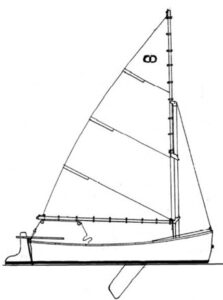
A sliding gunter rig (also known simply as a gunter rig) is a traditional fore-and-aft sail configuration developed in the 19th century—named after British navigator Edmund Gunter—and widely used on small to medium working boats like whaleboats, dinghies, and yawls, featuring a triangular or quadrilateral mainsail supported by a short mast along its forward luff and am upper spar (gaff or yard) that is raised at a variable angle to the mast (from a little above horizontal to vertical) and slides up and down the mast’s full length via rings, parrel beads, or wooden jaws attached to the gaff, effectively mimicking the hoist of a taller bermudan mast while retaining gaff-rig elements for a compact, efficient sail plan. The rig employs simple ropework: a peak halyard hoists the gaff vertically along the mast (often via a sliding shoe or wire track for larger boats), a throat halyard or downhaul tensions the lower luff at the mast base, and sheets control the clew (lower aft corner), with the foot typically loose or attached to a short boom; reefing is streamlined by lowering the gaff partway down the mast to reduce sail area without tilting or complex adjustments, making it safer and quicker than a traditional gaff where the spar pivots at the masthead. Compared to a standard gaff rig (with a pivoting gaff for higher peak angle but more cumbersome lowering) or a bermudan sloop (taller fixed mast without gaff overlap for roach), the sliding gunter offers a shorter overall mast height for easier trailering or storage while delivering comparable sail area and drive—especially upwind, where the upper gaff section generates extra power like a topsail—plus neutral helm balance and versatility for adding a jackyard topsail or jib in yawl setups. Its enduring appeal for coastal or inland use lies in the rig’s low-tech simplicity (unstayed mast, minimal hardware), forgiving handling in moderate winds, and quick setup/reefing for single-handers, though it may require vangs or parrel adjustments to prevent gaff lift-off in gusts and can induce slight weather helm if not tuned properly. (More examples of the sliding gunter in the Good Old Boat sail plan data base: Cape Dory 14, Ellen 12, Gartside 20ft Sailing Pram, Green Island 15, Boston Whaler Squall, one version of the Mirror Dinghy and the Caledonia Yawl.)
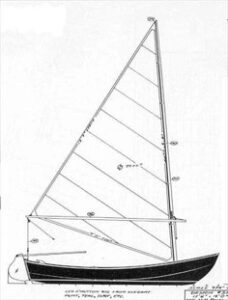
A leg-o’-mutton rig (also spelled leg-of-mutton or LOM) is a simple, traditional fore-and-aft sail configuration popular on small boats like dinghies, skiffs, and racing classes such as the Puddle Duck Racer since the 19th century, featuring a tall, triangular mainsail (resembling the shape of a leg of mutton, a broad-shouldered cut of meat) set on a short mast with its luff attached along the mast and a diagonal sprit boom (a lightweight spar angled from the mast to the peak or clew) extending the sail’s aft edge for tension and support, often loose-footed at the bottom for easy reefing and minimal hardware. The rig typically uses basic ropework—a halyard to hoist the peak high above the mast for a high aspect ratio, a snotter or downhaul to adjust the sprit’s angle and flatten the sail (serving as the primary reef by drawing the boom down), and sheets at the clew for control—while remaining unstayed for quick setup and single-handed operation, with the boom positioned high to clear the crew’s heads during maneuvers. Compared to a balanced lug (quadrilateral sail with forward tack for self-tending) or bermudan sloop (triangular sail on a tall fixed mast), the leg-o’-mutton excels in upwind pointing and light-air acceleration due to its efficient shape and low center of gravity, though it may lose power on reaches or runs without a spinnaker and requires careful sprit tension to avoid excessive twist or heel. Its enduring appeal for coastal, inland, or racing use lies in the rig’s affordability, simplicity (just a mast and sprit, often under 10 pounds total), and forgiving nature for novices—reefing by easing the snotter or rolling the sail—while delivering disproportionate power from a compact sail area, making it a favorite in homebuilt or kit boats where versatility trumps complexity. (More examples of the leg o’mutton rig in the Good Old Boat sail plan data base: John Dory, Sweet Pea, Nemah, Goat Island Skiff, Bevan’s Skiff, Bolger Brick, and Bolger Micro).