Issue 131: March/April 2020
Being Big Brother
Last year, as hurricane Dorian headed for Florida, I was forced to evacuate, leaving my schooner Britannia to fend for herself in a Cape Canaveral marina. For two days I worried about how she was faring. Britannia did fine, and shortly afterward, I acquired a FloatHub monitor.
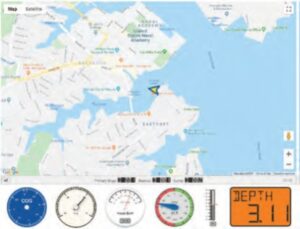
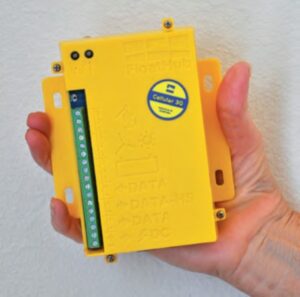
The concept is simple: I connect any of my boat’s instruments to the small FloatHub box (3 x 5 x 11⁄2 inches), and the data from my instruments is broadcast to the FloatHub server and then to the FloatHub app on my phone or computer. I connected my wind and depth gauges to FloatHub. I also ran the bilge pump circuits through it so I can be alerted when they run. I connected my batteries to it so I can keep an eye on their state of charge. In addition, the monitor independently measures and reports data like temperature, pressure, and GPS position (the latter is great for tracking a stolen boat, or one that’s drifted from its mooring). FloatHub operates on the NMEA 0183 protocol, and will reportedly soon support NMEA 2000. After wiring everything together, it all worked automatically.
FloatHub needs a connection to transmit and accordingly sells two models. For boats in a marina with always-on wifi, the wifi-only model might be a good choice. For boats without constant wifi access, the wifi/cellular model is the answer. The latter costs a bit more up front and requires a data plan purchase (currently $9.99/month or $99.99/year).
FloatHub must be connected to power and any instruments connected to it need to be left on, but power draw is minimal, and a boat that is connected to shorepower or a passive charging source, like wind or solar, should be fine.
I’m not looking forward to the next storm, but it will be interesting to see—no matter where I am—what is happening aboard Britannia.
For more information, floathub.com —Roger Hughes, Good Old Boat contributor
Clean Prop for Christmas
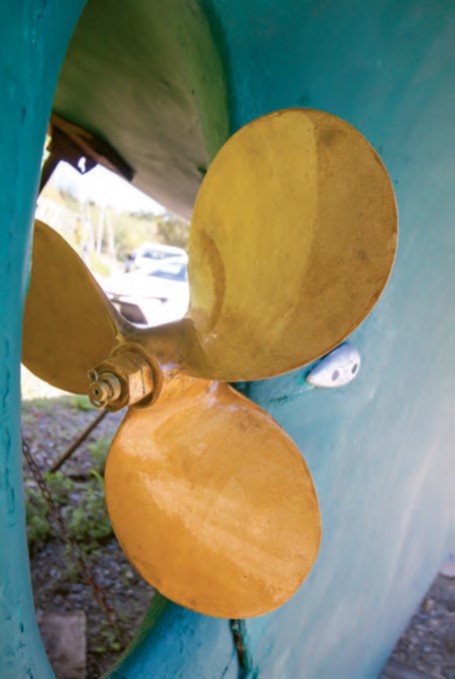
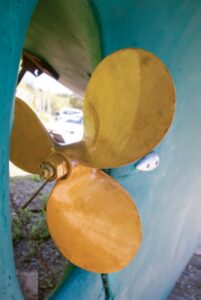 We launched Christmas the first week of June 2019 and hauled her out late October 2019. This is our typical five-month sailing season on the coast of Maine. Before launch, I prepped the prop (which was removed due to shaft replace¬ment) for an application of Propspeed, an antifouling treatment for propellers. As advised by the folks at Propspeed, I sanded the prop by hand with 80-grit sandpaper. A Propspeed technician visited the marina to apply the product, which is what they advised for this test. Propspeed appeared nearly clear and quite thick after application. It feels almost tacky to the touch, although it is quite dry.
During the season, the prop performed perfectly. There is no way to tell whether the coating enhanced performance, but it seemed particularly easy to reach hull speed under power this season. Toward the end of the season, when growth on the prop typically diminishes efficiency, performance was still tops, even in reverse, where growth really takes a toll.
At haul out, there was the usual growth on the hull and some minor growth on the prop. (To be fair, I hadn’t used the boat for more than a week when she was hauled out.)
After pressure washing the hull and prop, I inspected the prop, and the Propspeed coating looked completely intact with no voids. There were a few barnacles still stuck on the hub (easy to remove), but this seems to be an effective multiseason coating.
For more information: oceanmax.com —Tom Young, Good Old Boat contributor
Thank you to Sailrite Enterprises, Inc., for providing free access to back issues of Good Old Boat through intellectual property rights. Sailrite.com