A Beamy, Obliging Pocket Cruiser
Issue 132: May/June 2020
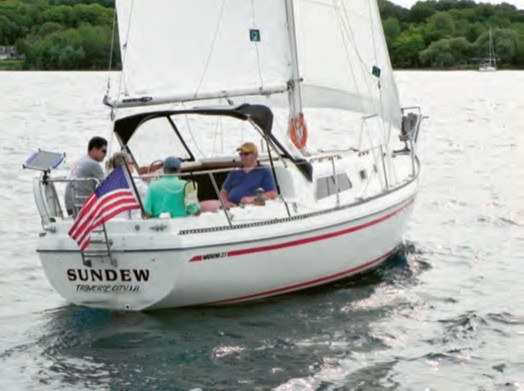
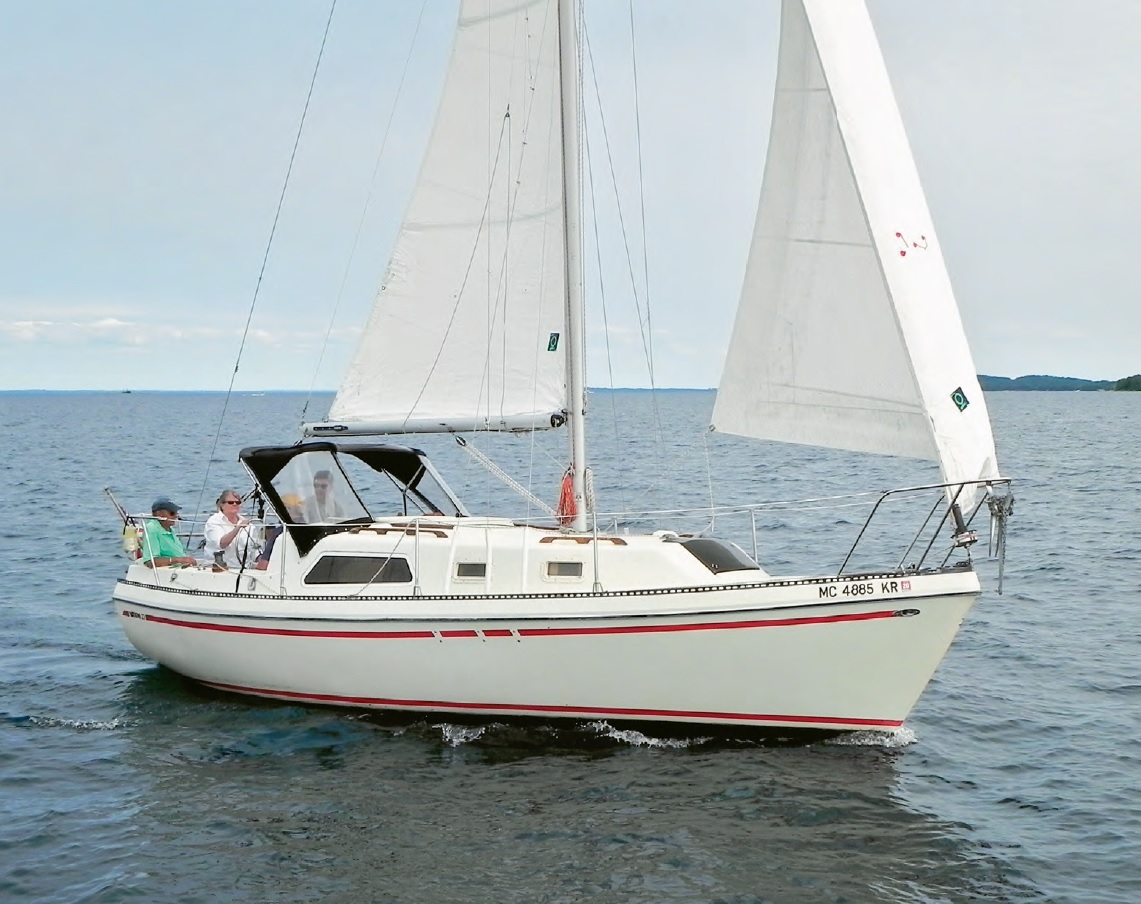
A sailor’s reasons for buying a boat are myriad and often mysterious; in the case of James and Barb Shroeger of Traverse City, Michigan, James admits to being “possessed by demons” when he came across a Watkins 27 that had fallen on hard times and had been donated to a nonprofit.
Boats have been part of James’ life since his grandfather built a Windmill. Among them was a Clipper 26, then a Cal 28 on which the family made several three-month cruises of the North Channel of Lake Huron with two children and a poodle. A derelict 24-foot Paceship they restored became a Good Old Boat story (“Renewed Serendipity” Jan. 2006).
After Serendipity, along came the Watkins 27. Named Sundew, its long restoration has inspired many projects reported in Good Old Boat, including lovely double companionway doors as well as an oak-and-mahogany cabin sole. While they’ve cruised Sundew some, mostly James and Barb have daysailed her in the crystal-clear waters of Traverse Bay.
When I visited Sundew for this review, the Shroegers were selling their boat of the last 14 years to a young local couple, fledgling sailors Bill and Lisa Westling, so they could move on to a Catalina 36. I sailed with both couples out of a marina in picturesque Northport, Michigan.
History
Four Watkins brothers formed Watkins Yacht and Marine of Clearwater, Florida, in the early 1970s. In 1973, they produced their first sailboat, the Watkins 23, which was modeled after the then-popular Venture 22/23. Altogether the company would, in its various ownership iterations, continue until 1989, building 1,280 sailboats from 17 to 36 feet.
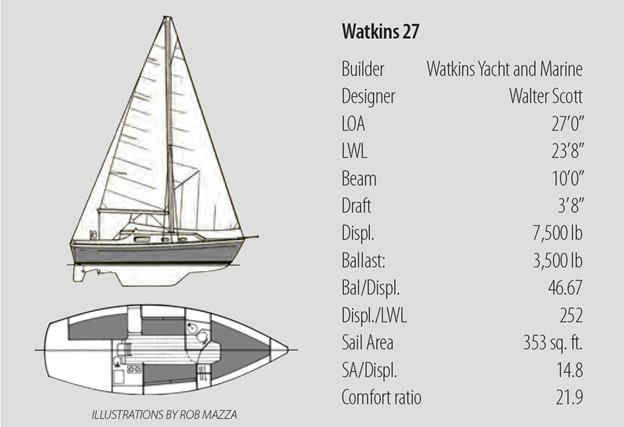
Other than the muddy lineage of the W23 (reportedly designed by Jopie Helsen and modified by Watkins), the Watkins 27 (W27) was the only sailboat not designed in-house. Walter Scott, who also designed the Allmand 31, drew the 27. Production began in 1977. At that time the Watkins 27 was considered a better value than the Catalina 27, featuring better hardware and construction for the same price. The boats were sold ready-to-sail, including life jackets, dock lines, and fenders, and at one time there were more than 20 dealers.
Watkins offered the boat with a centerboard/stub keel, shoal fixed keel, or deep fixed keel, but of the 514 W27s built, nearly all feature the shoal fixed keel. The company also built seven pilothouse (W27P) versions in 1981.
In 1979, after building 600 boats, the Watkins brothers sold the business to a private individual. At about the same time, Al G. Larson of Auroraglas had bought the Columbia molds and built the Coronado 35 as the Portman 36. Larson merged Auroraglas with the new Watkins owner in 1979, and the Portman 36 became the Watkins 36. To promote a big-boat feel with features of the 36, Larson redesigned the W27 as the W27 Mk II, with an outward flange hull-to-deck joint, new keel, all opening portlights, and new interior design.
In 1984, the W29 replaced the W27 with major modifications, yet retained the same interior as the W27 Mk II.
Watkins Yachts was sold to McLaughlin Body in 1986. A year later, when Larson left the company, it was mostly building powerboats, though the sailboat line was kept alive with limited production. In a further modification, the W29 (formerly the W27) gained a reverse transom to become the W30. After building one last W30 in late 1989, McLaughlin ended production. Except for the W25 mold, which was sold and reused to produce the popular Com-Pac 25, the remaining molds were abandoned.
Design
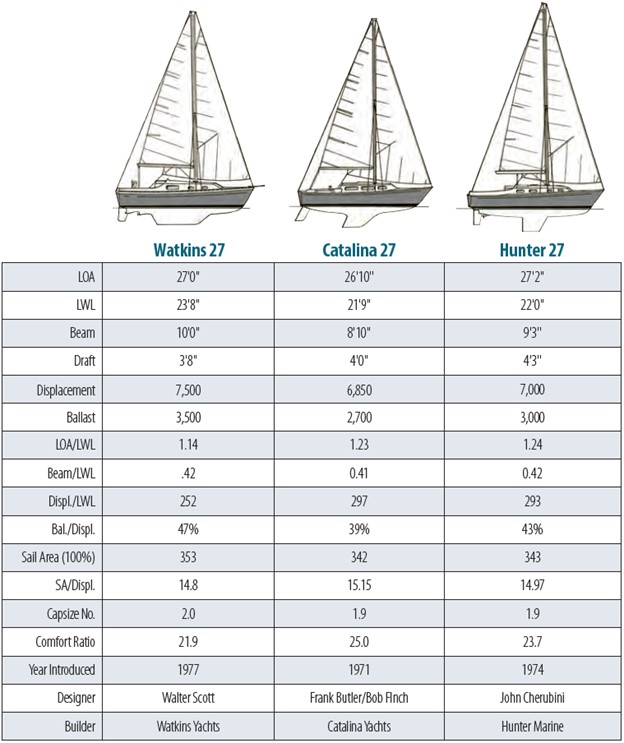
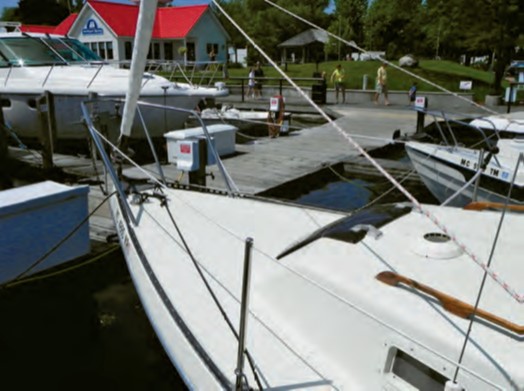
With a 10-foot beam, the W27 has a somewhat stubby look, particularly with its blunt bow and inward-angled topsides above the rubrail. This generous beam, however, makes for good form stability and a nice stiff ride that can stand up to strong winds. The popular shoal draft is 3 feet 8 inches with 3,500 pounds of ballast against a total displacement of 7,500 pounds. If you come upon a centerboard version, you’ll find its board-up draft is 3 feet even and board down draft is 7 feet.
With a displacement/length waterline ratio of 252 and a sail area/displacement ratio of 14.8, both conservative numbers, the boat isn’t fast, but the relatively long waterline increases hull speed. Most fleets have PHRF ratings of 234 seconds per mile; for comparison, a Catalina 27 rates 204 and the performance-oriented J/27 around 123.
Construction
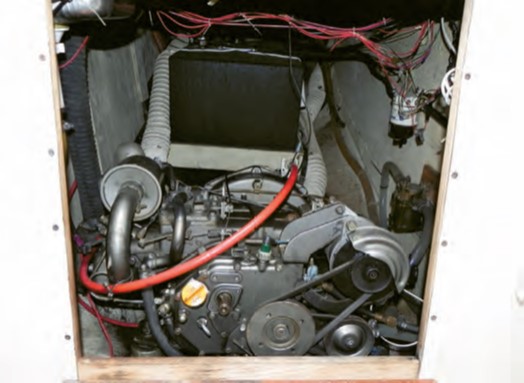
The hull-to-deck joint on models before 1979 is a shoebox arrangement (prone to leaking); post-1979 boats have an outward flange. Fiberglass construction was woven roving and mat. The deck and hatches are reinforced with encapsulated plywood. Generally, W27s were equipped with a variety of Yanmar diesels of 8, 12, or 22 horsepower. However, a few had gas engines, both inboard and outboard.
The long fin keel is encapsulated lead, and the rudder is attached to a partial skeg.
Deck and Rigging
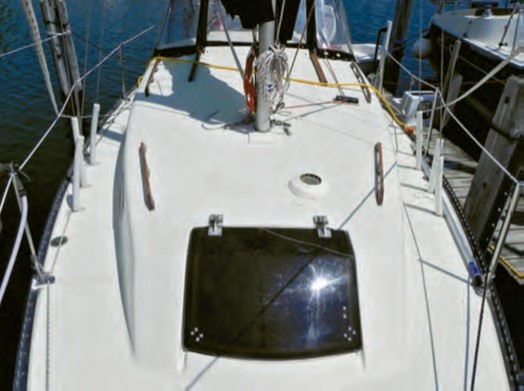
The W27 features stainless steel bow and stern pulpits with single lifelines between them. The foredeck is quite wide but lacks an anchor locker. I noted a very sturdy cast stemhead fitting and substantial cleats.
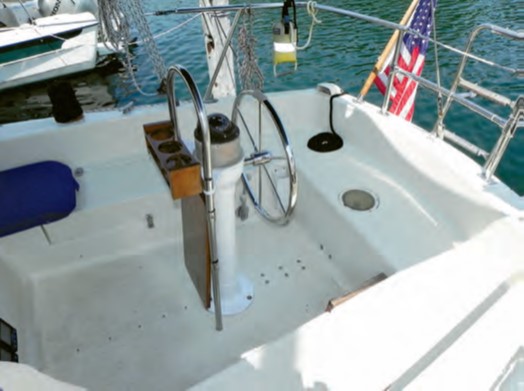
The cockpit is roomy but rather shallow. The seats are set quite far apart and garner a Penticoff Napability Index (1-5 scale) rating of only a 3 due to being long but narrow. It’s not possible to brace against the opposite seat while heeled underway, and the coaming hits one in the back. It seems the designer could have easily made the seats wider and pushed them together a bit to fix both issues. That said, Sundew is socially spacious for a 27-foot boat.
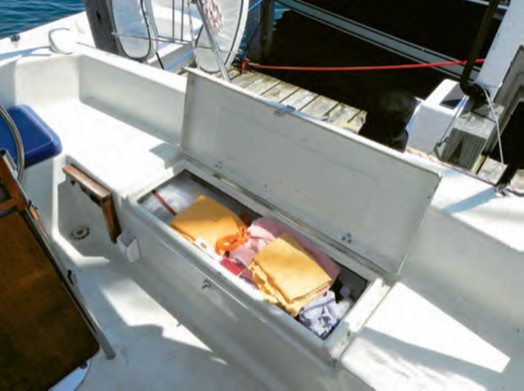
The starboard cockpit locker is deep while the port locker is shallow, and the emergency tiller is handy to the helm. The vertical transom is a great place to mount a swim ladder. Two cockpit drains keep the footwell dry.
The W27 has a masthead rig with double inboard lower shrouds. Lines are led aft to a cabintop winch to port. The mainsheet is led to the end of the boom where it would benefit from the addition of a traveler; as it is, the mainsheet can interfere with the helm. Sundew is equipped with lazy jacks, a 150 percent genoa on a furler, and new self-tailing winches on the cockpit coamings.
Accommodations
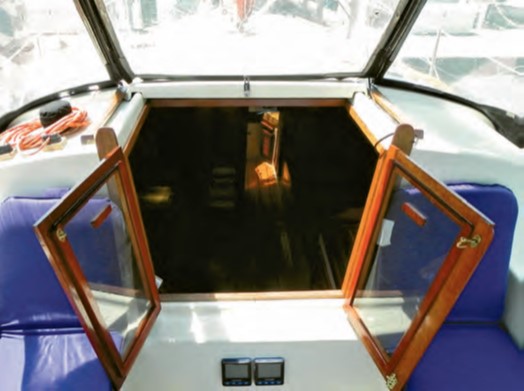
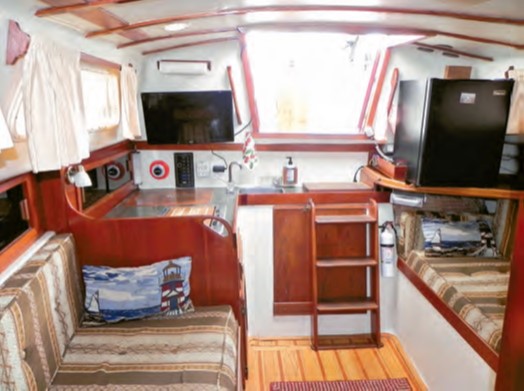
If you like wood, you will love this boat. There is plenty, particularly in the cabin. But your first encounter is in the wide companionway before heading down the wood three-step ladder. Sundew has a lovely oak-and-mahogany sole. James glued up two boards at a time with 3M 5200 so there are no screws. Beneath the sole is a deep bilge. The traditional saloon is quite wide with a teak-veneer bulkhead forward where there is storage and a large fold-down table with fiddles. Solid teak is copious throughout.
The overhead is a textured fiberglass liner with teak accent ribs. The W27 really needs overhead grab rails due to the wide saloon. Port aft is a tight quarter berth (thus the shallow locker above).
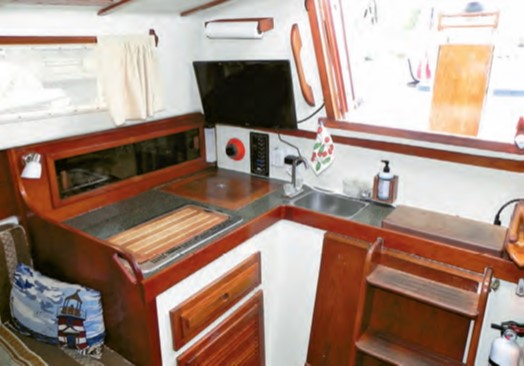
Both galley countertops feature granite that James installed, and the galley itself is small but functional. The settees are long and wide enough to use as berths; the downside is that they’re rather high off the cabin sole, so your legs tend to be impinged at the knee by the cushion fiddles (mostly due to the present softness of the cushions). Plentiful storage above the seatbacks is enclosed by sliding acrylic panels.
Under Sail
Motoring out, the W27 has typical inboard diesel handling, with little prop-wash vibration felt in the wheel. It turns quite smartly under power. James claims the 8-horsepower single-cylinder Yanmar diesel sips a half-gallon per hour at 6 knots.
The steering felt a bit stiff, as James had the friction knob cranked down hard. He prefers it on the stiff side to help with tracking. He says with loose friction, it does not track well: “It has a mind of its own.”
Standing at the wheel was comfortable with the mainsheet off to one side; it is easy to reach from behind the helm. Sail work is very easy with the huge flat cabintop.
While under sail the boat tracked decently but needed a fair amount of attention to keep it on heading. Due to the helm stiffness and design I could not feel through the wheel what the boat was doing. With the stiff steering, the helm felt mechanical, like steering a lawn tractor —point it in a direction and watch. The helm was not telling me what was happening.
While one can steer from either seat, it isn’t fun. Visibility was good at all times. Standing to steer felt natural. I did not note any significant weather helm. Tacking was quick enough, and although it’s no sport boat, it’s fine for cruising. Downwind was no-brainer sailing. While our test sail was under ideal conditions, the Watkins 27 performed quite well.
Conclusion
The W27 is a remarkably wide boat for its length and may make a compact home in a slip as well as an obliging sailing platform. Watkins boats were sold to novices, and this very stable boat remains a good place to learn—just ask Bill and Lisa, who are now becoming sailors.
At sailboatlistings.com I found 16 Watkins 27s listed for sale, ranging from 1978 to 1989. The highest price was for a 1981 at $15,000, and someone was asking $14,500 for a 1978. Low end was a couple of 1979 boats going for $4,000 with plenty of other boats priced between. Equipment and condition will be everything in pricing these boats. There are a few condition problems on some models, and it would be best to consult the excellent owner website, watkinsowners.com, before proceeding to inspect a potential purchase.
Allen Penticoff, a Good Old Boat contributing editor, is a freelance writer, sailor, and longtime aviator. He has trailer-sailed on every Great Lake and on many inland waters and has had keelboat adventures on fresh and saltwater. He owns an American 14.5, a MacGregor 26D, and a 1955 Beister 42-foot steel cutter that he stores as a “someday project.”
Thank you to Sailrite Enterprises, Inc., for providing free access to back issues of Good Old Boat through intellectual property rights. Sailrite.com