. . . but not one to brag about or to repeat
Issue 123: Nov/Dec 2018
When I was 15 or so I spent my weekends hanging out at the local yacht club looking pitiful until an old man felt sorry for me and took me for a sail. His name was Alan Byrd and he owned a 24-foot cruising sloop. I crewed for him regularly on weekends for several months until it occurred to me that I now knew everything about sailing and wanted my own boat.
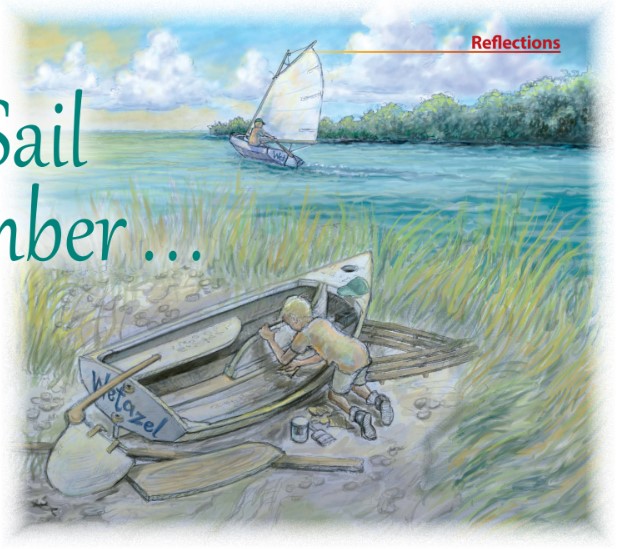
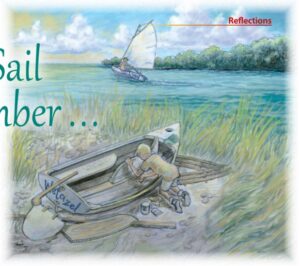
My parents couldn’t afford a boat, so I sniffed around the dinghy park alongside the yacht club and eventually found a 14-foot hard-chine wooden catboat with a steel centerboard. She had about her the sad air of a long-abandoned boat. She was called Wetazel and I was to find later that she lived up to her name. She seemed very ancient indeed. There were patches of rot around the centerboard casing and most of the paint had long ago flaked off the sun-bleached floorboards.
I kept a watch on Wetazel for several weeks and noted that no one ever came near her. I poked around in the yacht club locker room and found her old yellowed mainsail in a pile of discarded canvas and rope. I made surreptitious inquiries about her ownership but nobody knew whose boat she was. Someone thought she was actually owned by the yacht club. He said she belonged to the singlehanded class of some long-past Olympic Games.
Eventually, I could stand it no longer. I bought some coarse sandpaper and started sanding her down. I worked on the theory that any club member who saw me would naturally conclude she belonged to me because who in his right mind would sand a boat that wasn’t his? Wetazel became mine by right of hard labor.
I got all the loose flakes off the bottom inside the boat and wondered what to do about the thin gaps between the bottom planks. I bought a large can of Pliobond rubber paint and sloshed it all over the bottom inside, forming a skin that by any reasonable calculation should have been waterproof.
On the day when I took my first boat for my first sail on Durban Bay, the sun was shining brightly and the wind was steady from the northeast. I was delighted with the way Wetazel handled. Her rig was very simple, of course, just that one big mainsail with the mast right forward, and she was not at all hard-mouthed, even in the gusts that had her flying along on a broad reach and carving a fuss of white foam through the warm waters.
About two miles from the yacht club, we rounded the sandbank near the container terminal and ran dead down-wind along the channel leading to the mangrove swamps. I intended to land on the white beach near the mangroves because, despite her coating of Pliobond, Wetazel was leaking. I needed to bail her out. The rubber coating had lifted from the bottom and three or four inches of water was swilling around the bilges.
I moved forward to reach my bailing bucket just as a gust pounced on us from astern. All the bilge water ran forward in a rush with me and put the bow under. Wetazel kept plowing on at an angle until water came pouring over the small half-deck up forward. And then she simply filled up and sailed herself completely to the bottom in 40 feet of water.
I floated out of the cockpit as it disappeared beneath me. I had no life jacket, of course, but I could swim, and the sandbank was only about 100 yards away. I stood and shivered on that isolated sandbank for nearly an hour until a small fishing skiff happened along and came to see what all the frantic waving and shouting was about.
They took me back to the yacht club, where I got on my bike and pedaled home as fast as I could go. I kept clear of the club for several weeks for fear of being hunted down, but in the end, nobody said a word about Wetazel, or asked why she had disappeared. I eventually joined the club (and am still a member) but never ventured a word of what happened when I took my first boat for her first sail.
John Vigor, a former newspaper columnist and editorial writer, is the author of 12 sailing books. He is a retired sailing and navigation instructor accredited with the American Sailing Association. He lives in Bellingham, Washington. johnvigor.com
Thank you to Sailrite Enterprises, Inc., for providing free access to back issues of Good Old Boat through intellectual property rights. Sailrite.com