

Penguin Class Dinghy
Description
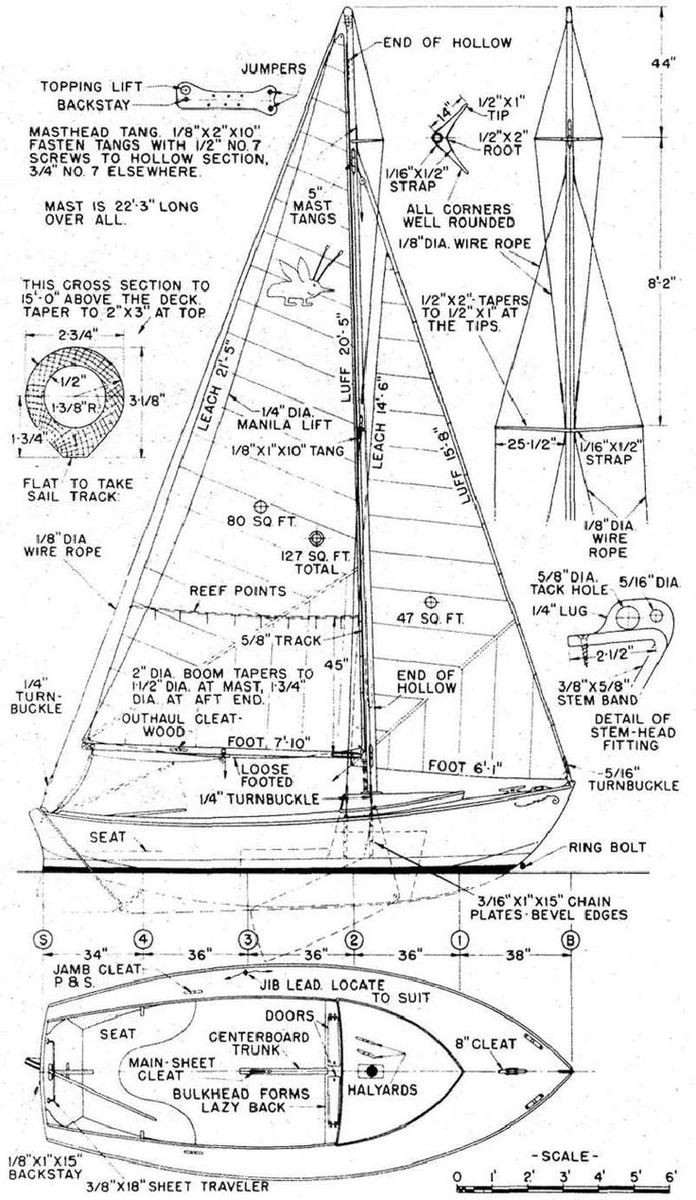
The Penguin Class Dinghy is an 11½‑foot, two‑person one‑design racing dinghy designed in 1939 by naval architect Philip L. Rhodes and originally built by various U.S. yards such as Chesapeake Marine Design and later Alcort, Inc., with both wood and fiberglass versions produced through the mid‑20th century. Conceived as a stable yet competitive centerboard fractional‑sloop, the Penguin features a simple flat‑bottom hull, transom‑hung rudder, jumper‑stayed mast about 22 feet tall, and a total sail area of roughly 127 sq ft split between main and jib. Its forgiving handling, portability, and strong class association made it a favorite training and club‑racing dinghy in North America from the 1940s onward.
Construction Details
| Designer | Philip L. Rhodes |
|---|---|
| Builder | Alcort (AMF Alcort) |
| Length | 11.500 ft |
| LOA | 11.500 ft |
| LWL | 10.500 ft |
| Beam | 4.500 ft |
| Displacement | 140 lb |
| Max Draft | 3.250 ft |
| Min Draft | 0.330 ft |
| Year Built | 1939 |
The standard boat dimensions
| i | 16.50 ft |
|---|---|
| j | 5.75 ft |
| p | 20.42 ft |
| e | 7.83 ft |
| p2 | - |
| e2 | - |
| i2 | - |
| j2 | - |
| I | J | P | E | P2 | E2 | I2 | J2 |
|---|---|---|---|---|---|---|---|
| 16.50 ft | 5.75 ft | 20.42 ft | 7.83 ft | - | - | - | - |
Blueprints
Sails
Penguin Class Dinghy - MAINSAIL
| Luff | * 20.42 ft - (6224 mm) |
|---|---|
| Foot | * 7.83 ft - (2387 mm) |
| Leech | * 21.48 ft - (6547 mm) |
| Tack Angle | * 88 ° |
| Diagonal | * 21.61 ft - (6587 mm) |
| Head (inches) | * 4.5 in - (114 mm) |
| Area | * 83.691 ft² |
| Edit in Calculator |
Penguin Class Dinghy - JIBSAIL
| Luff | * 13.98 ft - (4261 mm) |
|---|---|
| Foot | * 7.73 ft - (2356 mm) |
| Leech | * 11.96 ft - (3645 mm) |
| Percentage LP | * 115 % |
| Length Perpendicular | * 6.61 ft - (2015 mm) |
| Deck Angle | * 12 ° |
| Area | * 46.19 ft² |
| Edit in Calculator |
Disclaimer. Boats are not all the same -- even when produced in the same factory of the same model. Sailrite does its best to publish accurate dimensions, but we often find it worthwhile to have our customers measure their boats carefully before we produce kits for them. You should take the same precautions, especially when the data is not from Sailrite. The information on this site is not guaranteed to be accurate. Sailrite offers this content as a service to our community, but takes no responsibility for the reliability of the data provided.
Comments


