

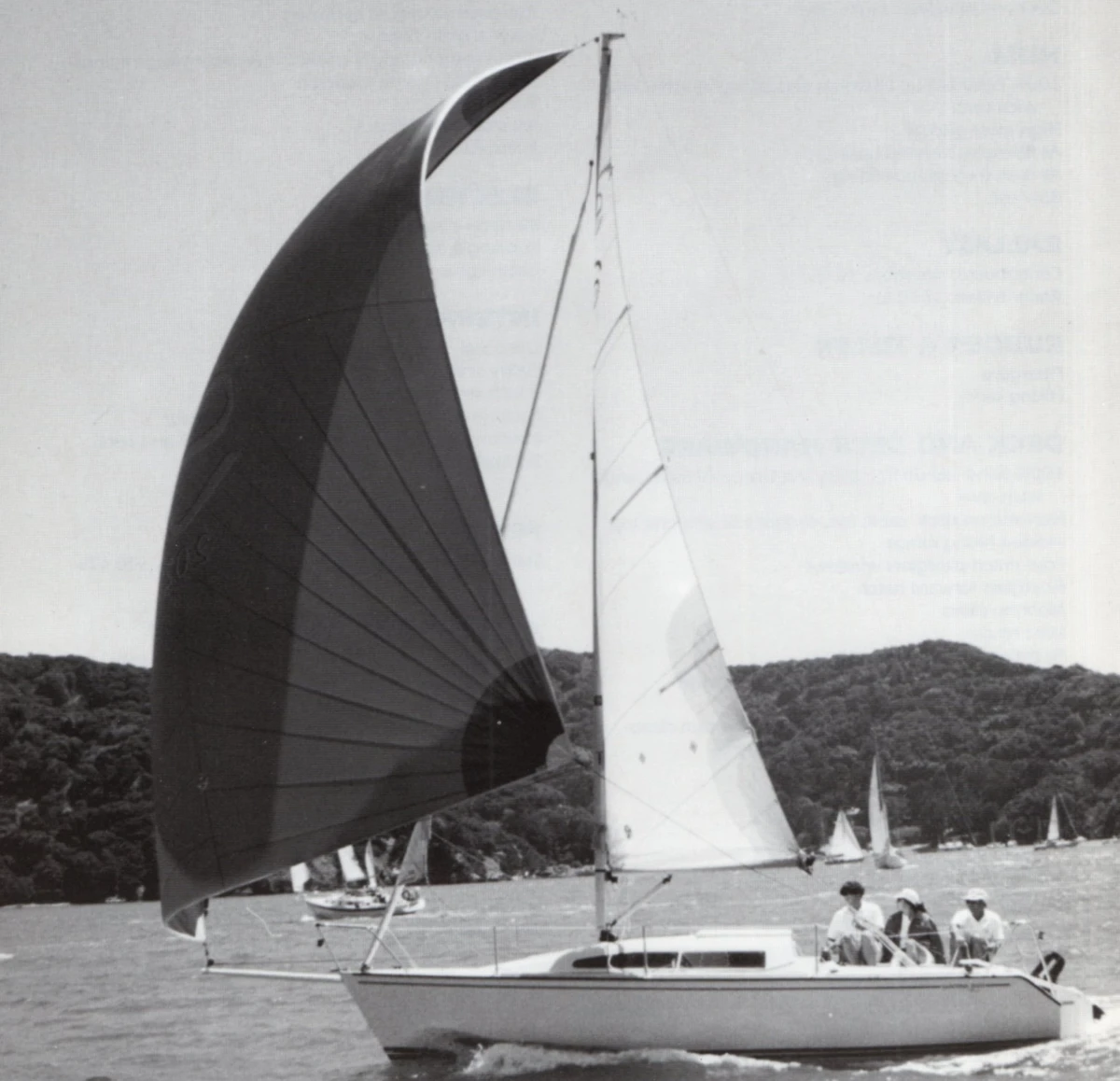
Santana 2023r
Description
The Santana 2023R is the racing-oriented variant in the Santana 2023 family of American trailerable sailboats, designed by Steve Schock for high-performance club racing and spirited day sailing on lakes or protected coastal waters. It shares the lightweight fiberglass monohull and water ballast system of the standard 2023 models but features optimizations like a taller rig, lighter construction, and specialized foils for superior speed and handling. The design emphasizes quick setup, agile tacking, and downwind prowess with an asymmetrical spinnaker, while maintaining shallow-draft versatility for trailering and beaching. Introduced in 1993 by W.D. Schock Corp in the United States, the 2023R evolved from the 1978 Santana 23D (hull lines by W. Shad Turner), with production continuing until 2001. It addressed racer demands for a faster PHRF rating through refinements like foam-cored hull/deck and elliptical appendages
Construction Details
| Designer | Steve Schock |
|---|---|
| Builder | W.D. Schock Corp. (USA) |
| Length | 23.330 ft |
| LOA | 23.330 ft |
| LWL | 20.620 ft |
| Beam | 8.500 ft |
| Displacement | 2630 lb |
| Ballast | 1300 lb |
| Max Draft | 5.330 ft |
| Min Draft | 1.170 ft |
| Year Built | 1993 |
The standard boat dimensions
| i | 28 ft |
|---|---|
| j | 8.75 ft |
| p | 29 ft |
| e | 10.50 ft |
| p2 | - |
| e2 | - |
| i2 | - |
| j2 | - |
| I | J | P | E | P2 | E2 | I2 | J2 |
|---|---|---|---|---|---|---|---|
| 28 ft | 8.75 ft | 29 ft | 10.50 ft | - | - | - | - |
Documents
Sails
Santana 2023r - GENOA
| Luff | * 27.87 ft - (8495 mm) |
|---|---|
| Foot | * 14.09 ft - (4295 mm) |
| Leech | * 26.25 ft - (8001 mm) |
| Percentage LP | * 149.94 % |
| Length Perpendicular | * 13.12 ft - (3999 mm) |
| Deck Angle | * 4.02 ° |
| Area | * 182.84 ft² |
| Edit in Calculator |
Disclaimer. Boats are not all the same -- even when produced in the same factory of the same model. Sailrite does its best to publish accurate dimensions, but we often find it worthwhile to have our customers measure their boats carefully before we produce kits for them. You should take the same precautions, especially when the data is not from Sailrite. The information on this site is not guaranteed to be accurate. Sailrite offers this content as a service to our community, but takes no responsibility for the reliability of the data provided.
Comments


