

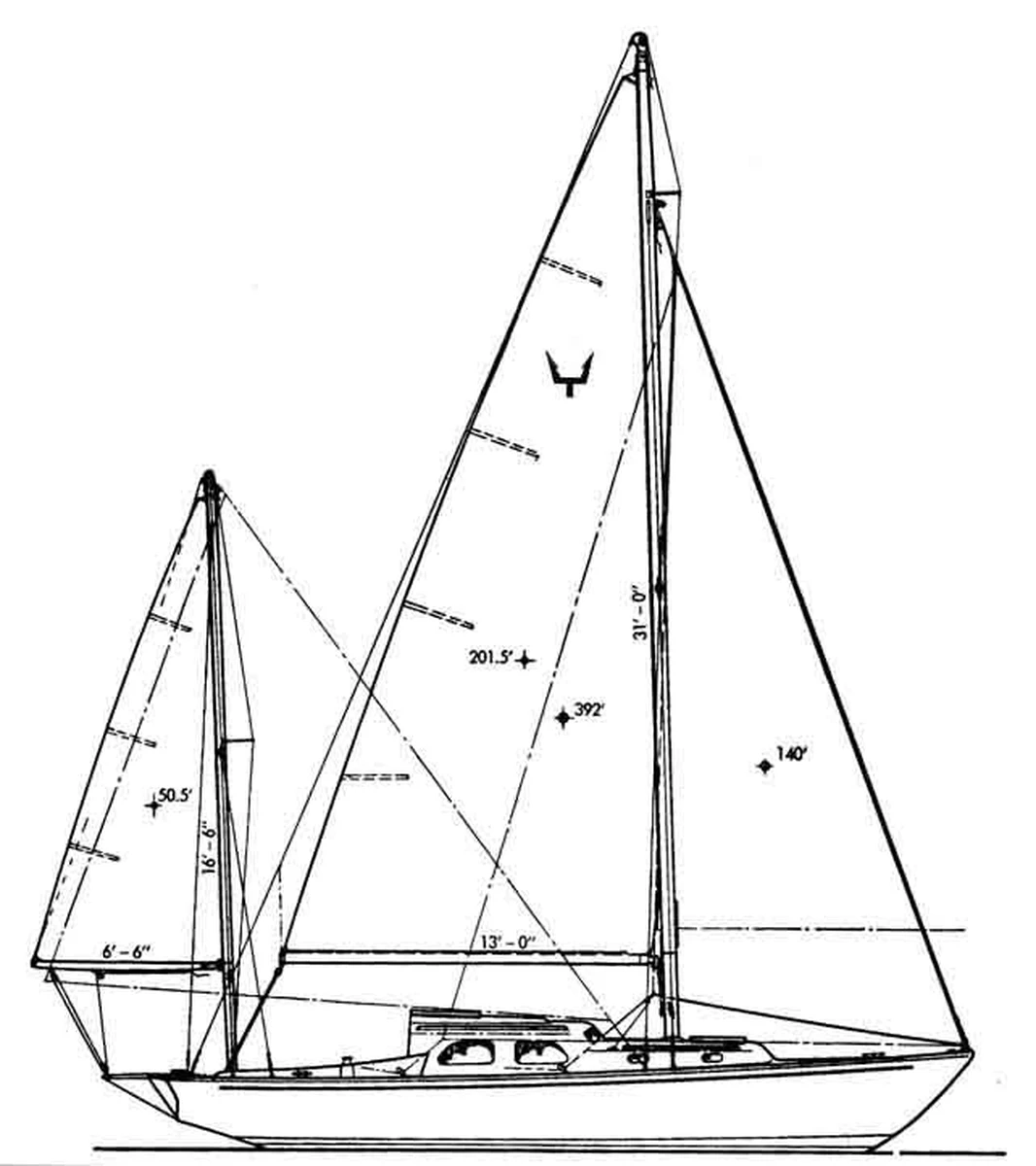
Pearson Triton yawl
Description
The Pearson Triton Yawl is a classic fiberglass sailboat designed by renowned naval architect Carl Alberg as a versatile racer-cruiser, introduced in 1958 alongside the standard sloop version. Inspired by traditional Scandinavian Folkboat lines, it features a spooned raked stem, raised transom, low freeboard, long overhangs, and a fixed long keel with a keel-mounted rudder controlled by tiller, emphasizing seaworthiness and aesthetic appeal. Produced primarily by Pearson Yachts in Portsmouth, Rhode Island, until 1967 (with about 700 total Tritons built across variants), the yawl configuration was a factory option on early models, offering a divided rig for easier handling in heavy weather or for those preferring the yawl's balanced sail plan. It was priced affordably at around $9,700 upon launch, filling a market gap for a family-friendly 28-footer under $10,000 with stand-up headroom.
Construction Details
| Designer | Carl Alberg |
|---|---|
| Builder | Pearson Yachts |
| Length | 28.330 ft |
| LOA | 28.330 ft |
| LWL | 21.500 ft |
| Beam | 8.250 ft |
| Displacement | 6930 lb |
| Ballast | 3019 lb |
| Max Draft | 3.920 ft |
| Year Built | 1958 |
The standard boat dimensions
| i | 30.25 ft |
|---|---|
| j | 9.79 ft |
| p | 31 ft |
| e | 12.62 ft |
| p2 | 15.50 ft |
| e2 | 6.38 ft |
| i2 | - |
| j2 | - |
| I | J | P | E | P2 | E2 | I2 | J2 |
|---|---|---|---|---|---|---|---|
| 30.25 ft | 9.79 ft | 31 ft | 12.62 ft | 15.50 ft | 6.38 ft | - | - |
Blueprints
Sails
Pearson Triton yawl - MIZZEN
| Luff | * 15.5 ft - (4724 mm) |
|---|---|
| Foot | * 6.38 ft - (1945 mm) |
| Leech-AftHdBd | * 16.38 ft - (4993 mm) |
| Tack Ang | * 88 ° |
| Diag (clew/head) | * 16.55 ft - (5044 mm) |
| Head (inches) | * 3.5 in - (89 mm) |
| Area (no Roach) | * 51.36 ft² |
| Edit in Calculator |
Disclaimer. Boats are not all the same -- even when produced in the same factory of the same model. Sailrite does its best to publish accurate dimensions, but we often find it worthwhile to have our customers measure their boats carefully before we produce kits for them. You should take the same precautions, especially when the data is not from Sailrite. The information on this site is not guaranteed to be accurate. Sailrite offers this content as a service to our community, but takes no responsibility for the reliability of the data provided.
Comments


